A Gentle Introduction To Learning Calculus

I have a love/hate relationship with calculus: it demonstrates the beauty of math and the agony of math education.

Calculus relates topics in an elegant, brain-bending manner. My closest analogy is Darwin’s Theory of Evolution: once understood, you start seeing Nature in terms of survival. You understand why drugs create stronger germs (survival of the fittest). You know why sugar and fat taste sweet (encourage consumption of high-calorie foods in times of scarcity). It all fits together.

Calculus is similarly enlightening. Don’t these formulas seem related in some way?

circle sphere formula

They are. But most of us learn these formulas independently. Calculus lets us start with “circumference = 2 * pi * r” and figure out the others — the Greeks would have appreciated this.

Unfortunately, calculus can epitomize what’s wrong with math education. Most lessons feature contrived examples, arcane proofs, memorization and abstract symbol manipulation that body slam our intuition & enthusiasm before they can put on their gloves.

It really shouldn’t be this way.

Math, art, and ideas

I’ve learned something from school: Math isn’t the hard part of math; motivation is. Specifically, staying encouraged despite

  • Teachers focused more on publishing/perishing than teaching
  • Self-fulfilling prophecies that math is difficult, boring, unpopular or “not your subject”
  • Textbooks and curriculums more concerned with profits and test results than insight

‘A Mathematician’s Lament’ [pdf] is an excellent essay on this issue that resonated with many people:

“…if I had to design a mechanism for the express purpose of destroying a child’s natural curiosity and love of pattern-making, I couldn’t possibly do as good a job as is currently being done — I simply wouldn’t have the imagination to come up with the kind of senseless, soul-crushing ideas that constitute contemporary mathematics education.”

Imagine teaching art like this: Kids, no fingerpainting in kindergarten. Instead, let’s study paint chemistry, the physics of light, and the anatomy of the eye. After 12 years of this, if the kids (now teenagers) don’t hate art already, they may begin to start coloring on their own. After all, they have the “rigorous, testable” fundamentals to start appreciating art. Right?

Poetry is similar. Imagine studying this quote (formula):

“This above all else: to thine own self be true, and it must follow, as night follows day, thou canst not then be false to any man.”
–William Shakespeare, Hamlet

It’s an elegant way of saying “be yourself” (and if that means writing irreverently about math, so be it). But if this were math class, we’d be counting the syllables, analyzing the iambic pentameter, and mapping out the subject, verb and object.

Math and poetry are fingers pointing at the moon. Don’t confuse the finger for the moon. Formulas are a means to an end, a way to express a mathematical truth.

We’ve forgotten that math is about ideas, not robotically manipulating the formulas that express them.

Ok bub, what’s your great idea?

Feisty, are we? Well, here’s what I won’t do: recreate the existing textbooks. If you need answers right away for that big test, there’s plenty of websites, class videos and 20-minute sprints to help you out.

Instead, let’s share the core insights of calculus. Equations aren’t enough — I want the “aha!” moments that make everything click.

Formal mathematical language is one just one way to communicate. Diagrams, animations, and just plain talkin’ can often provide more insight than a page full of proofs.

But calculus is hard!

I think anyone can appreciate the core ideas of calculus. We don’t need to be writers to enjoy Shakespeare.

It’s within your reach if you know algebra and have a general interest in math. Not long ago, reading and writing were the work of a trained scribes. Yet today that can be handled by a 10-year old. Why?

Because we expect it. Expectations play a huge part in what’s possible. So expect that calculus is just another subject. Some people get into the nitty-gritty (the writers/mathematicians). But the rest of us can still admire what’s happening, and expand our brain along the way.

It’s about how far you want to go. I’d love for everyone to understand the core concepts of calculus and say “whoa”.

So what’s calculus about?

Some define calculus as “the branch of mathematics that deals with limits and the differentiation and integration of functions of one or more variables”. It’s correct, but not helpful for beginners.

Here’s my take: Calculus does to algebra what algebra did to arithmetic.

  • Arithmetic is about manipulating numbers (addition, multiplication, etc.).
  • Algebra finds patterns between numbers: a2 + b2 = c2 is a famous relationship, describing the sides of a right triangle. Algebra finds entire sets of numbers — if you know a and b, you can find c.
  • Calculus finds patterns between equations: you can see how one equation (circumference = 2 * pi * r) relates to a similar one (area = pi * r2 ).

Using calculus, we can ask all sorts of questions:

  • How does an equation grow and shrink? Accumulate over time?
  • When does it reach its highest/lowest point?
  • How do we use variables that are constantly changing? (Heat, motion, populations, …).
  • And much, much more!

Algebra & calculus are a problem-solving duo: calculus finds new equations, and algebra solves them. Like evolution, calculus expands your understanding of how Nature works.

An Example, Please

Let’s walk the walk. Suppose we know the equation for circumference (2*pi*r) and want to find area. What to do?

Realize that a filled-in disc is like a set of Russian dolls.

Disc and Rings

Here are two ways to draw a disc:

  • Make a circle and fill it in
  • Draw a bunch of rings with a thick marker

The amount of “space” (area) should be the same in each case, right? And how much space does a ring use?

Well, the very largest ring has radius “r” and a circumference 2 * pi * r. As the rings get smaller their circumference shrinks, but it keeps the pattern of 2 * pi * current radius. The final ring is more like a pinpoint, with no circumference at all.

Disc and Ring Area

Now here’s where things get funky. Let’s unroll those rings and line them up. What happens?

  • We get a bunch of lines, making a jagged triangle. But if we take thinner rings, that triangle becomes less jagged (more on this in future articles).
  • One side has the smallest ring (0) and the other side has the largest ring (2 * pi * r)
  • We have rings going from radius 0 to up to “r”. For each possible radius (0 to r), we just place the unrolled ring at that location.
  • The total area of the “ring triangle” = 1/2 base * height = 1/2 * r * (2 * pi * r) = pi * r2, which is the formula for area!

Yowza! The combined area of the rings = the area of the triangle = area of circle!
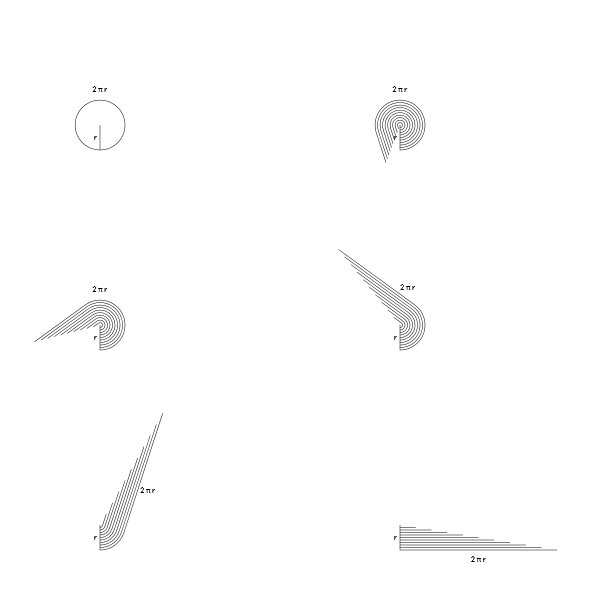
This was a quick example, but did you catch the key idea? We took a disc, split it up, and put the segments together in a different way. Calculus showed us that a disc and ring are intimately related: a disc is really just a bunch of rings.

This is a recurring theme in calculus: Big things are made from little things. And sometimes the little things are easier to work with.

A note on examples

Many calculus examples are based on physics. That’s great, but it can be hard to relate: honestly, how often do you know the equation for velocity for an object? Less than once a week, if that.

I prefer starting with physical, visual examples because it’s how our minds work. That ring/circle thing we made? You could build it out of several pipe cleaners, separate them, and straighten them into a crude triangle to see if the math really works. That’s just not happening with your velocity equation.

A note on rigor (for the math geeks)

I can feel the math pedants firing up their keyboards. Just a few words on “rigor”.

Did you know we don’t learn calculus the way Newton and Leibniz discovered it? They used intuitive ideas of “fluxions” and “infinitesimals” which were replaced with limits because “Sure, it works in practice. But does it work in theory?”.

We’ve created complex mechanical constructs to “rigorously” prove calculus, but have lost our intuition in the process.

We’re looking at the sweetness of sugar from the level of brain-chemistry, instead of recognizing it as Nature’s way of saying “This has lots of energy. Eat it.”

I don’t want to (and can’t) teach an analysis course or train researchers. Would it be so bad if everyone understood calculus to the “non-rigorous” level that Newton did? That it changed how they saw the world, as it did for him?

A premature focus on rigor dissuades students and makes math hard to learn. Case in point: e is technically defined by a limit, but the intuition of growth is how it was discovered. The natural log can be seen as an integral, or the time needed to grow. Which explanations help beginners more?

Let’s fingerpaint a bit, and get into the chemistry along the way.

Where next?

My goal is to begin presenting a beautiful, oft-maligned subject in a new light. Many ideas are more intuitive than you think:

My knowledge of calculus is still very mechanical, but I know this can change. As I explore this topic I’ll cover the insights that worked, hoping you’ll chime in with what has helped you. Happy math.


Tools of the trade:


52 Comments »

Trackbacks & Pingbacks

  1. Pingback by Mainfram Reality » links for 2008-05-03 — May 2, 2008 @ 11:34 pm

  2. Pingback by nulleando.com.ar » Blog Archive » Replanteo … — May 3, 2008 @ 5:16 pm

  3. Pingback by The Case For Teaching Calculus Early - Standard Deviations — May 3, 2008 @ 5:56 pm

  4. Pingback by Adam @ Dusk » Math Class — May 10, 2008 @ 3:57 pm

  5. Pingback by Spy story « The Braden Files — May 12, 2008 @ 8:09 pm


Comments

  1. Sign me up! I did all that crazy “area under the curve” stuff at school, but never understood how it REALLY worked. y=2x^2 => dy/dx = 4x…sure, but what the heck is going on. They lost me when the sines and cosines joined the calculus party.

    I’ve nevertheless remained interested in maths over the 20 years since, and here’s the crack: your article is brilliant. I can absolutely get what you’re talking about. Your circle example is dynamite, and I also found the idea that calculus “finds patterns between equations” very intuitive.

    Now let me remember, my little equation is differentiation. That’s like taking pi.r^2 back to 2pi.r So what you showed was integration; which makes sense to me as you did take the area under a curve. So, to differentiate pi.r^2 I don’t ask for dy/dx, but rather something/dr I don’t see any other letter, an pi is just a number, so maybe the use of y is just convention? So…dy/dr?

    Keep up the good work.

    Paul — May 2, 2008 @ 12:43 pm

  2. Beautiful commentary. I’m currently taking Calculus III, and have already finished Differential Equations. For my degree, these would be the final mathematics courses I would need. However, recently I’ve felt that it’s all starting to make sense and come together, and I’ve found that mathematics is quite elegant. After a certain point, I don’t feel awed by its complexity, but rather it’s simplicity. How an incredibly seemingly complex relationship can be broken down into a symbolically simple idea is truly beautiful. I’ve decided to continue taking some mathematics courses in my next semester, and see how far I want to go in that direction.

    It really is a shame that the way mathematics is presented creates a negative impression from grade school on. Conceptually, it is beautiful and elegant and explanatory and all-encompassing. If I had been introduced to mathematics in that form when I was younger, I would have probably been hooked then.

    My favorite moments in horrible math classes in high school and junior high would be when the teacher would digress and just talk about the nature of zero or infinity or other interesting concepts. Of course, the teacher would usually end with something like, “Well, anyway, to get back on topic…” and resume with some cumbersome proof.

    I’m not saying that a conceptual presentation of mathematics should precede basic grade school necessities like arithmetic, but it should definitely have its place. By misrepresenting the elegant nature of mathematics, we are restricting students who would otherwise begin to take interest.

    Again, great article!

    Mike — May 2, 2008 @ 12:50 pm

  3. I like these sorts of examples for people who have never seen calculus before because, honestly, the subject is not that hard. Give me an above-average student and I can teach them the basics of calculus in less than a week.

    But it’s rarely the basics that get people. These methods, after all, were how calculus developed up into the mid-19th century — nary a delta or an epsilon in sight.

    Euler was the master of these types of proofs. It wasn’t until mathematicians like Weierstraß started getting counter-intuitive results with these so-called “intuitive” methods that they decided an absolutely rigorous foundation for calculus (and all of mathematics) was necessary.

    So, the only caveat is that while these methods might be intuitive and help people just learning calculus, there are limits at which this type of reasoning breaks down and we simply can’t reconcile what is true with what our intuition says is true.

    Jesse Farmer — May 2, 2008 @ 12:51 pm

  4. Dude, you rock!

    Being an Engineer, I understand the pain a naive student goes through when he is burdened with truck load of Calculus books having tons of theorems, proofs and unimaginable number of weird questions that have absolutely no relevance to the real world!

    I scored well in my engineering mathematic subjects but I never really understood the point of learning that stuff. Heck, I don’t even remember half of it now.

    I wish we had someone like you who could paint such a wonderful picture and make the subject more relevant to students.

    I look forward to whatever article you come up with next in the series.

    God Bless You!

    (BTW, where are you from? I wud love to meet a genius like you sometime!)

    Prateek Sharma — May 2, 2008 @ 12:57 pm

  5. I just wanted to say I’ve been reading your blog for some time now, but I just had to let you know every article is great and very informative, I just wish you wrote more often =) (j/k I know it must be a lot of time to put together these articles, but thanks again!)

    Justin — May 2, 2008 @ 1:30 pm

  6. This was just great. Now can someone out there with the requisite skills (I don’t have them) *please* make the circle into triangle thing into a video and post a link to youtube?

    James — May 2, 2008 @ 2:16 pm

  7. You said: “Instead, let’s share the core insights of calculus. Equations aren’t enough — I want the “aha!” moments that make everything click.” Amen! Those “aha!” moments make live worth living (or math worth learning ;) )

    Rodrigo — May 2, 2008 @ 2:16 pm

  8. “[…] they decided an absolutely rigorous foundation for calculus (and all of mathematics) was necessary”

    Well “they” may have decided that, but they failed. No mathematical system is absolutely perfect. There are always holes to poke. This is the essence of Gödel’s work. Your system will never be rigorous enough to always be right, but it might be rigorous enough to work for the problems you care about.

    x — May 2, 2008 @ 2:51 pm

  9. Wow, thanks for the comments guys!

    @Paul: You got it — we were essentially integrating the equation for circumference. But if you call it that from the outset, and define it rigorously, people’s eyes will glaze over :) .

    And as you said, the use of x (input) and y (output) are conventions. So the regular way would be to say the equation is really 2 * pi * x, where x is the radius (never mind that we always learned it as 2 * pi * r). dy/dr is a perfectly fine way of saying it too.

    One interesting thing about integration is seeing how something that doesn’t “look” like a curve (a bunch of rings) can be twisted into a format that does.

    @Mike: Thanks for the awesome comment! You really nailed it, there are such beautiful ideas buried in math, which could really encourage people, but don’t have a chance because we jump into the details.

    Conceptual discussions & drills have their place. It may be like listening to fun music (rock, rap, etc.) and being inspired to play. Then you start learning an instrument and memorize scales (doing drills). Drills are much more manageable when you have an appreciation for why you’re doing them.

    Those side discussions you mention can be awesome — it highlights the discovery side of math. For every equation, there was someone seeing it for the first time and saying “whoa”.

    @Jesse: That’s a very good point. I see it similar to teaching Physics: we start with Newtonian mechanics, which are “intuitive” to a degree. Then, as people advance, we teach them about the exceptions: strange things happen at the speed of light (relativity) and when you get really small (quantum mechanics).

    But if we started off with relativity and quantum we’d lose everyone along the way.

    @Prateek: Thanks for the kind words! Just a curious learner here. I know what you mean — I’ve taken many math classes, but the formulas just seemed to stay there, and didn’t really change how I viewed the world.

    I’m usually in the Boston or Seattle area, and if you’re around feel free to drop me an email (kalid@instacalc.com).

    @Justin: Thank you for the kind words, that really means a lot. Yeah, I wish I posted more frequently too :) .

    The articles can be time consuming (10-15 hours) but I think my brain is the bottleneck — procrastination, perfectionism, and sometimes it’s a struggle to have a “good enough” insight (I don’t want to rewrite what’s already on wikipedia). Maybe I can find a way to trick myself into writing more :) .

    @James: That would be awesome. Unfortunately I don’t have any animation skills either.

    @Rodrigo: I agree — math would be a boring place if it was only about pushing numbers around :) .

    Kalid — May 2, 2008 @ 3:01 pm

  10. @x: You hit the nail on the head. Math, at its core, depends on unprovable axioms and assumptions — at some point you have to say “this seems to work, it’s good enough, let’s run with it”.

    Unfortunately the quest to make calculus rigorous turned it into something which isn’t as easily understood for beginners.

    Kalid — May 2, 2008 @ 3:02 pm

  11. This is something I’ve learned from my quite limited independent study of calculus, which is my personal way of looking at it: calculus is all about how things change. The derivative is one tiny change, and the integral is the sum of many tiny changes. That explanation works quite well, to me, for setting up equations that use calculus. It also makes the fundamental theorem of calculus very simple to understand.

    I have to agree about math education; I’m reminded every day that there are people intelligent enough to understand math who don’t get it because it’s not explained in a way that makes sense intuitively. It wasn’t even until about a year or two ago that I started to really understand math and not just use the equations I was given.

    I’m sick of the way the education system teaches math, so much that I’ve considered writing a textbook in the style I think math should be taught. To me, it’s simple: learn the way that it was originally discovered. It was discovered through intuition, and that’s the best way to learn it.

    I’ll cut short my rambling here. I’ve given you too much to read as it is.

    Zac — May 2, 2008 @ 7:19 pm

  12. Hi Zac, thanks for the comment. Yep, seeing the derivative and integral that way (in terms of changes) can really give an intuitive feel — and the fundamental theorem becomes that much clearer.

    I agree with you about math education — I think many people are capable of learning the subject, but it’s not presented in the best way. We tend to show the final result without all the steps along the way — and those steps are what build intuition. It surprises me that people don’t often write about their own insights (vs. formulas), so just trying to take a stab at it.

    Always appreciate an interesting discussion!

    Kalid — May 2, 2008 @ 9:37 pm

  13. Another good explanation. Thanks Kalid.

    Viru — May 2, 2008 @ 11:11 pm

  14. You’re welcome Viru, glad you enjoyed it.

    Kalid — May 2, 2008 @ 11:28 pm

  15. Hi,

    Wow! You have communicated a beautiful simplicity. I have several books on calculus (Calculus for Dummys, Math for the Millions, etc. etc.–never was able to read them) but your explanation is what I have needed all these years. Congratulations, and thanks.

    Doug Hogg
    Former Prinicpal of Pinewood Academy

    P.S. Since it only communicates to people who know calculus, I think you could leave this line out:
    “I’d feel I cheated if I called calculus “the study of limits, derivatives, integrals, and infinite series”.

    Doug Hogg — May 3, 2008 @ 1:51 am

  16. “You know why sugar and fat taste sweet (encourage consumption of high-calorie foods in times of scarcity).”

    Sounds like just as strong an argument for Creation if you ask me! Sugar and fat are provided to aid survival, and our bodies are designed to make use of them in an optimum way. Sweet fruits encourage consumption and hence spreading of seeds for survival; sounds like a good “plan” to me.

    I enjoy your articles, but weakly weaving religion into an article on math is unnecessary and, frankly, I didn’t think it was your style.

    Mark — May 3, 2008 @ 6:12 am

  17. I have always, ALWAYS hated math. I’m actually pretty decent at it when I understand it, but it is such a painful process to get to where I understand it that by the time I do, I’m sick of it and don’t want to do it anymore. I would be so much better at it if I bothered to practice it, but I hate it so much that I don’t WANT to practice it. I’m in my first year of college, and the placement test put me in trigonometry (I don’t know how, because I only made it through a year and a half of high school algebra before I gave up), but I only have to take college algebra to transfer, so that’s what I’m going to do next fall because it stands a chance of not making me crazy.

    But reading this post…well, it kind of made me want to learn how to like math. It made me CURIOUS about numbers, which has honestly never happened before. The rings-into-triangle thing was the biggest “AHA!” moment I’ve ever had regarding math. It made sense, so I liked it. (I like things when I understand them, see. Like, solving gigantic equations is ridiculously fun, because I know how to do it.)

    Anyway. I am rambling. But thank you, thank you! I feel like there’s a glimmer of hope that I might be able to get a handle on math if I just look at it differently. I never thought of it being ideas; it was just brain-numbing formula memorisation until now. And I hate it when I’m unable to do something, so I really would love to be able to do math and not excuse myself by saying it isn’t my subject. Your definition of calculus made so much more sense than the ones I’ve heard.

    Kat — May 3, 2008 @ 6:36 am

  18. @Mark

    2nd Paragraph:
    “Calculus relates topics in an elegant, brain-bending manner. My closest analogy is Darwin’s Theory of Evolution: once understood, you start seeing Nature in terms of survival. You understand why drugs create stronger germs (survival of the fittest). You know why sugar and fat taste sweet (encourage consumption of high-calorie foods in times of scarcity). It all fits together.”

    I guess I don’t see where Kalid is “weakly weaving religion into an article on math.” Or was your comment meant to be taken sarcastically?

    Zack — May 3, 2008 @ 11:18 am

  19. @Doug: Thanks for the note, I’m glad you found it helpful! Good point on the note — I changed the wording a bit. It makes me chuckle when I see complex subjects (calculus) explained in terms of other complex subjects (limits, integrals, etc.), without at least _some_ plain-english explanation. How is a beginner looking up what calculus means supposed to have an idea of what it does?

    @Mark: I’m not sure I understand the connection to creation — the goal was to use evolution as an example of a simple, unifying theory that can explain a lot of natural behavior.

    Animals that hated sugar, fat and other high-calorie foods probably starved when times were tough. But their siblings with a sweet tooth probably survived, which selected for that trait. Evolutionary pressure gives an explanation of why sugar would seem sweet to us today (I’m not a biologist, there may be other reasons too).

    Anyway, the point is that calculus finds similar connections/underlying themes between math — there are nice (simple) reasons why the formulas are linked.

    Without calculus, the similarity in the equations just looks like a happy coincidence, much like “sugar is sweet and spoiled food tastes bad” might seem like a lucky coincidence without the theory of evolution. Hope this helps clarify what I meant.

    @Kat: That’s awesome! I love getting those “aha” moments and I’m happy you were able to get excited about calculus ideas (it’s a rare thing in this day and age).

    You definitely can get a handle on math — I really believe it’s a skill like writing. Once upon a time, everyone thought reading & writing were “hard” and only for scribes; today everyone does it.

    The hardest part about math can be staying interested and keeping your motivation, so hang in there! Seeing it as just another way to talk about an idea can help get the big picture. And you’re right, when you get it, even solving gigantic equations can be fun :) .

    Kalid — May 3, 2008 @ 5:37 pm

  20. @Kalid:

    Your implication appears to be that evolution is THE theory that provides the “aha” level of understanding the natural world. Yet the example you provided is just as easily explained by creation. It came off a bit preachy to me and detracted from an otherwise well-written article.

    Mark — May 3, 2008 @ 6:38 pm

  21. I always wanted to learn this calculus stuff. Tho I seemed to have survived the last 40 years of electronics and computer theory without it, I’ve always had a curiosity about just what all those squiggly lines were on the old chalk boards. I think you have succeeded in clearing up some of the fog. (so far so good anyway) Please keep up the good work you have been doing on this web site. I really have enjoyed all of your articles.

    Paul — May 3, 2008 @ 9:03 pm

  22. @Mark: Point taken, and happy for the discussion. I think the key point behind it all is that the sweetness of sugar serves a purpose (to help us survive) — but if we don’t notice this underlying theme then we miss many of connections that exist in the real world.

    @Paul: Thanks for dropping in, and for your comment! Glad to make things clearer as I can — the funny thing is that despite using the squiggly lines many times, they tended to stay in the realm of abstract symbols without much inherent meaning. So I’m trying to go back and relearn the stuff with the viewpoint of “it has to mean something!”. I’ll keep writing as best I can :) .

    Kalid — May 4, 2008 @ 11:45 am

  23. Absolutely magnificent. One of the best things I’ve ever stumbled upon. The analogy with finger painting only after learning chemistry/physics/anatomy is so very accurate.

    Keep it up!!

    Grey — May 4, 2008 @ 5:43 pm

  24. Thanks Grey, I’m thrilled you enjoyed it so much! Yes, not letting people fingerpaint (with the absence of tests & grades) can destroy a child’s interest in a subject. “Drill & kill”, I’ve heard it been called.

    Kalid — May 4, 2008 @ 8:45 pm

  25. Many Thanks for Sharing, such a valuable information.

    Best Regards
    Team
    Web Hosting Sri Lanka

    Derive Host — May 4, 2008 @ 10:28 pm

  26. Hi Kalid,

    I’ve been waiting for this article/series about calculus for few months since started reading your blog. I tried to learn calculus myself few times. I’ve learned something I knew how to compute some simple examples but I’ve been missing that “Aha” moments so much. So I’ve decided that I’ll wait until you start to write about the calculus, since you explained so well every area you wrote about so far (exponential functions, natural log, complex numbers, …) and in the meantime I’ll spend my math time in other areas. I’m very lucky that I did such choice. Your article is, as always, so enlightening and clear. I’m very happy to have such a great math teacher! ;) Thanks you so much for such material.

    Also, I would like to mention the book by Keith Devlin, “The Language of Mathematics: Making the Invisible Visible”, which actually brings me to the interest in math, one or two years ago. Without that book I would probably not read this blog and would not believe in my bright math days ;) So for others asking “Why Math?” or searching for a lot of “Aha!” moments, the Keith’s book is great reading during waiting for next Kalid’s article :)

    Martin — May 5, 2008 @ 12:35 am

  27. @Martin: Thank you for the wonderful comment — I’m glad you’re finding the articles helpful! I’ll try to keep them that way :) .

    Thanks for the book recommendation, I’ll need to check that out. I’m always interested in resources that can help people understand & appreciate math more.

    Kalid — May 5, 2008 @ 11:34 am

  28. WOW.

    amazing stuff, when you first told me you were going to write an article how real world calculus I thought it’d be a stretch. this was very impressive, and made it easy to understand.

    I like your approach, I used to learn very complex subjects by picking up the kids editions of things, it gave me the 80% i needed to know to be able to converse in very little time.

    nice job.

    Pham — May 6, 2008 @ 10:06 am

  29. It’s Paul from comment #1 again. Thanks for the reply Kalid. Again, the article is brilliant.

    I wonder, does the triangle analogy also work with squares instead of discs? If the side length is x, the perimeter is 4x. I apply your awesome triangle procedure and get (1/2).x.4x which is 2x^2; but I was hoping for x^2.

    Best wishes,
    Paul

    Paul — May 7, 2008 @ 1:44 am

  30. @Pham: Thanks man, glad you enjoyed it :) . Yeah, it’s funny how explaining stuff “for kids” can force you to distill all the mumbo-jumbo into its most basic elements (and therefore making it more clear for everyone).

    @Paul: Thanks for dropping by. That’s a great question — I think using a square should work. The tricky part is that even with “square rings”, we only want to take the radius (x/2).

    Looking at the jagged triangle, you can see how you could bend the sides all the way around to make a circle. Thus, we’re only measuring the “outward” distance from the center, since the perimeter wraps around. Similarly for the square, you can imagine that we’re bending the jagged triangle into 4 corners — we move from the center to the right side, but the height of each line can wrap around the entire square. So we only go from 0 to x/2.

    The equation turns into (1/2)(base)(height) = (1/2)*(x/2)*(4x) = x^2.

    Hope this makes sense, I had to think about it for a bit. I think it’s weird because we aren’t used to talking about the “radius” of a square.

    Kalid — May 7, 2008 @ 1:08 pm

  31. Keep up the fantastic maths analysis. Your diagramatic, pictoral explanations should be taught around the world.

    Interested Reader — May 8, 2008 @ 8:21 am

  32. Many thanks, glad you enjoyed it!

    Kalid — May 8, 2008 @ 11:15 pm

  33. Another great article from a great writer. :)

    Ferenc — May 11, 2008 @ 2:02 pm

  34. Hi Ferenc, thanks for the support!

    Kalid — May 11, 2008 @ 5:38 pm

  35. Amazing! Four semesters of mind-numbing calculus in engineering and I was blown away by the circle triangle example. Never really looked at such a basic relation in this light! Can’t wait for more!

    Goldust — May 11, 2008 @ 9:35 pm

  36. Awesome, glad it helped you! I know what you mean — sometimes we get stuck in the nitty-gritty of integrals and derivatives that we don’t realize that calculus was buried inside the formulas we learned in middle school :) .

    Kalid — May 11, 2008 @ 9:46 pm

  37. One of the things that I have tried to encourage engineers and mathematicians to do is to tell things to me as though I were 8 years old. You’ve done that here and I am a wee bit wiser for it. Nothing is difficult if the teacher cares enough to make it simple. Congratulations for a [formerly] calculus-shy lawyer.

    Richard Bash — May 12, 2008 @ 8:16 pm

  38. Hi Richard, glad you found it useful! The funny thing is that many engineers & mathematicians would prefer the 8-year old version too! Many people end up learning the mechanics but not the insight of the operations. Thanks again for the comment.

    Kalid — May 12, 2008 @ 9:12 pm

  39. Kalid, Thanks for such a wonderful article. So far I have never understood maths “the way it needs to be understood”. Your article was enlightening.

    I also appreciate your efforts in replying to each of the comments.

    My wish is that you write a book on Maths in “Simple & easy to understand” way and i would definitely recommend it. Many Thanks Again.

    Vasanth — May 13, 2008 @ 10:30 pm

  40. Hi Vasanth, thanks for the message :) . I think math can be understood a variety of ways (intuitively, mechanically, etc.) and you need them all to have a good grasp. Usually, though, we only focus on the mechanical aspects.

    On the book, I think it would be a great idea. Currently I’m looking into collecting these pages and organizing them into a series. Maybe after I get a few calculus posts under my belt ;) .

    Kalid — May 14, 2008 @ 12:34 am

  41. I’ve been reading your blog for months now, and I think everything you write is well thought out, informative, and above all, interesting!

    Calculus was by far my favorite math subject. I had so many “a-ha!” moments that I felt like the world was different after I learned it.

    I think it would be great if in a follow-up article you discuss the relationship between velocity and acceleration. In this modern world there’s so many everyday analogies to be made, and I think determining the rate of change of a rate of change is something that is easily overlooked, yet so elegant once you realize it. It might also be too simple for your blog, but I’d love to see a Kalid explanation for it!

    Another related topic I think would be simple yet interesting is events happening in instantaneous vs discrete time, although personally I can’t think of any good examples for that. I just remember how shocked I was that we could determine an object’s velocity at any given instant and totally remove change in time from the equation, yet it is still inherently dependent on time!

    Kai — May 14, 2008 @ 5:21 pm

  42. Hi Kai, thanks for the message! I’m glad you’re enjoying the articles, I really believe that there are interesting nuggets in any subject — sometimes we just have to dig for them :) .

    I think the relationship of acceleration to velocity is a good one, I’m thinking about how best to present it. Even in a car, you don’t set your *speed* — you push down the gas or brake, which accelerates you, which changes your velocity, which changes your distance. So really, the distance you travel is ultimately a “function” of where your foot is on the pedal. I think it’d be an interesting topic — no subject is too simple :) .

    The use of instantaneous rates is intriguing as well, I’m trying to figure out the best way to approach the limit concept. It’s essentially a machination from the 1800s to deal with “infinitely small changes”/infinitesimals which had been used intuitively before then. Again, a topic that will need a bit of thinking.

    Thanks again for the comment!

    Kalid — May 14, 2008 @ 10:29 pm


  43. Did you know we don’t learn calculus the way Newton and Leibniz discovered it?

    I have often thought about this one.. Thanks!

    Sarnath — May 15, 2008 @ 5:26 am

  44. Hi, I’d like to first congratulate on that example. And I’d like to point out that that’s the first time i’ve seen that, or anything like that, witch should be mind bogling since i’m a seniour student in a technical college and my knowledge of math and physics is way above that of the average layman.
    I have my own example of math being tought moronically. I remember once when our high school physics teacher asked us what was the integral(antiderivative) of 1/VdV(the work being done in an isothermal transformation), and no one had a clue, witch was rather odd given that we we’re pretty good at math, and all of us knew the antiderivative for 1/xdx however the antiderivative of 1/VdV, was a whole together diferent story.

    Paul — May 15, 2008 @ 6:05 am

  45. @Sarnath: Yes, I consider it ironic that Newton probably wouldn’t recognize calculus as we teach it today :) .

    @Paul: Thanks for the message. Yep, sometimes we get so deep into the nitty-gritty that we forget how calculus can help us see relationships between “everyday” equations. And sometimes we get sidetracking when a variable is replaced :) .

    Kalid — May 15, 2008 @ 7:46 pm

  46. I “StumbledUpon” this a few days ago, and thoroughly enjoyed it! I had, especially in retrospect, a great calculus teacher in high school. We learned a lot of the intuitive aspects of the subject, but at the time I didn’t realize how unusual and great that was! Unfortunately, it been a long time, and I’ve forgotten a lot. Thanks for publishing this explanation, it makes me want to revisit the subject!

    But the real reason I’m posting is because of what Mark said in the comments above. I wasn’t going to say anything, because religion vs science arguments belong in a different forum, and I felt it was very big of Kalid to say, “@Mark: Point taken, and happy for the discussion.” And then he very deftly sidestepped the whole subject and restated his original point without the “offending” reference to scientific theory. It was definitely a very mature way of handling an immature poster, and I’m hesitant to re-open the subject.

    However, it really bothers me that we tend to treat these pushy religious types as if their “theories” of the origin of life and the origin of the universe deserve respect, or as if they’re harmless. Now people will always believe crazy things, and that’s fine. But a lot of these people are making an organized, concerted effort to undermine human progress, and with our ecosystem in such a delicate position, we as humans can’t afford to let them.

    “I enjoy your articles, but weakly weaving religion into an article on math is unnecessary and, frankly, I didn’t think it was your style.” The first word or concept on the page having anything to do with religion is in Mark’s previous paragraph, when he brings up “Creation.” Apparently, Mark is saying that the theory of evolution is a religion. The simple fact that he believes this shows how ignorant we can be if we hold false beliefs. Ignorance is often very dangerous. Especially widespread ignorance. This also shows how rude and pushy these religious types can be, while making it seem as if we are slighting them, by (in this case) not making allowances for somebody’s random, wacky religious beliefs in a discussion about math.

    “Your implication appears to be that evolution is THE theory . . .” Just as the theory of gravity is THE theory we have to explain the observable fact that gravity exists, the theory of evolution by natural selection is THE theory that explains the observable fact that evolution exists. There are no others. Go ahead, try and name one. But remember, in order to qualify as a theory, it must explain the available evidence, and it must make predictions which are testable. In other words, it must be refutable. Otherwise, it is not a theory.

    “It came off a bit preachy to me.” This is so ridiculous I just had to include it. Sorry. It would make me laugh if it didn’t make me lose so much hope for our future.

    I just think that the most important way to combat the kind of ignorance that leads to the election of incompetent public officials is to combat ignorance whenever we encounter it in our daily lives. Sort of a “think globally, act locally” plan.

    Now this post really is preachy! Sorry, Kalid. Now I’ve had my say, I’ll leave it alone. I Promise.

    Jeff — May 16, 2008 @ 10:35 pm

  47. I have to disagree with you on your Shakespeare example. Sure, it gets at the idea “be yourself,” but there’s a reason Shakespeare didn’t just say “be yourself.” The Shakespeare quote is beautiful, and to figure out why, we can diagram the sentence, figure out the meter, look at word choice — in short, figure out *why* it is beautiful. All of those components contribute to the way the sentence functions, so it’s important to look at them. There’s a reason we don’t read simplified, abridged, plain-language versions of Hamlet in English class!

    Gabe Murchison — May 17, 2008 @ 2:51 pm

RSS feed for comments on this post. TrackBack URI

Leave a comment

Have a question? Know an explanation that caused your own a-ha moment? Write about it here.


Like it? Try All articles, RSS Feed or Email Subscription | Idea or suggestion? Contact me
copyright © 2007 Kalid Azad