I see the dot product as directional multiplication. But multiplication goes beyond repeated counting: it’s applying the essence of one item to another.
Normal multiplication combines growth rates: “3 x 4″ can mean “Take your 3x growth and make it 4x larger (i.e., 12x)”. Complex multiplication lets us combine rotations. Integrals let us do piece-by-piece multiplication.
A vector is “growth in a direction”. The dot product lets us apply the directional growth of one vector to another: the result is how much we went along the original path (positive progress, negative, or zero).
Today let’s build our intuition for how the dot product works.
Getting the Formula Out of the Way
You’ve seen the dot product equation everywhere:

And also the justification: “Well Billy, the Law of Cosines (you remember that, don’t you?) says the following calculations are the same, so they are.” Not good enough — it doesn’t click! Beyond the computation, what does it mean?
The goal is to apply one vector to another. Each computation examines this from a rectangular perspective (x- and y-coordinates) or a polar one (magnitudes and angles). The “blah = foo” equation above really means “Here’s two equivalent ways to ‘directionally multiply’ vectors”.
(Similarly, we can show that Euler’s formula (e^ix = cos(x) + i*sin(x)) is true because the Taylor series is the same on both sides. Accurate but unsatisfying! Instead, see how both sides can describe the same motion.)
Seeing Numbers as vectors
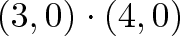
Let’s start simple, and see 3 x 4 as a dot product:

The number 3 is “directional growth” in a single dimension (x-axis, let’s say), and 4 is “directional growth” in that same direction. 3 x 4 = 12 means 12x growth in that single dimension. Ok.
Now, suppose each number refers to a different dimension? Suppose 3 means “triple your bananas” (sigh… or “x-axis”) and 4 means “quadruple your oranges” (y-axis). They’re not the same “type” of number: what happens when we apply growth (take the dot product) in the (bananas, oranges) universe?
- (3,0) is “Triple your bananas, destroy your oranges”
- (0,4) is “Destroy your bananas, quadruple your oranges”
Applying (0,4) to (3,0) means “Destroy your banana growth, quadruple your orange growth”. But (3, 0) had no orange growth to begin with, so the net result is 0 (“Destroy all your fruit, buddy”).

See how we’re “applying” and not adding. With addition, we sort of smush the items together: (3,0) + (0, 4) = (3, 4) [a vector which triples your oranges and quadruples your bananas].
“Application” is different. We’re mutating the original vector according to the rules in the second. And the rules are “Destroy your banana growth rate, and triple your orange growth rate“. And, sadly, this leaves us with nothing.
The final result of this process can be:
- zero: we don’t have any growth in the original direction
- positive number: we have some growth in the original direction
- negative number: we have negative (reverse) growth in the original direction
Understanding the Calculation
“Applying vectors” is still a bit abstract. I think “How much energy/push is one vector giving to the other?”. Here’s how I visualize it:
Rectangular Coordinates: Component-by-component overlap
Like multiplying complex numbers, see how each x- and y-component interacts:
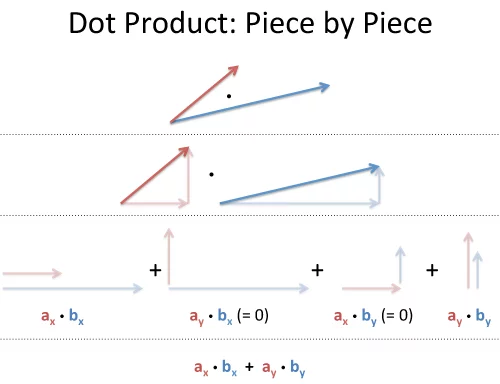
We list out all four combinations (x-x, y-x, x-y, y-y). Since the x- and y-coordinates don’t affect each other (like holding a bucket sideways under a waterfall — nothing falls in), the total energy absorbtion is absorbtion(x) + absorbtion(y):

Polar coordinates: Projection
The word “projection” is so sterile: I prefer “along the path”. How much energy is actually going in our original direction?
Here’s one way to see it:

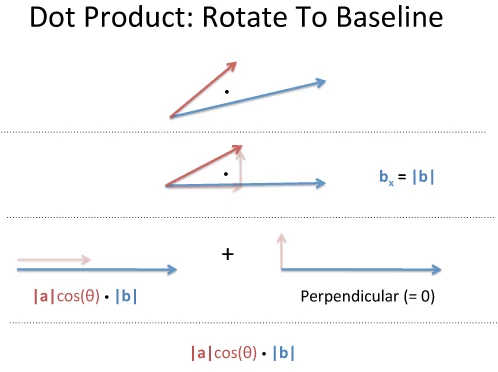
Take two vectors, a and b. Rotate our coordinates so b is horizontal: it becomes (|b|, 0), and everything is on this new x-axis. What’s the dot product now? (It shouldn’t change just because we tilted our head).
Well, vector a has new coordinates (a1, a2), and we get:

a1 is really “What is the x-coordinate of a, assuming b is the x-axis?”. That is |a|cos(θ), aka the “projection”:

Analogies for the Dot Product
The common interpretation is “geometric projection”, but it’s so sterile. Here’s some analogies that click for me:
Energy Absorbtion
One vector are solar rays, the other is where the solar panel is pointing (yes, yes, the normal vector). Larger numbers mean stronger rays or a larger panel. How much energy is absorbed?
- Energy = Overlap in direction * Strength of rays * Size of panel

If you hold your panel sideways to the sun, no rays hit (cos(θ) = 0).
But… but… solar rays are leaving the sun, and the panel is facing the sun, and the dot product is negative when vectors are opposed! Take a deep breath, and remember the goal is to embrace the analogy (besides, physicists lose track of negative signs all the time).
Mario-Kart Speed Boost
In Mario Kart, there are “boost pads” on the ground that increase your speed (Never played? I’m sorry.)
Imagine the red vector is your speed (x and y direction), and the blue vector is the orientation of the boost pad (x and y direction). Larger numbers are more power.
How much boost will you get? For the analogy, imagine the pad multiplies your speed:
- If you come in going 0, you’ll get nothing
- If you cross the pad perpendicularly, you’ll get 0 [just like the banana obliteration, it will give you 0x boost in the perpendicular direction]
But, if we have some overlap, our x-speed will get an x-boost, and our y-speed gets a y-boost:

Neat, eh? Another way to see it: your incoming speed is |a|, and the max boost is |b|. The amount of boost you actually get (for being lined up with it) is cos(θ), for the total |a||b|cos(θ).
Physics Physics Physics
The dot product appears all over physics: some field (electric, gravitational) is pulling on some particle. We’d love to multiply, and we could if everything were lined up. But that’s never the case, so we take the dot product to account for potential differences in direction.
It’s all a useful generalization: Integrals are “multiplication, taking changes into account” and the dot product is “multiplication, taking direction into account”.
And what if your direction is changing? Why, take the integral of the dot product, of course!
Onward and Upward
Don’t settle for “Dot product is the geometric projection, justified by the law of cosines”. Find the analogies that click for you! Happy math.
22 thoughts on “Vector Calculus: Understanding the Dot Product”
This can be a really tough one, and to be honest I don’t find many of the analogies very useful. I’m a video game programmer so I need the dot product a lot, and I still find it easiest to think in terms of projection, as sterile as it may sound. I think of the dot product as the component of the first vector in the direction of the second. Or, if you think of the second vector as a hyperplane (more sterile, mathematical terms), how long would the first vector be projected onto it?
I love this site, and I don’t comment often, but I think you do a great job, and I’m sure I’ll be pointing my son at your articles before too long (he’s nearly 1)
As a matter of professional curiosity, are you certain that the Mario Kart boost pads only give you a boost proportional to your alignment? Or do they just give you a constant boost so long as you are crossing them in the correct direction?
@wererogue: Thanks for the feedback! You bring up some great points.
1) Yep, projection is only sterile because the term is unfamiliar (but not the concept). Another might be “What is the shadow of one vector on the other?”. One subtlety I should have mentioned was that the dot product gives a plain number (i.e. total energy absorbed) and not a new vector on your own (when I think “projection”, I think getting a new, likely shorter, vector that is in the direction of the first).
2) Awesome, looks like your son will be getting off to a head start
3) The real mario kart boost pads probably just add a constant amount to your speed, irrespective of direction (I should clarify that). My analogy was just to see “Hey, one vector is determining the multiplier effect, and the other the incoming direction.”
I’m no expert but just giving my 2c regarding my experience of reading this article:
I found your description of the different dot product equations as cartesian vs polar based very useful. I only groked that the morning after reading.
Also, the ‘Piece by Piece’ illustrated well why we add only products of the like-for-like axes and discard the rest (because they’re perpendicular and always equal zero!)
What worked for me (after reading ‘Piece by Piece’) is to think of the vectors from an abstract POV – neither as cartesian/polar. From there, we decide whether to decompose down to cartesian/polar. Polar is much more easy to intuit. Cartesian less so, but I think I see it now – you can decompose down to any any basis you like as long as it’s orthonormal – doing so lets you discard the orthogonal pairs of axes and end up with the simple ax.bx+ay.by+az.bz sum. If they aren’t orthonormal then the “optimisation” cannot be done.
I didn’t find the analogies 100% either, but then again I haven’t really found a 100% analogy yet anywhere – I’d like people to share theirs if they have one. The ‘shadow’ one works well, but it’s always the fact that you multiply by the magnitude of the vector you’re projection onto which doesn’t quite fit.
I did find them quite inspiring though, especially that of Mario-Kart. I too noticed that the gameplay might differ from your description, but it’s not too hard to imagine a game world where the dot product would be the resultant behaviour! In fact that might be quite an interesting demo: Dot-product racing.
I just found this site and I like it alot, thans! I use the dot product a lot as well and I also think in terms of projection. But, as a matter of fact, I never miss the oportunity to think about the symetry the dot product inherents and I feelit is missing in the text. If you think in terms of projection, you can think “the first vector, projected on the second” or “the second vector, projected on the first.” The point is to understand that both properties are equal and that is not very intuitive!
However, I love your way to use the dot product piecewise for each combination of dimensions and you can explain the distributive property of the operation with it. Very nice, I like it!
Much agreed with blub – the symmetry needs to be exposed more somehow.
I think this is half-exposed with Dot Product: Rotate to baseline, where the x-axis is used as the baseline. Perhaps the symmetry can be partially represented by rotating CCW to a y-axis baseline.
I’ve did some electrical engineering and some computer engineering and plain mathematics and although I’ve never really encountered problems with laws of physics it has almost always been just formulas for me. It’s not like I did not have some way of expressing it but wow do i feel like I actually know stuff now! Know what is actually going on and not just mechanically applying the formulas to get the solution of a problem …
@Justin: Thanks for the feedback — it’s really helpful to know what’s working (or not).
It took me a while to realize the cartesian / polar versions as well – now, when I see that “equation foo = equation bar” I really try to see “Ok, what perspective does the foo-side have? The bar side?”.
Yes! What you said about vectors is exactly it — they exist (abstractly) and here are two possible ways to describe it. There’s probably more, but polar/cartesian are the common ones.
Yes, the analogies aren’t 100% for me (probably 90%), shadow is maybe 95%, there might be an even better one out there (as they come in I’ll be amending the article).
Dot product racing sounds like an interesting idea for gameplay mechanics
.
@blub: Great point on the symmetry – it’s something I don’t have the best intuitive grasp for either. For the piece-by-piece it makes algebraic sense. For the “projection” side, not as much — why would the projection of A onto B be the same as B onto A?
One way to think about it: a vector is really a direction and magnitude. When we write (10, 10) that’s really a shorthand for “the 45-degree angle, scaled up some amount — 10x the unit circle”. So when we’re doing the dot product, we can save the scaling for the end (find the projection on the unit circle, then scale up by each amount). Because otherwise, it’s weird that projecting (10,10) onto (200, 0) would give a different result than projecting onto (2000, 0). Why does it matter that the vector being projected “onto” is larger? (That’s why plain “projection” doesn’t click nicely with me).
@nik: Awesome! Yes, the goal for each article is to move beyond mechanical formula applications, glad if it helped!
i lov dis page is so easy 2 undastand simply outstanding
Great post – I really liked the stpe-by-step breakdown of the different ways to look at it and I could imagine that the mario kart example would go down really well in class.
I found this discussion refreshing especially when combined with Professor Strang’s Linear Algebra Course on MIT open courses. Also having spent my first Saturday Night with AdaFruit I loved the kill your fruit analogy. As you fill this out a comparison with the cross product and some of the geometry of “in the plane” versus out of the plane would be great. Before I started to regularly come to this site to have my mind blown I did it on such simple realization as “the cross product of any two vectors in a plane gets you a vector normal to the plane.” Off to make some fruit salad…
@mark: Thanks for dropping by! Ah, I remember we used Prof. Strang’s book in our course too, sadly I don’t remember enough linear algebra (especially an intuition for eigenvectors / eigenvalues) but I’m looking forward to getting re-acquainted with it
.
@Daniel: Thanks — if you end up trying it, I’d love to know how it worked out! I’m still looking for really vivid analogies of what’s happening.
One of the most difficult things in mathematics isn’t failing to understand the initial concept (the one we’re first introduced to at school). Instead, the difficult thing in mathematics is to understand the generalised concept. You seem to have covered everything—and it was useful to me—but I don’t believe you’ve explained very well why it becomes a scalar.
Lets rewrite the first equation a bit:
vec{a} cdot vec{b} divided by |vec{b}| = |vec{a}| cos(theta)
or in words (arguing from the right side of the equation): to get the magnitude of the component of vector a in the direction of vector b, take the dot product of vectors a and b and divide by the magnitude of vector b. (Remember that “vec{b} / |vec{b}|” is the unit vector e_b.) This sounds remarkably similar to a coordinate transformation, specifically from polar to Cartesian coordinates. (I know you mention it, sorry)
But there is a second transformation happening at the same time. We’re changing from vectors to scalars. The “projection” doesn’t really explain that (at least it never did to me). Your question is better: “What is the x-coordinate of a, assuming b is the x-axis?” The thing to remember though, is that we’re simultaneously applying a parametrisation! That is why the dot product occurs in Line Integrals!
To summarise:
Step 1: take the component of vector a in the direction of vector b (it’s still a vector)
Step 2: alter the size of said component by multiplying it with |b|. (it’s still a vector)
Step 3: apply parametrisation to change it from a vector to a scalar.
That last part makes sense out of Line Integrals involving Work (and Energy): we’re parametrising vector a along curve C (which is defined by position vector b)
Hope it helps! (And I hope I didn’t make any mistakes.)
I forgot to mention that the context of the dot product determines whether its symmetry is important; whether its parametrisation is important; … and so on. The context also determines what we’re multiplying—and what our result represents (e.g. your: “What is the x-coordinate of a, assuming b is the x-axis?”).
Which is why I always had difficulty with the dot product. The dot product of a vector with itself, is conceptually completely different. Especially when you contrast it with the use of a dot product in line integrals.
Thanks.
P.S. Love your integral explanations:
Integrals are “multiplication, taking changes into account”; and…
the dot product is “multiplication, taking direction into account”.; and…
Line integrals are “multiplication, taking into account changes both in magnitude and direction”.
@alex: Really interesting comments! In my head, the dot product becomes a scalar because it’s the result of a directional multiplication, i.e. “Pretend we’re doing a regular 1-dimensional multiplication, but with “b” as the axis to use –what is the result?”
But, the transition from a vector to a scalar is interesting. So, the thinking is the “parameterization” is how far “a” is going along the curve defined by b (writing a in terms of b).
This is a little funky to me, because I normally think of parameterizations as being non-destructive, i.e. writing a circle as [cos(t), sin(t)] leaves the shape intact, but was defined using a different variable. I might not have the right terminology though.
Maybe another way to put it:
“b defines a path. If we go in direction a, how far do we move along the path?” (We can ignore scaling effects). For the line integrals, we have a curve are moving along — how much energy is going along this path? We can parameterize the input energy [vector a] and say “Oh, now we’re going to rewrite a in terms of how much energy it’s putting along the curve.”
I think it’s a neat idea
. (Glad you enjoyed the integral explanations, I’m constantly refining my understanding of seemingly fundamental operations).
@kalid, you said: “Pretend we’re doing a regular 1-dimensional multiplication, but with “b” as the axis to use –what is the result?”
Now I get it. Basically, you rotate vector ‘a’ to point to the same direction as vector ‘b’. Then you shrink the vector by a factor of “cosine theta”. Then you enlarge the vector by |b| … (only it has stopped being a vector, argh!)
Although…, if you stop thinking about it as multiplying 2 vectors—and instead see it as multiplying a 1X3 matrix with a 3X1 vector—then it easier to see it as just a multiplication. (Really, give me the cross product any day, as it doesn’t change its conceptual meaning as often.)
You are right that parametrisation is non-destructive. But (to use your example) you go from describing a circle in ‘x’ and ‘y’, to describing it in just one parameter ‘t’. Basically, the dot product combines a coordinate transformation and a parametrisation.
Which is why we always encounter dot products in line integrals. We are interested in the work done while moving along a curve inside a vector field (as an example). The coordinate transformation makes sure we only use the component of the vector that’s parallel to the direction we’re moving. The parametrisation makes sure we reduce the number of variables.
Moving away from line integrals. Taking into account the symmetry of the dot product, you’re “multiplication, taking direction into account” might be better described as a partial multiplication due to the fact that the vectors point in different directions. In other words:
|a| |b| cos(theta) = |a| ( |b| cos(theta) ) = ( |a| cos(theta) ) |b|
in that way, it makes clear that it doesn’t matter which of the two vectors you take as axis.
Off course, in the context of line integrals it does matter (at least conceptually) which vector you take as axis, because only one will describe a path.
It is fun to realise that some of the most difficult concepts in mathematics are much easier than we thought. An integral for example is nothing more than an advanced form of an advanced form of addition. LOL.
I thought some more about this. Your explanation lead me to try and wrap my head around line integrals and their use of the dot product. But…
You are absolutely right that the dot product in itself is just multiplication taking direction into account. Changing the vector notation into matrix notation makes that clear. And yet…
I asked myself: Why do we use the dot product? Well, we want an answer to a specific question, don’t we? That got me thinking about what vectors represent; which is “magnitude” and “direction”. So, when we multiply vectors we multiply both magnitude and direction.
Except…we don’t always care equally about magnitude and direction! When we only care about the magnitude of vectors, we don’t even bother with vector notation!
In the case of the dot product we care about the direction of vector ‘a’ with respect to vector ‘b’ (the direction of vector ‘b’ with respect to vector ‘a’). In other words we care about the RELATIVE DIRECTION—which explains why it is a scalar.
This raises the question: “How do we multiply vectors when we care about the absolute direction?” For a two dimensional vector the answer is easy; we convert the vector to a complex number and multiply complex number ‘a’ with complex number ‘b’.
In a similar way, this explains the multiplication of a Nx1 matrix with a 1xN matrix to get a NxN matrix. But in this case, we care about multiple direction (instead of relative direction, or absolute direction). The Jacobian is a good example.
Similarly, the cross product. We care about direction, but we only care about the direction perpendicular to both vector ‘a’ and vector ‘b’.
So vector multiplication is about multiplying a pair of numbers (magnitude and direction), whereby we take into account ‘direction’ to varying degrees.
To summarise, I would suggest changing “…the dot product is ‘multiplication, taking direction into account’.” into:
The dot product is multiplication while taking relative direction (or the difference in direction) into account.
Anyway, thank you for explanations like these. They help me to understand the basic mathematical idea—instead of the more specific physical idea—behind mathematical concepts like these.
Thanks.
Excellent article, as always. As a current engineering student, I’m going to be eternally grateful that I took my statics and dynamics courses BEFORE vector calculus, so I had a really good intuition on the physical uses of dot and cross products that helped me wrap my head around the mathematical intricacies. Sometimes there’s a benefit to be had from teaching things in the “wrong” order like that. Anyway, keep it up, I look forward to reading your thoughts on the cross product soon–the relationship between the cross product and the determinant is still one of the biggest ‘mystery math’ things out there for me.
@alex:
Yep, totally agree with the grouping — it shows the symmetry by thinking of a onto b, or b onto a. And yep, with line integrals, you usually have a defined Force and Path vector (it’s not as intuitive to project the Path onto the Force).
I love breaking down complicated ideas into easy-to-digest parts… yep, the integral is a wrapper around the idea of “applying” something piece by piece (of which multiplication and repeated addition are very simple base cases).
On the vector notation: I guess it depends on how deep you want to go
. For me, I take it as an axiom that “we want to figure out how much one vector pushes in the direction of the other, it will be a single number (called the dot product) and here’s why it should be what it is (i.e., x and y components interacting)”
Yes, relative direction is a good way to put it — the absolute doesn’t matter. In a system of relative coordinates (just angles between them), what do we know about the force of one onto the other? (Interestingly, I stumbled upon the concept of coordinate-free geometry today).
When we care about absolute direction, yep, we want different results when vectors that are 90 degrees apart but oriented differently are combined. I think we need to be careful with complex numbers though (for terminology) since the typical dot product gives 0 when perpendicular, but complex numbers do a rotation.
I might tweak it to “the dot product is multiplication, taking the difference in direction into account”. (I’ll have to tweak it). WIth all of these 1-liners, it’s a tradeoff between an immediate click vs. getting into too much detail.
And the feeling for these discussions is mutual, I love exploring these ideas!
@Joe: Thanks Joe. I agree, there’s an interplay between theory and application (I learned vector calc before E&M, and having physics examples definitely solidified my earlier understanding). I don’t think you can teach in some pyramid where the base ideas are learned, divorced from examples, and then the applications are sprinkled in later.
Appreciate the encouragement, I’d love to do the cross product & determinant in the future! (Two concepts I really, really want to get an intuition for & not just the mechanical calculation).
I’d love to feature this post in the Math and Multimedia Carnival #21 on my site, Math Concepts Explained. Please let me know! My site is at http://sk19math.blogspot.com. Thanks!
@Shaun: Definitely! I’ve emailed you as well, but feel free to use the content as you need. Thanks for asking!