Intuitive Understanding Of Euler’s Formula

Euler's identity seems baffling:
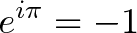
\displaystyle{e^{i\pi} = -1}

It emerges from a more general formula:

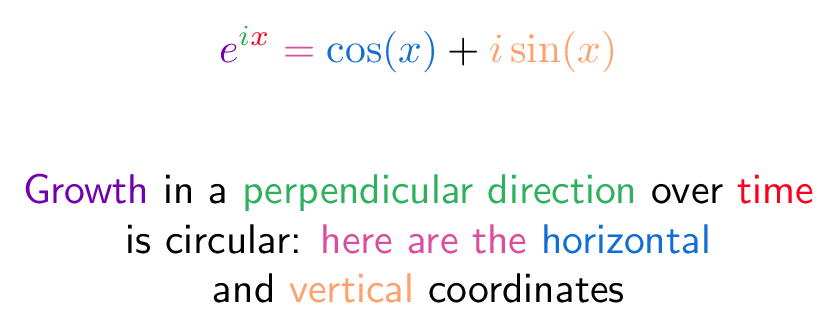
\displaystyle{ e^{ix} = cos(x) + i sin(x)}

Yowza -- we're relating an imaginary exponent to sine and cosine! And somehow plugging in pi gives -1? Could this ever be intuitive?

Not according to 1800s mathematician Benjamin Peirce:

It is absolutely paradoxical; we cannot understand it, and we don't know what it means, but we have proved it, and therefore we know it must be the truth.

Argh, this attitude makes my blood boil! Formulas are not magical spells to be memorized: we must, must, must find an insight. Here's mine:

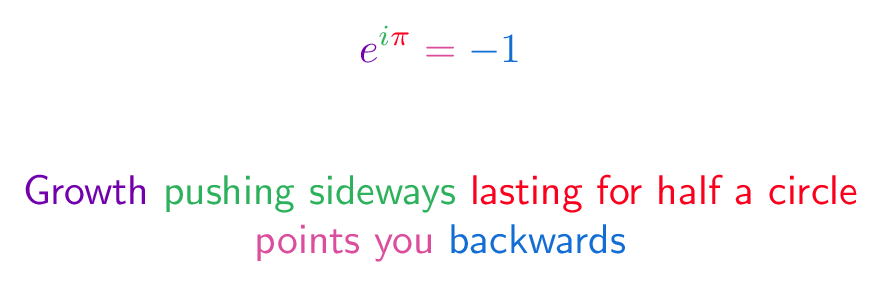
Euler's formula describes two equivalent ways to move in a circle.

That's it? This stunning equation is about spinning around? Yes -- and we can understand it by building on a few analogies:

  • Starting at the number 1, see multiplication as a transformation that changes the number (1 * e^(i*pi))
  • Regular exponential growth continuously increases 1 by some rate; imaginary exponential growth continuously rotates a number
  • Growing for "pi" units of time means going pi radians around a circle
  • Therefore, e^(i*pi) means starting at 1 and rotating pi (halfway around a circle) to get to -1

That's the high-level view -- let's dive into the details. By the way, if someone tries to impress you with "e^(i*pi) = -1", ask them about i to the ith power. If they can't think it through, Euler's formula is still a magic spell to them.

Update: While writing, I thought a companion video might help explain the ideas more clearly:

It follows the post -- watch together, or at your leisure.

Understanding cos(x) + i * sin(x)

The equals sign is overloaded. Sometimes we mean "set one thing to another" (like x = 3) and others we mean "these two things describe the same concept" (like sqrt(-1) = i).

Euler's formula is the latter: it gives two formulas which explain how to move in a circle. If we examine circular motion using trig, and travel x radians:

  • cos(x) is the x-coordinate (horizontal distance)
  • sin(x) is the y-coordinate (vertical distance)

The statement

\displaystyle{cos(x) + i \cdot sin(x)}

is a clever way to smush the x and y coordinates into a single number. The analogy "complex numbers are 2-dimensional" helps us interpret a single complex number as a position on a circle.

When we set x to pi, we're traveling "pi" units along the outside of the unit circle. Because the total circumference is 2*pi, plain old pi is halfway around, putting us at -1.

Neato: The right side of Euler's formula (cos(x) + i*sin(x)) describes circular motion with imaginary numbers. Now let's figure out how the e side of the equation accomplishes it.

What is Imaginary Growth?

Combining x- and y- coordinates into a complex number is tricky, but manageable. But what does an imaginary exponent mean?

Let's step back a bit. When I see "3^4" I think of it like this:

  • 3 is the end result of growing instantly (using e) at a rate of ln(3). 3 = e^ln(3)
  • 3^4 is the same as growing to 3, but then growing for 4x as long. So 3^4 = e^(ln(3) * 4) = 81

Instead of seeing numbers on their own, you can think of them as something e had to "grow to". Real numbers, like 3, give an interest rate of ln(3) = 1.1, and that's what e "collects" as it's going along, growing continuosly.

Regular growth is simple -- it keeps "pushing" a number in the same, real direction it was going. 3 × 3 pushes in the original direction, making it 3 times larger (9).

Imaginary growth is different -- the "interest" we earn is in a different direction! It's like a jet engine that was strapped on sideways -- instead of going forward, we start pushing at 90 degrees.

The neat thing about a constant orthogonal (perpendicular) push is that it doesn't speed you up or slow you down -- it rotates you! Taking any number and multiplying by i will not change its magnitude, just the direction it points.

Intuitively, here's how I see continuous imaginary growth rate: "When I grow, don't push me forward or back in the direction I'm already going. Rotate me instead."

But Shouldn't We Spin Faster and Faster?

I wondered that too. Regular growth compounds in our original direction, so we go 1, 2, 4, 8, 16, multiplying 2x each time and staying in the real numbers. We can consider this e^(ln(2)*x): grow instantly at a rate of ln(2) for "x" seconds.

And hey -- if our growth rate was twice as fast (2*ln(2) vs ln(2)), it would look the same as growing for twice as long (2x vs x). The magic of e lets us swap rate and time; 2 seconds at ln(2) is the same growth as 1 second at 2*ln(2).

Now, imagine we have some imaginary growth rate (R*i) which rotates us: e^R*i becomes imaginary and grows to "i". Well, if we double that, we get i^2 (-1) and as we keep going we just spin around the circle.

Now imagine we double that rate (2R*i). Would that spin us off the circle? Nope! Having a rate of 2R*i means we just spin twice as fast, or alternatively, spin at a rate of R for twice as long.

Once we realize that some exponential growth rate can take us from 1 to i, increasing that rate just spins us faster. We'll never escape the circle.

However, if our growth rate is complex (a+bi vs Ri) then the real part (a) will grow us like normal, while the imaginary part (bi) rotates us. But let's not get fancy: Euler's formula, e^(i*x), is about the purely imaginary growth that keeps us on the circle (more later).

A Quick Sanity Check

While writing, I had to clarify a few questions for myself:

Why e^x -- aren't we rotating 1?

e represents the process of starting at 1 and growing continuously at 100% interest for 1 unit of time.

When we write e we're capturing that entire process in a single number -- e represents all the whole rigamarole of continuous growth. So really, e^x is saying "start at 1 and grow continuously at 100% for x seconds", and starts from 1 like we want.

But what does i as an exponent do?

For a regular exponent like 3^4 we ask:

  • What is the implicit growth rate? We're growing from 1 to 3 [the bottom of the exponent].
  • How do we change that growth rate? We scale it by 4x (^4, the top of the exponent).

We can convert our growth into "e" format: our instantaneous rate is ln(3), and we increase it to ln(3) * 4. Again, the top exponent (4) just scaled our growth rate.

\displaystyle{3^4 = e^{ln(3) \cdot 4} = (e^{ln(3)})^4}

When the top exponent is i (as in 3^i), we just multiply our implicit growth rate by i. So instead of growing at plain old ln(3), we're growing at ln(3) * i.

\displaystyle{3^i = e^{ln(3) \cdot i} = (e^{ln(3)})^i}

The top part of the exponent modifies the implicit growth rate of the bottom part.

The Nitty Gritty Details

Let's take a closer look. Remember this definition of e:

\displaystyle{e = \lim_{n\to\infty} \left( 1 + \frac{100\%}{n} \right)^n}

That 1/n represents the interest we earned in each microscopic period. We assumed the interest was real -- but what if it were imaginary?

\displaystyle{e = \lim_{n\to\infty} \left( 1 + \frac{100\%\cdot i}{n} \right)^n}

Now, our newly formed interest adds to us in the 90-degree direction. Surprisingly, this does not change our length -- this is a tricky concept, because it appears to make a triangle where the hypotenuse must be larger. We're dealing with a limit, and the extra distance is within the error margin we specify. This is something I want to tackle another day, but take my word: continuous perpendicular growth will rotate you. This is the heart of sine and cosine, where your change is perpendicular to your current position, and you move in a circle.

We apply i units of growth in infinitely small increments, each pushing us at a 90-degree angle. There is no "faster and faster" rotation - instead, we crawl along the perimeter a distance of |i| = 1 (magnitude of i).

And hey -- the distance crawled around a circle is an angle in radians! We've found another way to describe circular motion!

To get circular motion: Change continuously by rotating at 90-degree angle (aka imaginary growth rate).

So, Euler's formula is saying "exponential, imaginary growth traces out a circle". And this path is the same as moving in a circle using sine and cosine in the imaginary plane.

In this case, the word "exponential" is confusing because we travel around the circle at a constant rate. In most discussions, exponential growth is assumed to have a cumulative, compounding effect.

Some Examples

You don't really believe me, do you? Here's a few examples, and how to think about them intuitively.

Example: e^i

Where's the x? Ah, it's just 1. Intuitively, without breaking out a calculator, we know that this means "travel 1 radian along the unit circle". In my head, I see "e" trying to grow 1 at 100% all in the same direction, but i keeps moving the ball and forces "1" to grow along the edge of a circle:

\displaystyle{e^i = cos(1) + i \cdot sin(1) = .5403 + .8415i}

Not the prettiest number, but there it is. Remember to put your calculator in radian mode when punching this in.

Example: 3^i

This is tricky -- it's not in our standard format. But remember, \displaystyle{3^i = 1 \cdot 3^i} -- the real question is "How do we transform 1"?
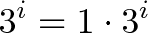
We want an initial growth of 3x at the end of the period, or an instantaneous rate of ln(3). But, the i comes along and changes that rate of ln(3) to "i * ln(3)":

\displaystyle{3^i = (e^{ln(3)})^i = e^{ln(3)\cdot i}}

We thought we were going to transform at a regular rate of ln(3) (a little faster than 100% continuous growth since e is about 2.718). But oh no, i spun us around: now we're transforming at an imaginary rate which means we're just rotating about. If i was a regular number like 4, it would have made us grow 4x faster. Now we're growing at a speed of ln(3), but sideways.

We should expect a complex number on the unit circle -- there's nothing in the growth rate to increase our size. Solving the equation:

\displaystyle{3^i = e^{ln(3) \cdot i} = cos(ln(3)) + i \cdot sin(ln(3)) = .4548 + .8906i}

So, rather than ending up "1" unit around the circle (like e^i) we end up ln(3) units around.

Example: i^i

A few months ago, this would have had me tears. Not today! Let's break down the transformations:
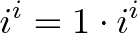
\displaystyle{i^i = 1 \cdot i^i}

We start with 1 and want to change it. Like solving 3^i, what's the instantaneous growth rate represented by i as a base?

Hrm. Normally we'd do ln(x) to get the growth rate needed to reach x it the end of 1 unit of time. But for an imaginary rate? We need to noodle this over.

In order to start with 1 and grow to i we need to start rotating at the outset. How fast? Well, we need to get 90 degrees (pi/2 radians) in 1 unit of time. So our rate is "i * pi/2". Remember our rate must be imaginary since we're rotating, not growing! Plain old "pi/2" is about 1.57 and results in regular growth.

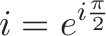
This should make sense: to turn 1.0 to i at the end of 1 unit, we should rotate pi/2 radians (90 degrees) in that amount of time. So, to get "i" we can use e^(i * pi/2).

\displaystyle{i = e^{i * \frac{\pi}{2}}}

Phew. That describes i as the base. How about the exponent?

Well, the other i tells us to change our rate -- yes, that rate we spent so long figuring out! So rather than rotating at a speed of i * pi/2, which is what a base of i means, we transform the rate to:

\displaystyle{\frac{\pi}{2}i \cdot i = \frac{\pi}{2} \cdot -1 = -\frac{\pi}{2}}

The i's cancel and make the growth rate real again! We rotated our rate and pushed ourselves into the negative numbers. And a negative growth rate means we're shrinking -- we should expect i^i to make things smaller. And it does:

\displaystyle{i^i = e^{- \frac{\pi}{2}} \sim .2}

Tada! (Search "i^i" on Google to use its calculator)

Take a breather: You can intuitively figure out how imaginary bases and imaginary exponents should behave. Whoa.

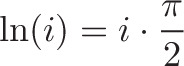
And as a bonus, you figured out ln(i) -- to make e^x become i, make e rotate pi/2 radians.

\displaystyle{ln(i) = i \cdot \frac{\pi}{2}}

Example: (i^i)^i

A double imaginary exponent? If you insist. First off, we know what our growth rate will be inside the parenthesis:

\displaystyle{i^i = (e^{\frac{\pi}{2}i})^i = e^{-\frac{\pi}{2}}}

We get a negative (shrinking) growth rate of -pi/2. And now we modify that rate again by i:

\displaystyle{{(i^i)^i = (e^{-\frac{\pi}{2}})^i = e^{-\frac{\pi}{2}i}}

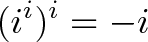
And now we have a negative rotation! We're going around the circle a rate of -pi/2 per unit time. How long do we go for? Well, there's an implicit "1" unit of time at the very top of this exponent chain; the implied default is to go for 1 time unit (just like e = e^1). 1 time unit gives us a rotation of -pi/2 radians (-90 degrees) or -i!

\displaystyle{(i^i)^i = -i}

And, just for kicks, if we squared that crazy result:
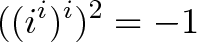
\displaystyle{((i^i)^i)^2 = -1}

It's "just" twice the rotation: 2 is a regular number so doubles our rotation rate to a full -180 degrees in a unit of time. Or, you can look at it as applying -90 degree rotation twice in a row.

At first blush, these are really strange exponents. But with our analogies we can take them in stride.

Complex Growth

We can have real and imaginary growth at the same time: the real portion scales us up, and the imaginary part rotates us around:
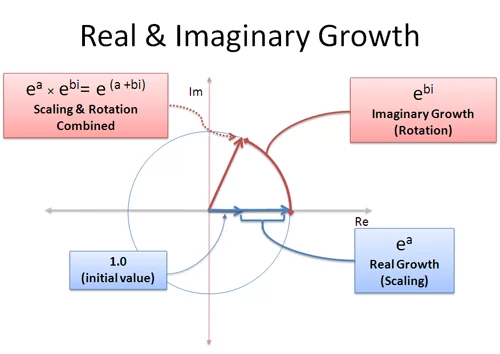
A complex growth rate like (a + bi) is a mix of real and imaginary growth. The real part a, means "grow at 100% for a seconds" and the imaginary part b means "rotate for b seconds". Remember, rotations don't get the benefit of compounding since you keep 'pushing' in a different direction -- rotation adds up linearly.

With this in mind, we can represent any point on any sized circle using (a+bi)! The radius is e^a and the angle is determined by e^(b*i). It's like putting the number in the expand-o-tron for two cycles: once to grow it to the right size (a seconds), another time to rotate it to the right angle (b seconds). Or, you could rotate it first and the grow!

Let's say we want to know the growth amount to get to 6 + 8i. This is really asking for the natural log of an imaginary number: how do we grow e to get (6 + 8i)?

  • Radius: How big of a circle do we need? Well, the magnitude is sqrt(6^2 + 8^2) = sqrt(100) = 10. Which means we need to grow for ln(10) = 2.3 seconds to reach that amount.
  • Amount to rotate: What's the angle of that point? We can use arctan to figure it out: atan(8/6) = 53 degrees = .93 radian.
  • Combine the result: ln(6+8i) = 2.3 + .93i

That is, we can reach the random point (6 + 8i) if we use e^(2.3 + .93i).

Why Is This Useful?

Euler's formula gives us another way to describe motion in a circle. But we could already do that with sine and cosine -- what's so special?

It's all about perspective. Sine and cosine describe motion in terms of a grid, plotting out horizontal and vertical coordinates.

Euler's formula uses polar coordinates -- what's your angle and distance? Again, it's two ways to describe motion:

  • Grid system: Go 3 units east and 4 units north
  • Polar coordinates: Go 5 units at an angle of 71.56 degrees

Depending on the problem, polar or rectangular coordinates are more useful. Euler's formula lets us convert between the two to use the best tool for the job. Also, because e^(ix) can be converted to sine and cosine, we can rewrite formulas in trig as variations on e, which comes in very handy (no need to memorize sin(a+b), you can derive it -- more another day). And it's beautiful that every number, real or complex, is a variation of e.

But utility, schmutility: the most important result is the realization that baffling equations can become intuitive with the right analogies. Don't let beautiful equations like Euler's formula remain a magic spell -- build on the analogies you know to see the insights inside the equation.

Happy math.

Appendix

The screencast was fun, and feedback is definitely welcome. I think it helps the ideas pop, and walking through the article helped me find gaps in my intuition.

References:

Other Posts In This Series

  1. A Visual, Intuitive Guide to Imaginary Numbers
  2. Intuitive Arithmetic With Complex Numbers
  3. Understanding Why Complex Multiplication Works
  4. An Intuitive Guide To Exponential Functions & e
  5. Demystifying the Natural Logarithm (ln)
  6. Understanding Exponents (Why does 0^0 = 1?)
  7. A Visual Guide to Simple, Compound and Continuous Interest Rates
  8. Using Logarithms in the Real World
  9. How To Measure Any Distance With The Pythagorean Theorem
  10. Surprising Uses of the Pythagorean Theorem
  11. Rescaling the Pythagorean Theorem
  12. Intuitive Guide to Angles, Degrees and Radians
  13. Intuitive Understanding Of Euler's Formula (This post)
  14. Intuitive Understanding of Sine Waves
  15. An Interactive Guide To The Fourier Transform
Enjoying BetterExplained? Also try InstaCalc on the Mac App Store. It's the fast, easy, shareable calculator you'll love using.

Share what worked: Aha moments & FAQ

Let's create a living reference for how best to understand this topic.

140 thoughts on “Intuitive Understanding Of Euler’s Formula

  1. This is a phenomenal article! Took me quite a bit of time and multiple readings to get my head around it, but now I get it. I think. :)

  2. Hey cool that makes a lot of sense. I already thought of imaginary numbers that way, but the growth pulling in a circle is very straightforward.

    Are there complex equations that move in this way that intersect the real set of numbers in cool ways? Like I could imagine some complex equation that loops around, intersecting the real set of numbers (the real numberline) to create the set of primes or something like that.

  3. @Aditya: Thanks! Yes, it took me a while to really see the equation, there may be a nicer way to go back and streamline how it was presented — I’d like to avoid the need for people to have multiple readings :) .

    @Brandon: That’s an interesting question — actually, the Mandelbrot set is like that to some degree, where there is a complex (2d) function which gives rise to some pretty amazing patterns. I don’t know of any others off the top of my head though.

  4. I <3 BetterExplained – keep 'em coming!

    This gets easier if you've already got the hang of the physics concept that to move in a circle you must keep accelerating. If you accelerate in one direction, you will get faster and faster, but if you keep accelerating in a new relative direction, your speed will be the same, but you'll move in a circle (your velocity changes.)

    Acceleration is a kind of growth, and so it logically follows that if you grow in a relative direction, you'll rotate but not speed up.

  5. @wereogue: Thanks for the support! Yes, the physics interpretation definitely helps see this relationship, and I like the way you put it — our growth/change is really an acceleration. Our velocity is always perpendicular to our position (and acceleration perpendicular to velocity) which gives us a circle. It’s funny how much overlap there is between math and physics :) .

  6. Thank you for showing us that Maths can be easy and simple. You are an example to today’s mathematicians, what you are doing is really inspiring. I always try to think how to make things easier to teach, learn and do. But you really make it so well!

    Congratulations!
    Keep it doing it!
    you can go very far!

    Mariano
    (Excuse my English)

  7. Great article and great video!

    I was wondering about what you used to generate the graphics, they look great :) .

    Cheers from Romania,
    Alex

  8. I didnt bother to follow your argument because the topic doesnt interest me but I like your attitude that math is just logic and “common sense” and theres way too much hocus pocus and ‘mysticism” that often creeps in imho.

  9. Kalid,

    I’m still digesting it all, but i just have to say: “continuous perpendicular growth will rotate you” is just plain sexy. Wow, it makes sooo much sense to me :) Keep it up sir!

    Sebastian

  10. Kalid, this is extremely impressive. I’ve been trying to understand this for a long long time. I found it difficult to see past the numbers and symbols and wanted to understand it ‘visually’ so I knew what was trying to be achieved. You have described it all beautifully and for the first time I am really understanding how it all fits together. I so wish you were teaching me in school 25 years ago. Thanks again.

  11. @Kalid’s Friend: It really bothered me for a long time also — Euler’s formula was used everywhere but I didn’t have a gut feel for it! I’m really happy it was able to help :)

  12. @Mariano, @Mithun: Thanks for the kind words!

    @stuart: Yes, I think everything should be understood / explained intuitively, and not accepted as mystic.

    @mark: You’re more than welcome.

    @Sebastian: Haha, I like that phrase too — whatever it takes to make it click :) .

  13. Kalid,

    Thank you for this!

    Would it be accurate to say that if you traced out the complex growth curve just as you did the real and imaginary growths, you would get a spiral?

    By “tracing out”, I simply mean that if you are given e^(ax+bi), you simply put points at specified intervals to the answer. For example the following would give you 3 points on the way to your answer:

    e^((a/4)x+(b/4)i)
    e^((a/2)x+(b/2)i)
    e^((3a/4)x+(3b/4)i)

  14. @lewikee: Yep, you got it — imaginary exponential growth rotates you in a circle, and regular exponential growth grows you (e^a/4, e^a/2, etc.). You end up spinning around the circle but getting further and further away, making a complex spiral.

    If you put

    parametric plot (e^(t/4) * cos(t), e^(t/4) * sin(t))

    plot on wolfram alpha

    into wolfram alpha you can see an example (I separated e^ix into cos(x) + i*sin(x) to get the x and y components, and put them separately into the plot — I also scaled down the regular exponential growth to make a tighter spiral).

  15. Wow, you are *amazing*! You explain things a way *nobody* has ever done (around me I mean). It is unbelievable: it’s like you enter my head, grab the questions inside and then explain each of them with a 100% chance of understanding!
    Very nice and useful article, explains what I used to consider trivial, wow!
    I love the site, please keep on publishing such wonderful articles!
    Thanks a lot.

  16. @nschoe: Thanks, really glad it helped! Yeah, I really feel it’s important to answer those “huh?” questions we get in our heads as they come up, instead of pretending that learning is one smooth process from A to B. We need to explain why we don’t want to go to C and D :) .

    Appreciate the support!

  17. Hi Kalid, thanks for all these articles, I’m finding them illuminating.

    I’m still struggling with this one a bit, though. I’m confused by the use of the phrase “growing instantly”. E.g. “3 is the end result of growing instantly (using e) at a rate of ln(3), i.e. 3 = e^ln(3)”

    If something grows instantly, then its rate of growth is infinite, isn’t it? I don’t understand how something can grow “instantly” at a finite rate.
    And then “3^4 is the same as growing to 3, but then growing for 4x as long” – but if the growth was instant before, then “4x as long” is also instant. Four times zero is zero.

    And what does “using e” mean in this instance? Starting with a value of e? Why are we doing that? I thought e was a sort of fundamental growth rate, not a starting value? In your Expand-o-tron analogy in another article, the base is the desired growth rate per unit time, and the exponent is the number of units of time to grow for. But here, the exponent seems to be the rate, while the base is the starting value.

  18. @PaulH: Thanks, great question (I need to setup a FAQ for exponents since there are so many parts that I still have to remind myself also).

    You’re right — perfectly instantaneous growth would indeed be infinite. Getting at this idea of “infinitely small” is one of the problems of Calculus actually. A better phrasing may be “Growing at a compounding interval that appears perfectly smooth to us”, i.e. we cannot see the sudden, punctuated growth that pops up with compounding on an interval (like making a staircase so fine-grained that it looks like a smooth curve). For example’s sake, we can imagine compounding every nanosecond (billionth of a second).

    “Using e” means figuring out the net effect of compounding as fast as possible (every nanosecond, let’s say). So taking the examples you mentioned:

    >> E.g. “3 is the end result of growing instantly (using e) at a rate of ln(3), i.e. 3 = e^ln(3)”

    We can think of 3 in two ways. The first is the traditional way — at the end of the year, we have 3 times as much (we start with a dollar, get 3 dollars at the end). The other way is to say “3 is the result of starting at 1.0 and growing instantly (compounding as quickly as possible) at some rate.”

    If our rate is 100% and we compound as quickly as possible, we end up with 2.718… (e). But we want to get to “3″, so we need to grow a bit faster than 100% per year. The actual number is ln(3) = 109.8%, so we can say:

    “We can get to 3.0 at the end of the year if we start at 1.0 and grow at 109.8% per year, compounding as fast as possible”. e is the way we work out what super-fast compounding gives us, so we can write it

    e^1.098 = 3

    So, we do start at 1.0, but e^x gives us the impact of starting at 1.0 and compounding at x% return as fast as possible.

    In other words, e isn’t the starting point because we want to start at 2.718. We start at e because we want to compound 1.0 as fast as possible, and e is the shortcut for that (i.e., the price after shipping, handling, and taxes if you get my drift).

    Hope this helps!

  19. How would you go about solving this problem, i was asked to put ln( pi*i -ln (-e^w)) into the for a + bi, and the question states that w is a complex number. Need help for a final tomorrow.

  20. Fantastic!!! You should do more explanations like that, you’re as good (or perhaps even better) than Sal Khan from Khan Academy!

  21. @Rafay: I can’t really comment on specific homework problems, but break it into groups: you can see that ln(e^w) should just be “w” (since ln and e are inverses) so you get something like ln(pi * i – w). From the rules of logarithms, this equals ln(pi * i) / ln(w). The natural log of i is explained above — that should help get you started.

    @Flo: Thanks! I plan to keep creating more :) .

  22. Wow, the last time my mind was blown this hard was when I did LSD. Only this time I can remember what it was that had caused the mind-blow (lol?) the next day.

  23. Kalid,

    I’m not sure, but I think your description of 3=e^ln(e) is a very interesting way of converting discrete mathematics to continuous. It is like saying, there is a finite rate with which to generate a number (3), you grow so much per unit time. You can use this method to compute new numbers, by “growing them”. Brilliant.

  24. @Mark: Glad you liked it! Yes, it’s interesting to see regular whole numbers (like 3, 4, etc.) as just “some amount” of growth that e takes you to.

  25. It deserves to be called a “phenomenal” article.

    Hope, to see Fourier Transform/Laplace Transform/Z-transform articles. If that happens, thousands of students would change the way they learn (I think they will like it more).

  26. @Nasser: Thanks! I’m planning on doing the Fourier transform soon — the others, I still need to learn about :) .

  27. I’m a math major studying topology, and really really sympathize with the attitude that math is about the underlying structure, the geometry and simplicity of the problem; with the analytic formulas being a good book-keeping device, but unenlightening unless you have a picture in your head. I can’t say enough how well-written I found this article (and the one about “e”), I have never enjoyed complex numbers because it always feels like a bunch of tedious algebraic laws, but this is a wonderful explanation of euler’s formula; and after reading the small bit in “Visual Complex Analysis; I picked up a copy and its awesome.
    Keep up the good work; and I also look forward to the fourier transform/laplace transform installment!

  28. @Steve: Thanks! I really like Visual Complex Analysis too — even though I wasn’t a math major (maybe in another life :) ) I have a severe interest in it and want to study it deeper. Appreciate the encouragement!

  29. Just a comment I always considered e^ix identical to e^x, except the mapping of e^ix to the 3D complex plane created a helix that turned the runaway exponential to spiral around the x axis, but still always increasing in size.

    The projection on the real and imaginary axis being the cosine and sine made it look like a simple rotation, but looking at the complete 3D picture this is not so.

  30. This may be the most insightful article I have ever read. Finally someone care about making formulas intuitive! Very VERY well explained. Genius!

  31. I love that. any number can be written in terms of e ‘growing’ at a certain rate for a certian amount of time! brilliant!

  32. Second paragraph under “But Shouldn’t We Spin Faster and Faster?”: mustn’t it be “if our growth rate was twice that (2*ln(2)), it would look the same as growing twice as fast (2x vs x)” instead of “if our growth rate was twice that (2*ln(2)), it would look the same as growing for twice as long (2x vs x)”? Thank you.

  33. Really helpful for the project that my group is doing in Math class! Thanks, I understand this so much more clearly now!

  34. the comment above is from me, i forgot to write my name but i just wanted all of you math lovers to know that i LOVE math!

  35. math is a wonderful thing
    math is a really cool thing
    so get off your ass, lets do some math
    math math math math mathhhhh

  36. @Paul: Great question. I clarified the sentence a little — e^rt has the cool property that increasing the growth rate (2*ln(2) vs ln(2)) would have the same effect as increasing the amount of time spent (2x vs x).

    @Sam: Awesome, glad it helped!

    @Jamie: Math rocks :) .

  37. In the section “what does i as an exponent do” it seems like you are saying that 3^4 is equivalent to ln(3) * 4. Obviously, this is wrong.

  38. Kalid, the intuitions your articles provide are of unmatched quality. Thanks, and keep writing!
    I really like the physics interpretation wererogue mentioned (angular and uniform acceleration), which is an excellent metaphor. But for me (who thought about this topic like 19^th century Benjamin), the most important inside you provided is that (-1)^n becomes a less awkward special case if you have complex numbers. The e^(i pi n) model now feels more elegant and obviously superior ;)
    I need to read more (all) of your articles, but in case you haven’t yet: Would you please demystify residues and contour integrals :) ?

  39. Doh, two! wrong words in the analogy. Although the idea of viewing the imaginary part as kind of centripetal force seems still nice, the real part is of course not uniform but proportional to the position. So x” = x works perfectly, but the analogy (with one acceleration growing exponentially, and the other one staying constant, if I got it right this time) is maybe not that nice after all.

  40. @Rick: Thanks! I love sharing those aha moments with people :)

    @Peter: Thanks for the comment — I’ve updated the article to be more clear in that section.

    @Benedikt: Wow, appreciate the note! I’d love to do those topics as I learn more about them!

    For the analogy, yes, you have to
    @Rick: Thanks! I love sharing those aha moments with people :)

    @Peter: Thanks for the comment — I’ve updated the article to be more clear in that section.

    @Benedikt: Wow, appreciate the note! I’d love to do those topics as I learn more about them!

    For the analogy, yes, you have to sort of pick the portions where it works best. There’s clearly some issues with scaling and rotating at once — I prefer to split them up.

    So, if your exponent is e^(a+bi) then I see that as a combination of real exponential growth and imaginary exponential growth (rotation). It’s really e^a * e^bi and you get the best of both :) . I’m not sure if this answers your question? If it doesn’t, let me know.

  41. I’m still trying to grasp the concepts, and have some basic ideas.

    One analogy to this movement is like a pen moving in the x direction and writing on a rotating flat disk below the pen (the disks diameter is parallel to the x axis). A (2-dimensional) spiral will be created. The spiral will be perpendicular to the pen then. This is just a basic analogy, perhaps a rotating cylinder centered on the x axis would be another analogy. The drawn figure would be a 3-dimensional spiral.

    If anyone knows a similar type of analogy, let us know.

  42. Hi Kalid,

    Thank you for this wonderful explanation. One question for you, however, or for anyone else who might be able to answer it: I still can’t seem to understand why it makes intuitive sense that imaginary growth is orthogonal. Could anyone explain this?

    Thanks in advance, and again, a really awesome website.

    –Stephen

  43. I mean I see why the shape of the imaginary growth is a general curve, but how do you know it’s circular (ie the growth is orthogonal)?

  44. @Jon: Thanks, that’s a great diagram! Seeing a helix is another way to interpret the formula.

    @Stephen: Great question, and thanks for the kind words! For me, the key to imaginary numbers is to see an equation like

    x^2 = -1

    and break it down to

    1 * x * x = -1

    That is “What transformation x, when applied twice, will turn 1 to -1?”. A rotation of 90 degrees is one such interpretation; as long as the rotation is perfectly orthogonal, then two such rotations will result in a mirror image.

    If imaginary growth had a small component in your current direction (a 89 degree rotation, say) then

    1) Two imaginary rotations would not perfectly flip your direction (89 + 89 = 178)
    2) Accumulating imaginary rotations could slowly grow you as you added imaginary interest (in effect, you are multiplying by a complex number, not a purely imaginary number)

    But, a key principle in imaginary multiplication is that 1 = i^4 = i^8 = i^12, i.e. every set of 4 perfectly cancels. In my head, I think “multiplying by an imaginary number cannot give you any components in your current direction, otherwise that ‘boost’ could accumulate over time.”

    I hope this helps! Let me know if it didn’t, I love really getting at the heart of what makes these analogies click.

  45. Hi Kalid,

    Thanks so much for your really quick reply! It really means a lot to me. You don’t know how much this concept has been bugging me haha. You’re website has really made me think deeply over the past few days….

    My question doesn’t so much revolve around imaginary multiplication, but rather the complex number interest multiplication that shifts the vector, starting from 1 on the real axis, as outlined by e^(ix).

    I get your point about imaginary multiplication and that because it cycles back to 1, there can be no net growth in the vector magnitude, and from there it’s reasonable to conclude that all the change is orthogonal. That make sense.

    But as you said, when you’re looking at the multiplication you’re doing for e^(ix) (to achieve growth along the circle), you’re in fact multiplying by a complex number on each infinitesimal step (I guess your very first bit of interest would be all imaginary, that is, vertical). If I’m not mistaken, the multiplication would look something like (1+ix/n)(1+ix/n)(1+ix/n)….n times, with really small n’s, (please correct me if I’m wrong.) Each (1+ix/n) would cause a perpendicular change to the vector and would result in a rotation. So is there anyway to directly see how this multiplication changes the vector in a specifically perpendicular direction?

    I mean, I don’t know what other path you’d take to achieve the transformation you’re looking for, other than a circular path. It makes sense…I might be chasing nothing here, but I guess I’m looking for some way to see that multiplying by a small component of (1+ix/n) with a really small n, guarantees a change in a perpendicular direction specifically, not just in a general upwards direction. After all, there is a real component to the complex multiplication we’re doing here, so does the imaginary number multiplication logic hold up here? Couldn’t we end up with say…a spiral? idk

    Thanks, Kalid, for bearing with me. I really, really appreciate it.

    Take care

  46. @Stephen: You’re more than welcome, these are really fun to think about.

    Ah, I think I see what you’re getting at! Yes, it’s interesting how those little minute changes add up to a perfectly circular rotation… check out this page:

    http://www.cut-the-knot.org/arithmetic/algebra/Scott.shtml

    There are some diagrams halfway through, but he’s plotted an example of (1 + 2i/10)^10 [i.e. taking steps of 10]. You can see how it converges on a circle. As you make the exponent higher (n=10, n=100, etc.) you can see how it “wraps” the circle more tightly.

    He has more formal arguments about why the magnitude is 1 (no scaling) and the angle is exactly theta, which I need to work through and understand intuitively for myself ;) .

  47. Thanks a bunch, Kalid. The website is very helpful…I will have to go over it a few times though haha. A bit complicated….

    Appreciate your help.

  48. Hi,

    Is it a right “transcription” of the original formula:

    exp(pi) = ‘(square root of -1) root’ of -1

    ?

  49. @erik: Hrm, I’m not sure what you mean by transcription… do you mean “How would you put the formula into a sentence?”

  50. really good do you have any ideas about tetration to an imaginary number or irrational number?

  51. Hi,

    I love this site! Thank you!

    Quick question: if e^i*pi means going pi radians around a circle (in this case 1/2 circle), does that mean I can always think of the coefficient of i as radians? Is it correct to think about it this way?

    Thanks again for a great site.

  52. @Bill: Thanks for the comment! I consider the coefficient on i as how “long” you go around the unit circle, assuming unit speed. So, pi “seconds” takes you halfway around. Another way is to think about it in terms of distance, i.e. halfway around directly (speed and time are “equivalent” here since it’s a unit speed… but I like thinking e^rate*time where the “rate” is i and the time is pi).

    We’re using radians because we want measurements from the perspective of the mover (vs. degrees, which are an arbitrary measure from the perspective of the observer).

  53. (1+x/n)^n =(1+x/(x*m))^(x*m)=((1+1/m)^m)^x | N=x*m
    So taking limit n goes to infinite, also m goes to infinite
    So (1+x/n)^n=e^x

    Was great insight of you. Thanks for your explanation.
    Was great job of you.

  54. (1+x/n)^n =(1+x/(x*m))^(x*m)=((1+1/m)^m)^x | N=x*m
    So taking limit n goes to infinite, also m goes to infinite

    And n is real number. If x is imag i, m should be -i * absolute (n)

    So as n goes infinite (1+i/n)^n become [(1+1/(-i * absolute (n)))^(-i * absolute (n))]^i = [e]^i

    So I just wonder the expression n goes infinite applied only in real number direction. But as it shows it also work in complex number set.

    as (-i * absolute (n)) goes infinite…

    Am I something wrong?

  55. If some number goes to infinite also work in 2D number set (complex number set), what is it really mean?…. ” the some number goes to some direction to the infinite”…

  56. You claim i^i = e^(-π/2). Is it possible you might be forgetting an infinite amount of possible values? I could be wrong, but hear me out:

    In general, sin([4n+1]π/2) = 1 and cos([4n+1]π/2) = 0 for any integer n
    So e^(i*[4n+1]π/2) = i
    Exponentiating, i^i = {e^(i*[4n+1]π/2)}^i = e^(–[4n+1]π/2)
    For example, taking n = 1 yields your answer, whereas taking n = 2 (for which it seems this equation is still valid), yields i^i = e^(-5π/2). So I would conclude i^i doesn’t map to only one place on the real line.

  57. @Christian: Good question! When talking about sine, I think about it more like this:

    i^i is equal to the computation e^(-pi/2) which is approximately 0.207

    The fact that e^(-pi/2) = e^(-5pi/2) is a bit like 4/4 = 2/2 = 1 — different “computations” that approximate the same real number. So, i^i still only has one spot on the number line because e^(5pi/2) = e^(pi/2).

  58. i wasted 4 ys of my life in the faculty of science studying magic spells
    punch of idiots were there

  59. @Christian: Whoops, my mistake! I meant to write e^(-i * 5*pi/2) = e^(-i * pi/2) but that leads right back to your point!

    You are correct, if you allow the base “i” to be defined as any value e can be raised to (i*pi/2, i*5pi/2, …) then when you raise it to the “i” power you could have e^(-pi/2), e^(-5*pi/2), etc. which clearly have different values.

    @Dmitry: Thanks for the clarification! Google calculator, for example, will treat (e^(i * 5 * pi/2))^i the same as (e^(i*pi/2))^i. More interesting things to read up on!

    @Alqazzafi: Funny how much we can study but not really learn, right? Anyway, happy if the article helped.

  60. khalid, brilliant. There is also a scenario where e^xi is a uniform helix in a 3d axes of img,real and x (x being phase angles limited to 2pi) that there use for circular electromagnetic model. It is a very good explanation of euler’s formula and imaginary no. except without the need for img no. The circle being the proj of helix on img-real plane while the x-img and x-real planes gives u the sine and cos proj.I hope u might expand on that…

  61. @alan: Thanks for the comment — that’s a really interesting visualization I’d like to explore :) .

  62. I am an electrical engineer, 74 years old, and am most impressed by your approach to such mathematical problems. I always felt to live on solid ground, the tools were useful, but now I feel to have walked on an thin ice-layer of a deep lake. And I am most fascinated by what I see under the ice.

  63. @Helmut: Thank you for the kind words and beautiful analogy! Learning is a constant quest to venture deeper :) .

  64. There is another approach for finding i to the i. e to the ipi is -1. The square root of -1 is i. So therefore i is equal to the square root of e to the ipi or in terms of exponents it is equal to e to the ipi to the one half power. From there you simply multiply the exponents by i giving e to the iipi/2 which equals e to -pi/2 .

    I do like your using i as a rotator ( precessor). Seldom is it presented as such. In fact that’s exactly what it is- a quaternion. Euler’s identity is simply (actually very profoundly) the compact form of Hamilton’s quaternions. That is: e to the ipi equals ii=jj=kk=ijk=-1

  65. @Will: Thanks for the comment! I like that alternative derivation of seeing i as the sqrt of -1, where -1 = e^(i*pi). Glad you liked the rotator analogy, I want to learn more about Hamilton’s equations.

  66. Thanks for this Kalid, it helped me to visualize the maths involved which is the only way that I ever end up actually learning anything. Formulas are a road-block, I need pictures.

    So I ended up here because I’m trying to wrap my head around the Fast Fourier Transformation in two dimensions (image processing) and understanding Euler’s Formula is an essential stepping stone along the way. I eventually figured that out after watching this: http://www.youtube.com/watch?v=ObklYbQaX24

    Now there’s a challenge for you, give the FFT the Better Explained treatment so that even a calculus flunker like me can have an “aha” moment. Massive challenge that ;-)

  67. Hi Khalid.

    Love what you do, just a remark ( correct me if I m wrong and sorry fro my poor english, native French speaker): I believe you should have wrote:

    e^i =lim (n->+00) ( 1+ 100%*i/n)^n instead of e, I see it as the number growing from 1 => e^i at imaginary compounded growth.

    obviously for n=1 , we are far from it as e^i is very different from (1+i), same as e^1 is very different from 2.

    I believe it could be fun and useful to understand this formula by running it for n=let s say 10:

    e^i ~ (1+i/10)*(1+i/10) … ntimes

    by developpin : (1+i/10)*1 + (1+i/10) *i/10+ etc…

    we can feel the 90 deg pull with the multiplication by i/10 ( 90 degree pull of a 1/20 of a full circle). as n tends to infinate and this pull applied quasi-instantly we are litterally and very preciselly running the cirlce circumference

    Correct me if I m wrong and wish u the best!

    Farid

  68. I think I should have wrote * (1+i/10) enables you to rotate the equivalent of 1/40 of a circle… should be 9 deg . and as you said it, if you go for large numbers (1+i* 1/100000) the hypotenus remains equal ~1 at the limit ( 1/100000*1/100000 is second order)… and compounded growth rotates us in a very accurate way . Hope I m not too wrong with that insight. exponential and complex are a tricky but magic mix …. It could be cool to show an application of this in electronics as it s widely used…

  69. Another idea: as e^x is the fastest way and ideal way to compound infinetisimal growth( 100%/unit of time), e^ix would be the ideal way to add compounded infinetisimal 90 deg pull which can be interprated as perpendiculary small vectors, I see it as a geometric vector addition:

    =(1+i/10)*1+ (1+i/10)*i/10 +oo. hope I m not too wrong with that.. anyway ur article gave me plenty of brain storming moment and thanks for that! Cheers.

  70. The real puzzle of the equation is why, out of all the numbers in the universe, the ONE number that just happens to move you around in a circle (e) just happens to be the same number that you need to integrate under the curve 1/x to get 1 unit of area.

    You showed that e^i moves you around in a circle, and that sin and cos also move you around in a circle. But the mystery is why e^i moves you around in a circle in the first place. Why e???

    There is some deeper relationship between exponential functions and trigonometric functions that you have not reached with this essay.

  71. “Yowza — we’re relating an imaginary exponent to sine and cosine! And somehow plugging in pi gives -1? Could this ever be intuitive?”

    I think it was Gauss who said that if it wasn’t intuitively clear to you, you’d never be a first-rate mathematician. If it wasn’t Gauss, it was David Hilbert, or one of those other Germans.

  72. @Julian: Thanks for the note! I’d like to cover the Fourier Transform eventually :) .

    @Farid: Appreciate the note — I’m still a little confused, but as you say, you can plot out “e” with smaller approximations for n (like n = 10) and see the imaginary interest “wrapping around the circle”. The larger your n, the closer you follow the circle [with n=1, your interest is very "chunky" and doesn't keep turning you in micro-increments]. But thanks for the note!

    @mra: Great question. I actually don’t see “e” as a number by itself — it’s the result of starting with 1, and growing at 100% interest as fast as you can. The integral of 1/x can also get you to this “infinite growth” process, see this article:

    http://betterexplained.com/articles/developing-your-intuition-for-math/

    So instead of “why e?” think “Why is it this process of continuous growth?”. It’s important not see “e” as a magic spell :) .

    Sine is actually a similar process of continuous change as well, which makes it fit with e much better. See http://betterexplained.com/articles/intuitive-understanding-of-sine-waves/

    @Tim: Great quote. I can’t say I’ve really learned something unless it is intuitive to me. Otherwise, I’m just parroting facts someone else found out.

  73. Kalid, I appreciate the response but I still don’t see it as an answer to the underlying question. You are just inviting me to rephrase the question, so I will: Why is a process of continuous growth related to a process of continuous circular movement? It’s not enough to just observe that they are both continuous! You might as well say that e is related to c because they are both speed limits of a sort.

    So the mystery reamins: why does “the fastest way to grow at 100% interest” just happen to be related neatly to the irrational number whose sign is 0?

  74. mra: No problem, let me see if I can clarify.

    e^x represents continuous, never-ending change. Usually, this “change” is all in the same direction, and accumulates, and we call this exponential growth: 1, 2, 4, 8, 16, 32, etc.

    But… that’s because the exponent (“x”) is assumed to be a real number. But if we let x be imaginary, something happens: our “change” is NOT in the same direction. Each instant, we are changing by 90 degrees to our current direction. This is like swinging a rope over your head… every instant, the rope is moving in a direction perpendicular to where it is pointing [one of the characteristics of a circle: the radius, where you're pointing, and the tangent, where you are going next, are perpendicular].

    So, 100% continuous growth, when your interest is *always in a 90-degree direction*, will look like a circle. In other words, you can describe a circle as “start at 1, and always change 90-degrees to where you are. But as soon as you have changed a nanometer: stop, re-evaluate your direction, and grow 90 degrees to your current position.” (Continuous means you are constantly changing, not “moving for a while and then deciding to change”).

    Hope this helps!

  75. Ok, this is a very interesting and helpful reply, and it has definitely taken me at least one step closer to getting the underlying connection (which, by the way, I have been looking and looking for, and have not found anywhere but here).

    I think what you are saying here – correct me if I am wrong – is that the sine curve and the exponential curve are just different manifestations of the same underlying function. If we plug in real numbers, we see an exponential curve because we are constantly pushing “up”, and if we plug in complex numbers, we see a circle because we are constantly pushing “perpendicular”. So if we do some sort of transformation from the real domain to the complex domain, an exponential curve maps to a circle, and vice versa.

    Now, the next question that arises to me is, what is the deep relationship between the imaginary x and the 90 degree push. In other words, can we ask why it is that the one and only way to get 90 degree motion – which is the only motion that will give you a circle – in the complex plane is to use the same function that gives you continuous growth in the real domain? What FORCES that function to be the e^x function? Why was it impossible that an imaginary x give you a continuous 45 degree push, or an 88.63625 degree push? Why 90?

    I think I might see the answer in this concept of continuity that you are using. Is it that, if you push continuously at any non-orthogonal angle, you can’t do it with continuity? If you push, say, at less than 90, then there is a component of your push that takes you away from the origin, and not only do you not make a circle, but you go spiraling off to some infinite imaginary destination. If you push at more than 90, then a component of your push is in toward the origin, and you spiral to zero. Therefore, the function that gives you maximum continuity of growth in the real plane HAS to trace a circle in the complex plane because no other “shape” could offer the same maximal continuity.

    Did what I just said even make sense?

  76. Since he did it for Khan Academy, Bill Gates should give you five million dollars so you can do this all the time.

  77. Now let me see if I’ve got this straight. We can look at e^i as 1*e^1*i. (This little trick of yours was really helpful.) The 1*e means that we’re starting at 1, which in this case is 0 radians, our original amount, and then growing by e^1*i, where 1 is 1 radian and i is a continuous change in direction. All this is equal to cos(1) + i sin(1), a point on a circle in the imaginary plane.

    I think I’ve got it now. Thanks for letting me think out loud.

  78. @Tim: Thanks for the support — I wouldn’t sneeze at a few million :) .

    Happy to let you think it out: that’s pretty much how I see it. e^x is 1 * e^x, which means “Let’s grow continuously by x”. Oh wait! It turns out x = 1 * i [grow continuously and perpendicularly for 1 second]. This will rotate you “1 unit” along the circle. Turning that rotational (polar) coordinate into a linear one means you are at cos(1) + i sin(1).

  79. I found a nice derivation of i^i on Yahoo Answers:

    i^i=e^ln(i^i)
    =e^i*ln(i)
    =e^i*ln(o + i)
    =e^i*ln(cos(pi/2 + i sin(pi/2)
    =e^i*ln(e^i*pi/2)
    =e^i*i*pi/2
    =e^-pi/2

  80. There may be a mistake in the above derivation, which seems to say that ln(e^i*pi/2)
    is the same as e^ln(i*pi/2). Is it?

  81. Hi Tim! Yep, that derivation is right — it’s a bit tricky without the parens. The line should be

    =e^(i * ln(e^(i*pi/2))
    =e^(i * i * pi/2)

    In any derivation it’s important to have an intuitive feel for what’s happening. The essence of the derivation is to say “Let’s rewrite this value, i^i, as some type of growth rate for e”. Any number a can be rewritten a = e^ln(a). Thanks for the comment!

  82. Tim sent an email I thought would be helpful (publishing with his permission):
    =======
    Big K–

    Just from curiosity, I set out some time ago to learn about Euler’s Identity. Random searches led me to your site. But before I could assimilate your main article, I had to do some remedial learning, which your site abetted as well. And then, after I had noshed on e and pi and i and sine, I was able to able to sit down for the main course. It proved to be an imperishable feast. What made it all go down so smoothly were two key ideas: 1) any number can be converted into the e format and 2) when e is raised to a power, such as e^i, the number 1 is implicit in both the exponent and the base, yielding 1*e^1*i. This was less an insight to me than a revelation.

    Many thanks.

    –Tim
    =======

    I completely agree — the notion of seeing “e” as (1 * e, that is, we’re starting with 1 and growing continously) and i as (1 * i, that is, we’re starting at 1 and rotating) really helped Euler’s theorem click for me too.

  83. Hi Kalid,

    This is Rajesh here,

    Thank you so much for such an information stuffed website and sharing with everybody.

    The article about Euler’s theorem is very helpful. I need few clarifications regarding this. Can I say SINE theta as component which defines my position and COS Theta as the one which gives the rate of change of the position component, because if I differentiate SINE I’ll get COS theta.

    -Rajesh

  84. Hi Rajesh, sine & cosine are very related so there’s several ways you can look at it. On a circle, however, you have two dimensions, and sine only wiggles in one dimension (between 1 and -1), so you need both components if you want to describe a circular path. But, because circles are so symmetrical, it’s indeed the case that cosine is a “leading indicator” of what sine will do :) .

  85. mra:

    I have the same issue you have. This article is wonderful, but it lacks one key insight: how do you know the raising numbers to an imaginary power will necessarily push you sideways?
    I think our issue is that we try to draw parallels between imaginary and real numbers: if real growth is horizontal in the complex plane, shouldn’t imaginary growth in the CP be vertical? Well, no, because the two aren’t equatable. 1 is a powerful number; 1 to any power is 1. This is not true with i, and just this simple fact means that the two families of numbers are not as identical as we would like them to be.
    But the question still remains: how do you know that i rotates numbers?

  86. wererouge wrote “This gets easier if you’ve already got the hang of the physics concept that to move in a circle you must keep accelerating. If you accelerate in one direction, you will get faster and faster, but if you keep accelerating in a new relative direction, your speed will be the same, but you’ll move in a circle (your velocity changes.)” Then theoritically we can have perpetual motion. I dont know much about math and stumbled here trying to figure out euler’s magical formula perhaps its just what we need for a free energy. Hope you guys can decode what those crop circles mean for the good of humanity.

  87. Khalid, thank you so much for the info!

    Can I ask you why exactly is imaginary exponential growth at 90 degree?

    I mean seen one way it seems very intuitive: since there is no real growth, the length (i.e. the radius of the circle) cannot change. Therefore the e frustratingly goes in circles, unable to really grow!The more it is told that its growth is imaginary, the faster it spins around in circles.

    But if I look at what’s happening to it in the Re-Im plane, it seems to be oscillating between being completely real and being completely imaginary! Even though growth is imaginary, it is possible for it to become real again, only with a minus sign! Why this oscillation, given that it is only imaginary growth?

    So to satisfy my curiosity, I request you to forward me any resource you know regarding the reason imaginary growth happens at 90 degrees

  88. Swayam—I was doing some reading, and here’s what I found.
    TL;DR: The reason e^z (z is a complex number) results in curvy, circular growth is that e^z can be defined as foiling out polynomials with real and complex parts, and since i follows a nice pattern when you raise it to consecutive powers (try it yourself!), so do the results of the FOILing.

    e is often defined as {lim(x->infinity) of `[(1+1/x)^x]}. Similarly e^A is often defined as {lim(x->inf) of [(1+A/x)^x]}. If A is a complex number, this formula still holds.
    Now, imagine letting A=i*pi (i is of course the imaginary number sqrt(-1)). Let’s evaluate a few of the iterations as x–>infinity.
    (1+(i*pi)/1)^1= 1 + i*pi
    (1+(i*pi)/2)^2= 1 + 2*(i*pi/2) – (pi^2)/4 = -1.46 + i*pi (rounded)
    (1+(i*pi)/3)^3=-2.3 + 2i (rounded)

    (1+(i*pi)/10)^10=-1.6 + .15i

    Now look at the picture/animation/caption at this link:
    http://en.wikipedia.org/wiki/Exponentiation#Complex_exponents_with_positive_real_bases
    The final point of each blue “arm” is the solution to one the polynomials we calculated above (or would have calculated if we had done all the numbers).
    Though it’s hard to fully explain, the arithmetic and FOIL-ing doesn’t lie; it definitely approaches -1 + 0i.
    As for any number, A=i*k where k is a real number, the same principles apply. Somehow, the FOILing just works out.

  89. @swayam: Great question — you’ll want to check out the article on imaginary numbers in this series. If a negative multiplication is a 180-degree flip, then imaginary numbers (i * i = -1) must be a 90-degree flip each (so two flips gets us to 180). The reason for the “oscillation” is the imaginary growth is constantly turning us perpendicular to our current position. Eventually, we circle around to pure imaginary (north), pure negative real (west), pure negative imaginary (south), pure positive real (east). Imagine putting a rocket sideways on a wooden board, and nailing the center down in the middle. What will happen? (The imaginary growth is the rocket ship, pushing us sideways to our current position).

  90. I suspect that Euler’s eq and complex analysis in general are related to flux compactification in string theory. (The flux is considered to be a higher-order kind of EM flux). This flux is seemingly able to bend branes (or dimensions) into tiny particles like the Calabi-yau compact manifolds using a e^z algorithm where z is complex such that a inward spiral is obtained. Likewise, a value of z to result in an outward spiral may account for inflation although that is more difficult for me to see. By analogy I suspect that the unfolding and folding of biological molecules like DNA may operate by means of the same math principles. However the physics principles of how the algorithm is manipulated seems to be unknown, e.g., string theory postulates that flux compactification must hide the extra dimensions beyond 4D spacetime, but the Calabi-Yau compact manifold is the endpoint with no suggestion as to how it got there.

  91. Great article – thanks for taking the time to explain so much. But I still don’t see intuitively why i as an exponent causes rotation? It is intuitive to me why multiplying by i gives rotation (because multiplying by -1 gives rotation of 180 degrees). In your article you say “Imaginary growth is different — the “interest” we earn is in a different direction! It’s like a jet engine that was strapped on sideways — instead of going forward, we start pushing at 90 degrees…” I just don’t see how we can jump to saying that imaginary growth pushes at 90 degrees? Can you help me out?
    Thanks!

  92. Something else. I think the terminology of imaginary numbers and real numbers really hinders students. For a long time (20 years!) i thought imaginary numbers actually were ‘unreal’ in some sense and out there in some twilight half-world of semi-reality. But of course they’re not. They shouldn’t be seen as mysterious at all. I think if mathematicians had stipulated from the outset that the ‘imaginary numbers’ just had a different kind of polarity it would still be easier for students today e.g. when negative numbers were first stipulated we gave them the ‘negative’ polarity and said they run backwards at 180 degrees from the positive numbers. We didn’t use some new symbol, say ‘n’ to represent this new mysterious ‘unreal’ number ‘-1′… instead we just kept ’1′ and we stipulated a new polarity of ‘minus’ that we appended to 1. Similarly if we had just said that the negative roots had yet another kind of polarity (say a superscripted leading circle-plus and circle-minus… picture a leading superscripted plus and minus in a circle… instead of +i and -i) then we could have avoided inventing a new mysterious number ‘i’ and avoided the term ‘imaginary’. Just like we avoided inventing a new number ‘n’ to mean -1. We could have said that this new polarity runs perpendicular from the ‘real’ line. The circle (in this alternate circle-plus and circle-minus scheme) could have represented the ‘o’ in ‘orthogonal’ indicating that these are orthogonal numbers. No new number ‘i’ and no talk of imaginary and real numbers… just new interesting and REAL orthogonal numbers!

    I’m interested to hear comments from your readers on how this alternate imaginary number scheme may have worked out down the centuries – if we had never had ‘i’. Where ever see +i and -i today we would have had instead circle-plus and circle-minus … obeying all the same rules as +i and -i. So 7i would have been circle-plus 7 and -3i would have been circle-minus 3…. and the complex number 4+7i would have been 4 + circle-plus 7.

  93. Hi Steve, great question. Let me see if I can clarify.

    One interpretation of exponential growth is “earning interest”. What does 2^x mean? It’s (1 + 100%)^x

    That is, you start with a number, earn 100% interest, and repeat that process x times. So 1 earns 100% interest (becoming 2), 2 earns 100% interest (becoming 4), 4 earns 100% interest (becoming 8), and so on.

    What happens if our interest is imaginary? Well, 1 earns 100% interest and becomes… 1 + i. This isn’t in the same direction, it’s growing perpendicular! (Think about the endpoint… you went from (1, 0) to (1, 1), i.e., you grew “due north”).

    However, getting 100% “all at once” is a chunky type of growth, and not continuous. e^x (and therefore e^ix) is about taking tiny slivers of interest and applying those in sequence. You take the smallest sliver of interest you can, and apply that (so you grow due North, or perpendicular). Then you take the next sliver, and grow perpendicular to your current location (originally, you started East and grew North. Now you’re headed East and very slightly North, and head East and a little bit more North). This process constantly repeats, leading to circular motion (there’s a diagram in the post showing the slivers of interest constantly rotating you). Hope this helps!

  94. Hi Steve, totally agree about the language. In the article on imaginary numbers, I noted the name “imaginary number” was meant to be an insult! It’s crazy that we blithely introduce the “unfathomable” numbers without mentioning this historical footnote (at the time, imaginary numbers were considered “impossible”, just like zero, and irrationals, and negatives were before them).

    As you say, a better name would be “2d-numbers” or “orthogonal numbers” similar (although the 2d interpretation didn’t arrive until decades after imaginaries were discovered). Or, perhaps a better notation with a comma: 1,1 [written with a comma to separate the real & imaginary part, vs. an explicit 1 + i... we don't write 3 + .4, do we? :) ]

  95. I was hoping you’d share your opinion of what ‘i’ means to you.
    Mathematicians say that imaginary numbers system is orthogonal to real numbers systems but i see no suggestions about an inherent meaning of arriving at a square root -1 when deriving an equation related to a ‘real world’ phenomenon (e.g., electricity).

    Further, cos(x) + sin(x) is all that one requires to ‘rotate’ around a circle, point by point.
    The inclusion of ‘i’ as a coefficient of sin(x) does not induce a rotation.
    however, multiplying 2 COMPLEX numbers does result in rotation: “multiplication by a complex number of modulus 1 acts as a rotation.” – wikipedia

    So, I ask, are you convoluting the vector form of the equation of a circle [cos(x) + sin(x), where x stands in for an angle of rotation] which gives the path of rotation around a point (a circle) versus the general form of the Euler equation which includes i as a coefficient…which isn’t the same as ’1′ as a coefficient….i.e., it changes the meaning of the equation.

    I ask, not accuse, because it has been many years since i finished my engineering degree, and so haven’t played with these in a while.

  96. Hi Mike, I see i as a rotation.

    For something like cos(x) + sin(x), note that you need a 2nd dimension otherwise the numbers run together. Try plugging in x=45 degrees: you’ll get cos(45) + sin(45) = .7 + .7 = 1.4. Which isn’t “45 degrees around the circle” like we’d expect. We need a way to track the vertical component separately from the horizontal one (i gives us an option here).

  97. Kalid, your work is really a masterpiece. Finally I found a site (better late than never) that’s really helping me a lot. I couldn’t get this kind insights when I used to study.

    Thanks a lot.
    I will recommend your work to all my friends.

  98. Hi Charles, thanks so much for the comment and support. Once I first experienced what a math insight could feel like, I had to keep looking for them to share! :)

  99. Hi Kalid, thanks again for your great articles. I have one question on this topic.

    I understand that imaginary growth rotates around the unit circle, and I understand that using sin/cos we can do the same. What I don’t understand (maybe I’m missing a point here) is that the rotation we get by plugging a number into e^i.x gives us the exact same rotation as plugging in the number into cos(x)+i.sin(x). Why do these two ways of rotating are exactly ‘in sync’, rotate at the same ‘speed’?

    I hope you understand my question, basically: why are we sure that for example e^i.2 = cos(2) + i.sin(2) ? I see this must be true for the special case of euler’s jewel, where we plug in pi, but that does not guarantee that this is the case for the general formula (‘the intermediate steps’ so to speak). Might be a dumb question but the reason why this is true doesn’t click for me currently. Thanks!

  100. Hi Jeroen, great question. Intuitively, e^ix and cos(x) + i*sin(x) are two ways to describe the same act of “start at 1.0 and rotate by x radians”, just like 2^3 and 2 * 2 * 2 are both ways of describing the same act of “multiply by 2, three times”.

    Why does this work? We saw that e^ix represents rotation, and cosine/sine are defined to be the horizontal and vertical coordinates as we rotate on the unit circle.

    But that may not be satisfying enough :) . Analytically, cosine and sine can be defined with an infinite series. For example, sin(x) = 0 + x – x^3/3! + x^5/5! + … [more here: http://betterexplained.com/articles/intuitive-understanding-of-sine-waves/. Cosine can be defined a similar way [cos(x) = 1 - x^2/2! + x^4/4! - ...].

    And, what do you know, e^x has a series definition too [e^x = 1 + x + x^2/2! + x^3/3! + ...].

    If you plug in “ix” for x in e^x, you’ll see the series match up: series for e^ix = series for cos(ix) + series for sin(ix).

    This is a very rigorous mathematical justification; I prefer to focus on the insight that e^ix and cos(x) + i*sin(x) are referencing the same point on a circle.

Your feedback is welcome -- leave a reply!

Your email address will not be published.

LaTeX: $$e=mc^2$$