

The Law Of Sines is something I memorized in a class once, but didn’t internalize:

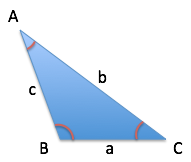
Ok, that’s a neat connection, and maybe we can prove it by drawing some right triangles (of course) and re-arranging terms.
But what does it mean?
Rather than the Law of Sines, think of the Law of Equal Perspectives:

Each angle & side can independently find the circle that wraps up the whole triangle. This connection lets us start with one angle and work out facts about the others.
Analogy: Kids Describing A Monster
I occasionally frighten the neighborhood children by unchaining the mutant gorilla in my front yard.
The kids run screaming, telling different stories of what they’ve seen:
“Alice claims the monster was 20 feet tall, but we all know she exaggerates by doubling. And Billy’s a bit of a crybaby, and said it was 30 feet tall. Charlie’s fairly no-nonsense and said the beast was exactly 10 feet high.”
If we know a kid’s “exaggeration factor” and the size they claim, we can deduce the true size of the monster. (Furious George has a name, you know.)
Even better, we can predict what other kids might have said: If Alice claimed it was 40 feet, what would Charlie have said?
Triangles And The Monster Circle
What do kids running from monsters have to do with triangles? Well, every triangle is trapped inside its own Monster Circle:

Whatever triangle we draw, there’s some circle trying to gobble it up (technically, “circumscribe it”). Try this page to explore an example on your own.
Now here’s the magic: just knowing a single angle and its corresponding side, we can figure out the Monster Circle.
Here’s how. Let’s say we have a triangle like this:

We don’t know anything except the angle A (call it 30 degrees) and the length of side a (call it an inch).
First off: is this the correct drawing of the triangle? Probably not! We don’t know the other sides, so this is equally valid:

It still has the same angle (A = 30 degrees) and the size of the base hasn’t changed (still one inch).
What if we start drawing more possibilities?

Whoa. From A‘s point of view all the possible triangles that have “A=30 degrees, a=1 inch” are on this circle. Whatever B and C end up being, they need to pick an option from this circle.
Similarly, we can argue this from the other perspectives:
- We can lock down angle B and side b, and trace out a circle of possibilities
- We can lock down angle C and side c, and trace out a circle of possibilities
This is the meaning of the Law of Sines: each angle unknowingly generates the same circle as the others.
(How do we prove, not just see that the possibilities lie on a circle? That’s the Inscribed Angle Theorem, for another day.)
Calculating The Actual Size
We’ve figured out that there is a Monster Circle, now let’s see how big it is. Um… how?
Remember, we can slide around the circle and keep A (30 degrees) and a (1 inch) the same. So let’s slide until we make a right triangle:

Ah! Now we can use sine. Remember that sine is the percentage height compared to the max possible. The max possible height is the full diameter (d) of the Monster Circle.
(Why is a 90-degree angle across from the full diameter? Draw a square inside the circle, touching the sides. It must be symmetric, the diagonals pass through the center along the diameter, and are opposite a 90-degree angle.)
With a little re-arranging, we get:

Using the same logic for the other sides, we get:

In a way, sin(A) is the “exaggeration factor” that converts the size the angle measured (a) to the full diameter (d). Each angle is a different kid, and some really misjudge the size of the full circle based on what they see. (90-degrees is right on target.)
Practice Problem
In our example above, A is 30 degrees and a is 1 inch.
We can calculate the diameter pretty fast. First, we get the sine:

That means our length a is 50% of the max height, so the full diameter must be 2 inches.
This isn’t enough to figure out the triangle by itself. Let’s say angle B comes along and says it is 45 degrees. How long is b?
Well,

which means that b is .707 of the max diameter. Therefore,

Previously, I would plug numbers into the Law of Sines formula and chug away algebraically. Now I can think in terms of the Monster Circle: “Ok, I have the max diameter. I take the sine, and get the fraction of the max diameter for that side.”
Most books write the formula with sin(A) in the numerator. It might read better “Sine A over A” but it distorts the conclusion that frac(a)(sin(A)) is the size of the circle.
Put the concept in your own words. The “Law of Sines” is a generic description of what’s in the formula, but the “Law of Equal Perspectives” explains what it means:
- All parts of the triangle have a perspective on the whole
- Sine is the “exaggeration factor” that scales up an individual side to the full diameter. (Sine is the percentage of the max possible, and we divide by it.)
Happy math.
Appendix: Obtuse Angles
Technically, because B is over 90 degrees, we can’t ever spin it and have either A or C be a right angle (if we could, the triangle would have over 180 degrees).

What to do? Realize the 180-degree complement of B (call it B·) acts like a stand-in on the other side:

B· has the same sine as B, which should make sense: they both point upwards along the same trajectory. To help us sleep better at night, we start with B· in the right-angle setup:

and get to the same conclusion as before. Phew.
However, the fact that B and B· can be swapped can lead to problems.
If I have a triangle where I know A (30 degrees) and a (1 inch), and then say b is 1.5 inches, what can you deduce?
The max diameter is 2 inches as before, so

Unfortunately, there are two angles with that sine value: a calculator says sin-1(.75) = 48 degrees, but 180 – 48 = 132 degrees would work too (more details).
Also, the triangle may not be possible given a hypothetical scenario. If I say b is 3 inches, you know something’s amiss. The max diameter was already calculated to be 2. Even a 90-degree angle, the best possible, could only have a side of 2 inches.
ADEPT Summary
| ADEPT Topic | Law of Sines |
|---|---|
| Analogy | Imagine kids describing the same monster with varying degrees of exaggeration. |
| Diagram |  |
| Example | Suppose A=30 and a=1 inch. Since sin(A) = 0.5, the Monster Circle is 1 / 0.5 = 2 inches wide. Given another angle, I can figure out the length of its side. If B = 45 degrees, then side b takes up sin(45) = .707 of the diameter, and is 1.414 inches. |
| Plain-English | Any angle + side can deduce the size of the wrapping circle. |
| Technical |  |


Leave a Reply
15 Comments on "Intuition For The Law Of Sines"
This is superb. With the usual proof I feel like someone with a better grasp of the ‘behind the scenes’ maths spotted a trick I wouldn’t find. With this, you can see the process of discovery. Somewhat different to a proof, but much more fit for purpose for the classroom. Thanks!
Thanks Anthony — exactly, I prefer to share the discovery process (“How did we get here?”) vs. the super-concise, cleaned-up proof that might not be very illuminating. Dropping right triangles, re-arranging, etc. doesn’t make sense without that “Aha! There’s a shared circle!”.
[…] Kalid Azad looks at a problem from several perspectives to gain Intuition For The Law Of Sines. […]
This is awesome. Could you use the same analysis/analogy to talk about cosine and tangent also?
Great question. For this scenario, sine is the only ratio that matches up with the fixed side. You could use trig identities like
and rewrite the Law of Sines as:
but it doesn’t have the right zing :). But there’s likely other geometric connections with the cosine or tangent that can be expressed more simply.
Kalid. This is AWESOME. Will definitely be using it in the classroom! (and thank you for improving MY understanding of the law of Sines : ). O
Hey Ollie! That’s awesome to hear. I’ve only recently figured out the meaning myself, really happy if it’s useful for your class :).
Excellent article ….. helped a lot in intuitive understanding.
kalid
thanks for another fantastic article . by your analogy the giant gorilla is tringle , angles are kids that see different versions (different sides) of gorilla , the angle of window and gorilla,s length never changes but why a circle circumscribe three windows , all possible triangle ????
hi khalid i studied all of your article i just want to say thanks. i can calculate the amount of mass sucked by a black hole from a donar star yet when i read about your articles about basic stuff like e and gradient i feel like i am ((understanding)) the concepts for the first time. i just want to say thanks for your great site.
since you are excited about understanding basic mathematics, i suggest you to read ((what is mathematics by richard courant ))
it is absolutely fantastic! You have helped lift up burden of memorization. I am increasingly getting contagious,no longer satisfy with mathematical expressions until I gain insight into the concept and its generalization (abstraction). I don’t have this behaviour before, it started after getting baptized into your site. I have read through the book suggested by Mahmud, “what is mathematics” by Richard Courant. Your site as equally drove me to read “Men of mathematics” by E.T. Bell. Thanks alot for showing the way.
This can be also be used to prove that sin(180-θ) = sinθ
Do each possible triangles within the circle have their perpendicular bisectors intersect at the center of the circle?
I do not get “they both point upwards along the same trajectory”. What is the same trajectory they both point to?
Alright. I think now I get it. You mean both $B$ and $B*$ point up to parts of the same circumcircle.