We’re taught that exponents are repeated multiplication. This is a good introduction, but it breaks down on 3^1.5 and the brain-twisting 0^0. How do you repeat zero zero times and get 1?
You can’t, not while exponents are repeated multiplication. Today our mental model is due for an upgrade.

Viewing arithmetic as transformations
Let’s step back — how do we learn arithmetic? We’re taught that numbers are counts of something (fingers), addition is combining counts (3 + 4 = 7) and multiplication is repeated addition (2 times 3 = 2 + 2 + 2 = 6).
This interpretation works for nice round numbers like 2 and 10. Strange concepts like -1 and sqrt(2) don’t work. Why?
Our model was incomplete. Numbers aren’t just a count; a better viewpoint is a position on a line. This position can be negative (-1), between other numbers (sqrt(2)), or in another dimension (i).
Arithmetic became a way to transform a number: Addition was sliding (+3 means slide 3 units to the right), and multiplication was scaling (times 3 means scale it up 3x).
So what are exponents?
Enter the Expand-o-tron(TM)
Let me introduce the Expand-o-tron 3000.

Yes, this device looks like a shoddy microwave — but instead of heating food, it grows numbers. Put a number in and a new one comes out. Here’s how:
- Start with 1.0
- Set the growth to the desired change after one second (2x, 3x, 10.3x)
- Set the time to the number of seconds
- Push the button
And shazam! The bell rings and we pull out our shiny new number. Suppose we want to change 1.0 into 9:
- Put 1.0 in the expand-o-tron
- Set the change for “3x” growth, and the time for 2 seconds
- Push the button
The number starts transforming as soon as we begin: We see 1.0, 1.1, 1.2… and just as finish the first second, we’re at 3.0. But it keeps going: 3.1, 3.5, 4.0, 6.0, 7.5. As just as we finish the 2nd second we’re at 9.0. Behold our shiny new number!
Mathematically, the expand-o-tron (exponent function) does this:

or

For example, 3^2 = 9/1. The base is the amount to grow each unit (3x), and the exponent is the amount of time (2). A formula like 2^n means “Use the expand-o-tron at 2x growth for n seconds”.
We always start with 1.0 in the expand-o-tron to see how it changes a single unit. If we want to see what would happen if we started with 3.0 in the expand-o-tron, we just scale up the final result. For example:
- “Start with 1 and double 3 times” means 1 * 2^3 = 1 * 2 * 2 * 2 = 8
- “Start with 3 and double 3 times” means 3 * 2^3 = 3 * 2 * 2 * 2 = 24
Whenever you see an plain exponent by itself (like 2^3), we’re starting with 1.0.
Understanding the Exponential Scaling Factor
When multiplying, we can just state the final scaling factor. Want it 8 times larger? Multiply by 8. Done.
Exponents are a bit… finicky:
You: I’d like to grow this number.
Expand-o-tron: Ok, stick it in.
You: How big will it get?
Expand-o-tron: Gee, I dunno. Let’s find out…
You: Find out? I was hoping you’d kn-
Expand-o-tron: Shh!!! It’s growing! It’s growing!
You: …
Expand-o-tron: It’s done! My masterpiece is alive!
You: Can I go now?
The expand-o-tron is indirect. Just looking at it, you’re not sure what it’ll do: What does 3^10 mean to you? How does it make you feel? Instead of a nice tidy scaling factor, exponents want us to feel, relive, even smell the growing process. Whatever you end with is your scaling factor.
It sounds roundabout and annoying. You know why? Most things in nature don’t know where they’ll end up!
Do you think bacteria plans on doubling every 14 hours? No — it just eats the moldy bread you forgot about in the fridge as fast as it can, and as it gets more it starts growing even faster. To predict the behavior, we use how fast they’re growing (current rate) and how long they’ll be changing (time) to figure out their final value.
The answer has to be worked out — exponents are a way of saying “Begin with these conditions, start changing, and see where you end up”. The expand-o-tron (or our calculator) does the work by crunching the numbers to get the final scaling factor. But someone has to do it.
Understanding Fractional Powers
Let’s see if the expand-o-tron can help us understand exponents. First up: what does at 2^1.5 mean?
It’s confusing when we think of repeated multiplication. But the expand-o-tron makes it simple: 1.5 is just the amount of time in the machine.
- 2^1 means 1 second in the machine (2x growth)
- 2^2 means 2 seconds in the machine (4x growth)
2^1.5 means 1.5 seconds in the machine, so somewhere between 2x and 4x growth (more later). The idea of “repeated counting” had us stuck using whole numbers, but fractional seconds are completely fine.
Multiplying exponents
What if we want to two growth cycles back-to-back? Let’s say we use the machine for 2 seconds, and then use it for 3 seconds at the exact same power:
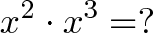
Think about your regular microwave — isn’t this the same as one continuous cycle of 5 seconds? It sure is. As long as the power setting (base) stayed the same, we can just add the time:

Again, the expand-o-tron gives us a scaling factor to change our number. To get the total effect from two consecutive uses, we just multiply the scaling factors together.
Square roots
Let’s keep going. Let’s say we’re at power level a and grow for 3 seconds:

Not too bad. Now what would growing for half that time look like? It’d be 1.5 seconds:

Now what would happen if we did that twice?


Looking at this equation, we see “partial growth” is the square root of full growth! If we divide the time in half we get the square root scaling factor. And if we divide the time in thirds?


And we get the cube root! For me, this is an intuitive reason why dividing the exponents gives roots: we split the time into equal amounts, so each “partial growth” period must have the same effect. If three identical effects are multiplied together, it means they’re each a cube root.
Negative exponents
Now we’re on a roll — what does a negative exponent mean? Negative seconds means going back in time! If going forward grows by a scaling factor, going backwards should shrink by it.
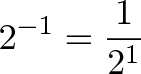
The sentence means “1 second ago, we were at half our current amount (1/2^1)”. In fact, this is a neat part of any exponential graph, like 2^x:

Pick a point like 3.5 seconds (2^3.5 = 11.3). One second in the future we’ll be at double our current amount (2^4.5 = 22.5). One second ago we were at half our amount (2^2.5 = 5.65).
This works for any number! Wherever 1 million is, we were at 500,000 one second before it. Try it below:
Taking the zeroth power
Now let’s try the tricky stuff: what does 3^0 mean? Well, we set the machine for 3x growth, and use it for… zero seconds. Zero seconds means we don’t even use the machine!
Our new and old values are the same (new = old), so the scaling factor is 1. Using 0 as the time (power) means there’s no change at all. The scaling factor is always 1.
Taking zero as a base
How do we interpret 0^x? Well, our growth amount is “0x” — after a second, the expand-o-tron obliterates the number and turns it to zero. But if we’ve obliterated the number after 1 second, it really means any amount of time will destroy the number:
0^(1/n) = nth root of 0^1 = nth root of 0 = 0
No matter the tiny power we raise it to, it will be some root of 0.
Zero to the zeroth power
At last, the dreaded 0^0. What does it mean?
The expand-o-tron to the rescue: 0^0 means a 0x growth for 0 seconds!
Although we planned on obliterating the number, we never used the machine. No usage means new = old, and the scaling factor is 1. 0^0 = 1 * 0^0 = 1 * 1 = 1 — it doesn’t change our original number. Mystery solved!
(For the math geeks: Defining 0^0 as 1 makes many theorems work smoothly. In reality, 0^0 depends on the scenario (continuous or discrete) and is under debate. The microwave analogy isn’t about rigor — it helps me see why it could be 1, in a way that “repeated counting” does not.)
Advanced: Repeated Exponents (a to the b to the c)
Repeated exponents are tricky. What does

mean? It’s “repeated multiplication, repeated” — another way of saying “do that exponent thing once, and do it again”. Let’s dissect it:

- First, I want to grow by doubling each second: do that for 3 seconds (2^3)
- Then, whatever my number is (8x), I want to grow by that new amount for 4 seconds (8^4)
The first exponent (^3) just knows to take “2″ and grow it by itself 3 times. The next exponent (^4) just knows to take the previous amount (8) and grow it by itself 4 times. Each time unit in “Phase II” is the same as repeating all of Phase I:

This is where the repeated counting interpretation helps get our bearings. But then we bring out the expand-o-tron: we grow for 3 seconds in Phase I, and redo that for 4 more seconds. It works for fractional powers — for example,
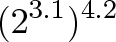
means “Grow for 3.1 seconds, and use that new growth rate for 4.2 seconds”. We can smush together the time (3.1 × 4.2) like this:

It’s different, so try some examples:
- (2^1)^x means “Grow at 2 for 1 second, and ‘do that growth’ for x more seconds”.
- 7 = (7^0.5)^2 means “We can jump to 7 all at once. Or, we can plan on growing to 7 but only use half the time (sqrt(7)). But we can do that process for 2 seconds, which gives us the full amount (sqrt(7) squared = 7).”
We’re like kids learning that 3 times 7 = 7 times 3. (Or that a% of b = b% of a — it’s true!).
Advanced: Rewriting Exponents For The Grower
The expand-o-tron is a bit strange: numbers start growing the instant they’re inside, but we specify the desired growth at the end of each second.
We say we want 2x growth at the end of the first second. But how do we know what rate to start off with? How fast should we be growing at 0.5 seconds? It can’t be the full amount, or else we’ll overshoot our goal as our interest compounds.
Here’s the key: Growth curves written like 2^x are from the observer’s viewpoint, not the grower.
The value “2″ is measured at the end of the interval and we work backwards to create the exponent. This is convenient for us, but not the growing quantity — bacteria, radioactive elements and money don’t care about lining up with our ending intervals!
No, these critters know their current, instantaneous growth rate, and don’t try to line it up with our boundaries. It’s just like understanding radians vs. degrees — radians are “natural” because they are measured from the mover’s viewpoint.
To get into the grower’s viewpoint, we use the magical number e. There’s much more to say, but we can convert any “observer-focused” formula like 2^x into a “grower-focused” one:

In this case, ln(2) = .693 = 69.3% is the instantaneous growth rate needed to look like 2^x to an observer. When you enter “2x growth at the end of each period”, the expand-o-tron knows to grow the number at a rate of 69.3%.
We’ll save these details for another day — just remember the difference between the grower’s instantaneous growth rate (which the bacteria controls) and the observer’s chart that’s measured at the end of each interval. Underneath it all, every exponential curve is a scaled version of e^x:

Every exponent is a variation of e, just like every number is a scaled version of 1.
Why use this analogy?
Does the expand-o-tron exist? Do numbers really gather up in a line? Nope — they’re ways of looking at the world.
The expand-o-tron removes the mental hiccups when seeing 2^1.5 or even 0^0: it’s just 0x growth for 0 seconds, which doesn’t change the number. Everything from slide rules to Euler’s formula begins to click once we recognize the core theme of growth — even beasts like i^i can be tamed.
Friends don’t let friends think of exponents as repeated multiplication. Happy math.
83 thoughts on “Understanding Exponents (Why does 0^0 = 1?)”
what about irrational exponents?
Great question. At an intuitive level, I see an irrational exponent as a different amount of time, in between known rational numbers, and ultimately approximated by a rational number.
When we write “3 * sqrt(2) = 4.24″ we “know” that we’re really taking an approximation, and that 3 * sqrt(2) goes on forever.
Similarly, “3^sqrt(2) = 4.72″ is just an approximation and the real decimal result goes on forever.
There is a small problem with your 2^3^4 = 2^12 example: exponentiation is (usually?) understood to be right-associative (ie top-down), therefore: 2^3^4 = 2^(3^4) = 2^81
I’m pretty sure your “repeated exponentiation” section is not quite right – when there are repeated exponents like that, in the standard notation, we work from right-to-left. Thus, 2^3^4 means 2^(3^4) which is neither 2^(3*4) nor 2^(4^3)…
2^3^4 is in fact 2417851639229258349412352 while 2^(3*4) is 4096 and even 2^(4^3) is only 18446744073709551616.
@Steven, sabik: Thanks for the comments! My mistake, I didn’t realize it was right-associative. I’ll add in the parentheses to make this more clear.
Amazing work once more Kalid. You make learning fun again.
@Paul: Thank you — I find math enjoyable when I’m working with analogies that make sense to me.
Forgive me if I ask a dumb question. It’s been awhile since I’ve been in any sort of math class.
If I put 3 in the expand-o-tron for 0 seconds, I get 3 because there was no time expanding. If I put it in for 1 second, shouldn’t I get 9 since it spent one second expanding? But I though 3^2 was 9. Maybe I’m reading it wrong.
@Todd: Great question — I should make the operation more clear. Normally, we start off with 1.0 and see how it grows, so with a setting of 3x power for 2.0 seconds, we’d get 1.0 * 3^2.0 = 9.0.
If we started with 3.0 and ran it for 1 second, we’d get: 3.0 * 3.0^1 = 9.0.
Most of the time we want to see what happens to a “unit” amount.
It’s great to see another article. As with many of your articles, it helped me realize that I have not understood something I’ve been using for so long.
About evaluating i^i: it appears that I have the problem half-way done.
So, I put 1 in with i times growth for i seconds. Meaning, each second I rotate 1 counter-clockwise 90 degrees in the complex plane. However, how do I look at i seconds intuitively and thus complete the computation?
Nobody: Unfortunately the “^i” operation is a little confusing. You should start by understanding e^i and e^(a*i) where a is a real number. Then remember that x = e^(log x), and i = e^(log i)
so i^i = (e^(log i))^i = e^(i*log(i))
Analogies only go so far!
@Nobody: Great question! (Tomer, thanks for the details).
It’s hard to think about “i” seconds, just like it’s hard to think about -1 seconds — it’s easier to think about what the transformation does. Negative numbers flip the direction, and i brings items into the complex plane. When you take i as an exponent, it changes the direction in which you are growing (instead of growing in the real dimension, you start growing in the imaginary dimension). There’s a lot more to say, but that’s the intuitive approach I take with it
.
I really appreciated this article, and just want to suggest that you make it more clear at the top that you ALWAYS start with one.
I really struggled with your explanation of 0^0 until I got down into the comments and saw that that was the case. Thanks.
@Andrew: Thanks for the comment! I’ll make that more clear, really appreciate the feedback.
When you take i as an exponent, it changes the direction in which you are growing (instead of growing in the real dimension, you start growing in the imaginary dimension).
Umm, what? When you have i as an exponent, you go in circles, getting neither larger nor smaller.
Is there a Nobel prize for explaining math
@Sabik: It’s tricky — consider i^i. It “seems” like it should stay on the unit circle (that’s where it started, magnitude of 1), but it doesn’t. I should be more clear: i as an exponent changes your _instantaneous_ rate of change by 90 degrees.
@NF: Heh, I think the rumor is Alfred Nobel hated mathematicians so there’s no prize for pure math
.
Thanks for the great visualization of how exponents work. I’m a huge fan of your articles.
The step I can’t intuitively grasp is in the multiplying exponents section: “What if we want to two growth cycles back-to-back? Let’s say we use the machine for 2 seconds, and then use it for 3 seconds at the exact same power”.
To me, if I put something in the microwave for 2 seconds, then again for 3 seconds, intuitively this would be like adding together two doses of microwaving:
x^2 + x^3 instead of x^2 * x^3 (i.e. running the microwave for 2 min, and then again for 3 min is 2 + 3 = 5 min, not 2 * 3)
I’m not sure how to picture what x^2 * x^3 means in microwave terms…maybe something like increasing the wattage by 3 times.
Anyway, keep the great articles coming!
yet another “a-ha” moment when reading this…=)
This certainly explains exponents better then I’ve ever encountered explanations before.
(In essence it doesn’t differ much from the repeated multiplication explanation but introducing “time” in the Expand-o-tron 3000 simplifies imagining non-integer powers and their effect on outcomes.)
@CL: Great question! I had the same thoughts myself, I may need to go back and make that section more clear.
Exponents act like multiplication, but the amount you multiply by has 2 inputs: growth rate and time (vs regular multiplication, which is just growth rate).
You can combine regular multiplication: Multiplying by 3, and then multiplying by 15 is the same as multiplying by 15 (3×5) all at once.
With exponents, using x^2 and then x^3 is the same as multiplying by x^(2+3) = x^5 all at once.
The tricky thing is to remember that the time is being combined, but it’s happening in the exponent you raise it to.
Hope this helps!
@mike: Glad it happened
@Theo: Thanks! That was the goal — to help expand our insight so things like fractional (or even negative) exponents can make sense. Negative counting is confounding.
Thank you Kalid. Another reminder that math concepts are easy to teach and very hard to explain. Your analogies and patient decomposition of the problems are wonderful to read.
Excellent article! You are good. You are on my RSS feed.
@Stuart: You’re welcome — I agree, I think the difficulties in understanding math is more to due with complex explanations, not complex ideas. Thanks for the kind words
.
@CJ: Glad you liked it!
Here’s my own little explanation for powers to the i, though it’s not nearly as well-written as yours, of course :3
Let’s start with this famous equation: e^i*pi=-1
It’s called Euler’s Identity, and is presented by purists as e^i*pi+1=0. We can prove it’s true, but it doesn’t seem to make any sense. After all, what the hell do i, e, and pi have to do with each other? Let’s see if we can boil this down a bit.
For this example, we’ll work with 2^i, which is equal to about 0.769+0.639i, if you plug it into a calculator.
First, let’s remember that, as Kalid put it above, we can turn an exponent into a grower-oriented one by changing it. So 2^i = e^ln(2)i.
Euler’s formula tells us that e^xi = cos(x)+sin(x)i
If we plug in ln(2) to this, we get cos(ln(2))+sin(ln(2))i, which is about 0.769+0.639i, the answer the calculator gave us before!
However, this doesn’t really help us much unless we already have a really good understanding, intuitive of what Cos and Sin are (and I’m not going to explain all of that here). Instead, we can look at this another way.
e^x is another way of saying e^(rate*time), correct? Well, rather than say we grow for i seconds, how about we use i as our rate of growth, since switching the order in which we multiple doesn’t change the result?
Multiplying by i is simply doing a 90 degree turn. So as Kalid previously said, we just start at 1 and start growing in a circle. So when we say “we grow for ln(2) seconds”, we mean traveling around the unit circle on the complex plane a length of ln(2) radians! (Read Kalid’s article on radians for more info) If you already know what Cos and Sin are, this should be making sense by now. We can check our work with this as well.
The circumference of a circle is 2pir, where r is the radius. Since we start at 1 before we start growing in a circle, the radius is 1, which means the circumference is 2pi. This means moving ln(2) radians around the circle is about the same as rotating 39 degrees.
Let’s return to Euler’s Identity. With what we’ve just established above, e^pi*i means moving pi radians around a unit circle with a radius of 1, right? Moving pi radians around the circle is the same as doing a 180 degree turn, since it’s half the circumference of the whole thing (2pi), right? Which means we go from 1 to -1.
Which brings us to e^i*pi=-1.
Hope this cleared up some confusion…
I would LOVE to hear Kalin do an article on Euler’s Identity or really on Euler’s formula. I have forever wanted to understand the relationship between e, i, pi, and rotational position. I appreciate your comments Apple but I’m just not quite there yet.
It would also give Kalin an opportunity to bring together many of his articles into one giant mathematical relationship that has many practical applications.
So here is the heart of all my Euler’s Identity questions:
Lets just look at e^pi for a moment:
1*e^pi means you start at one and then move in the positive direction at an increasing “unit rate” for pi seconds. You will end up at a seemingly arbitrary location (23.1407).
However e^i*pi means you start at 1 and ROTATE at an increasing “unit rate” for pi seconds. You end up making exactly 1/2 circle! This means there is some relationship between e and pi. 2^i*pi or 5^i*pi will put you at some random spot on the circle, but a growth rate of e takes you exactly pi radians in pi seconds. Doesn’t that seem strange?
@Apples, Jeff: Thank you both for the wonderful comments! Yes, I’d love to do a follow-up on Euler’s formula, and seeing i as “rotating” your rate of growth is how I’m learning to make intuitive sense of it
.
Thanks Kalin I am looking forward to it! At the very least can you help me understand this one point? I feel like the answer is staring me right in the face but I can’t wrap my mind around it.
1*e^pi means you start at 1, “grow” by a factor of e for pi seconds and you end up at 23.141.
Now if we throw a little “i” in the mix then it gives us 1*e^(i*pi). If this means our growth takes a “left turn” so to speak and we rotate our growth, then why don’t we travel 23.141 radians in pi seconds?
Thanks again Kalin for all your work.
I find thinking about exponents as “how many patterns can I make with some objects if the objects come in x varieties of color and I have y objects” for x^y.
For instance, let’s say we’re lining up a bunch of eggs.
Our eggs come in 2 colors: brown and white.
x represents the variety. x = 2.
y represents the number of objects (eggs in this case). y = 3
If we line up 3 eggs in a row, how many different patterns could we make with white eggs and brown eggs?
white, white, white. white, white, brown. white, brown, white. white, brown, brown. brown, white, white. brown, white, brown. brown, brown, white. brown, brown, brown.
That’s 8 patterns. 2^3 = 8.
If we had one egg, we’d only have to possible patterns: white. brown. 2^1 = 2.
If we didn’t have any eggs, we’d have exactly one pattern: no eggs. (the one and only pattern is the absence of eggs).
If we had -1 eggs, then how many patterns would we have? So -1 eggs means we take one egg away from however many we have. If we started out with 10 eggs, we have 1024 patterns (2^10). If we took one egg away, we’d have 512 patterns (2^9). So taking one egg away gives us exactly half as many eggs if we hadn’t taken that last egg away. 2^-1 = 0.5.
Now lets say we have (2^3)^4.
Inside the parenthesis, we have 3 eggs, each with 2 possible colors. We have 8 possible patterns. If we laid 4 groups of eggs side by side, how many patterns could we have? Now we will use a group of 3 eggs as our new object instead of using just using one egg as our object.
We know each group of 3 eggs has 8 patterns (2^3). So each group of 3 eggs has 8 possible variations. So our new x is 8. Our new y is 4.
(2^3)^4 = 8^4.
But instead of thinking in terms of groups, we can just count the number of eggs. If we have 4 groups of 3 eggs, then we have 12 eggs in a row.
Each egg has two colors. Thus, (2^3)^4 = 2^12.
I find this pretty intuitive. What do you think?
@Jeff: Great question. I’d like to do a more complete follow-up on Euler’s theorem, but consider this:
e^(i*pi) means we are growing at 100% (rotated) for pi seconds. Growing at a 90 degree angle does not change your *magnitude*, it only changes your *direction*. So we always end up growing at 100% (without the compounding interest) and end up going only 100*pi or 3.14 radians around the circle. We aren’t “growing” in the correct direction to increase speed; instead, we are growing to change our velocity.
@Jeremy: Thanks for the explanation! I think the set interpretation has some merit for whole numbers, but is too far removed from the traditional “repeated multiplication” explanation to help with repeated fractions (what does 0.5^2.3 mean in regard to sets with a number of elements?).
But, this may be because I’m not well-versed with it (and I think that may be the ‘modern’ definition of exponents). I always welcome other mental models as they may map better to different problems
.
Don’t get a big head (-: but I think you would make a very gifted math teacher – putting many so called “math teachers” in the US to shame, shame, shame.
Will you be writing any books?
If you have something like SQRT(8) + SQRT(2), the numbers underneath the square roots are not the same, but you can combine the terms. EXPLAIN?
Dear Sir,
I am sorry that someone had not brought this to your attention sooner, but you are plain wrong. 0^0 is an indeterminate form. Defining 0^0 = 1 is not only misleading, it is a mistake so deep that when mathematicians finally realized how much damage it was causing, our understanding of mathematics was greatly changed for the better.
Consider the following.
Choose ANY positive number ‘c,’ and for x>0, let
f(x) = x^(-c/log(x))
Naively “plugging in” x=0 looks like we should have
0^(-c/(-infinity)) = 0^0
But we need to be more careful. Taking the log base e (or “ln” if you like) of f(x) and using properties of logs gives
log(f(x)) = (-c/log x)*(log x) =-c
so that f(x) –> e^(-c) as x –> 0 (from the right). A similar argument works for negative c. The point is, c can be any number you want. Thus,
0^0 = any number you want.
Sometimes defining something which does not have a definition to begin with is OK, as in the case of a PARTICULAR function, such as g(x) = (x-1)/(x^2-1), which has a singularity at x=1. It is perfectly fine to let g(x) = 1/2 (or anything else, if you don’t mind violating continuity). However, to define 0/0, 0^0, 1^infinity, infinity – infinity, or any other indeterminate form will lead to many, many problems in mathematics. Historically, this has happened quite a lot, and it took us mathematicians quite awhile to realize the source of the problem, which was that people kept trying to define these things.
I urge you to please correct your article, and publish your mistake.
@Anon: Thanks for the details, I’ve updated the article to be more clear about this point.
It seems the debate about 0^0 is still not complete; the goal for the article is to present an intuitive (non-rigorous) interpretation which explains why 0^0 = 1 “makes sense” in many circumstances.
Typo: At the start you describe addition as “combing numbers”, you meant “combining”. Great site! Thank you so much- your take on maths is so intuitive and interesting.
Also, the URL “http://betterexplained.com/articles/intuitive-guide-to-angles-degrees-and-radians/” is not an actual link (Under subheading “Advanced: Rewriting Exponents For The Grower”). Probably because of the preceding colon.
Happy Math!
@Tim: Glad you enjoyed it, and thanks for the fixes! I just fixed them now.
That’s a great explanation.
But this make me wonder of how other people brain operate. For me most of the time I understand math as rule of the game and I don’t need interpretation to digest this. How about others?
Have to re-read this but when i entered 0^0 into my calculator and indeed “1″ came-up i know i mis-comprehended a critical point in high school math class…
Excellent explanation. I teach a high school Algebra 2/Trig course and I will definitely be using this approach when presenting exponents to my students this fall.
@watchmath: Thanks — I guess it depends on your personality. I need math to make sense at a deep intuitive level, it just doesn’t feel right if the rules seem “arbitrary” to me
.
@x: Yes, I think many calculators may be programmed with that result.
@DJ: Great, glad it was useful!
thios is a realy good website about exponents
@billy: Thanks, glad it helped!
This material is incredibly easy to digest and apply. Do you have any material on logarithms in general?
Here is a possibly more simple understanding of why 0^0 = 1 (depending on your point of view).
Take a total map to be a function that is defined on every point in the domain.
Then,
We can think of n^m as the number of total maps (ahem functions) from the m element set to the n element set. To see this draw 2 circles, but n dots in one and m dots in the other (it is advisable to pick small n and m!). Then very methodically draw all possible total maps. Maybe make a tree.
Now, the empty set is a subset of every set, thus there is always a map from the empty set to any set. Moreover, this map is unique. It follows that there is a map from the empty set to the empty set, and this map is unique. Then the number of maps from the 0 element set to the 0 element set is 1. Thus
0^0 = 1.
@Jonathan: Thanks for the comment! Yes, that’s another, more detailed/combinatorial way to think about it. Depending on the context of the problem, growth or combinations may make sense. Often times people see e^x and are trying to figure out the meaning of a 0 exponent; other times, you have n^m (n choices, m decision) and this interpretation helps too.
Hi.. Is your book available anywhere in India? Thanks.
@Lampan: Hi, you can get the ebook anywhere that supports PayPal, Google Checkout, or credit card. Thanks!
Hi Kalid,
My math teacher brough up the 0!=1 parodox today but wasn’t able to explain it so I thought I’d research it myself. It makes sense to me now except for I cant see why the expand-o-meter always starts out at one. If I accept that fact everything else is clear I just dont see why it should be and one. Thanks!
@Alley: Great question! Here’s how I see it — exponential growth is about, well, growing stuff with multiplication! So we need to start with something to grow and compare. The reference point is 1, our original amount, and we see what we transform it into.
If we don’t do any changes, then our input = output, so we finish with 1.
Another way to think about it “times 3″ really means “1 times 3″, that is, start with your original amount and then scale it up. We often drop the implicit “1″, but when doing exponents it can help to explicitly talk about it. Hope this helps!
What will happen if I place a base number of 1 to the expandotron, set it to zero growth and turn back time for 1 second?
@Lee: Let me see if I get the question. With the base number 1 in the expandotron, we’re saying that after a unit of time, we have the same result. In fact, with 1 as the base, any amount of time will have the same result (no change). If we use imaginary numbers, strange things can occur, but that’s another article
.
Turning back time for 1 second is asking “1 second ago, given this rate of growth, what was our number?”. Since the rate of growth doesn’t have any effect, the number is the same as the original. When you aren’t changing, 1 second ago you are still at your present amount.
In math terms, 1^x = 1 for any real x. Hope this helps!
Will you see:
30. Asked Is 0 to the power of 0 equals 0 a final answer 27 Oct 2010 05:54
31. First answer to Is 0 to the power of 0 equals 0 a final answer 31 Oct 2010 12:29
on WikiAnswer,
as my comment on your proof 0^0 = 1.
Thanks that really help though i still have a question in mind
by the way i do A-Level maths curently
i saw in a cartoon an equation that read
46x*87y over the sq root of 90?
i mean is that even close to possible cos i know you said that ‘once you work out the impossible, anything can happen’.
0 to the power 0 doesnt equal anything
it equals infinite or negative infnite
i will explain everything
if you have zero, its a value, aint positive nd aint negative
when you power that ‘nothing’ by ‘nothing’, as a result, you dont actually get a number
0^0 does not equal 1 or 0
it equals infinity OR negative infinity
0^0 wont equal 1, i can believe that
when 2 rules clash, neither would be valid
e.g. if you type 0^0, the calculator would be saying ‘syntax error’ ( if you have a scientific calc) when what its trying to say is that it cant have an answer because well the only time you can have 2 or 4 answers is in quadratic or sim quad equ
and calc cannot display 2 answers because that we cannot then perceive a calc as a correct instrument of mathematics.
and by the way jjeigers, infinity isnt a number
its a CONCEPT, its a way that we think of number
or bacially a limitless thing. It cease to exist as a number. However, google and googleplex are, google is 10^100 and google plex is 10^google(this is a huge number. probably close to infinity? no.)
0^0 is one of those questions that prove we haven’t found out everything about maths. we may know a heck of a lot, but not everything
0^0=1 by
=(1-1)^0
=(i-0*1) {by applying binomial theorem}
=(1-0)
=1
hence proved
0^0=1 by
=(1-1)^0
=(i-0*1) {by applying binomial theorem}
=(1-0)
=1
hence proved
is it right?
Hi. Just discovered your website; great stuff!
With all due respect, I don’t think you gave fractional exponents enough attention.
First of all you state that
2^2 means 2 seconds in the machine (4x growth).
According to your explanation, 2^2 should really mean a 2x growth followed by another 2x growth; 4^1 should mean a single 4x growth. But if this is the case, I have no understanding of what 2^(1/2) means: what does half of a 2x growth mean? It obviously can’t mean that the original amount only has a .5x growth because in that case 2^(1/2) would have to be 1.5 when, in fact, it is irrational.
Again, I think your approach to this topic and to knowledge, in general, is awesome, but I wish you can elaborate further on this.
Thank you.
@Befuddled: Great question, happy to help clarify. I think the key is realizing we’re talking about continuous growth, which happens instant by instant (see the article on e: http://betterexplained.com/articles/an-intuitive-guide-to-exponential-functions-e/).
When we see “2^2″ and think “2x growth for 2 seconds” we need to clarify what “2x” really means. Sure, we grew from 1 to 2 during the span of 1 second. But how did we get there? Did all our growth happen in the final .0001 second? Probably not.
Halfway through, we had *some* amount of growth. But was it exactly half? Let’s see. If at 0.5 seconds we are at 1.5x our initial amount, it means
* From 0.0 to 0.5 we started at 1 and grew .5, ending at 1.5
* From 0.5 to 1.0 we started at 1.5 and grew .5, ending at 2.0
Hrm — there’s a problem here. Our starting amount was *different* for each interval yet we grew the same amount! Something’s not right.
e to the rescue! It lets us figure out our *instantaneous growth rates* which work for any starting amount. In fact, the natural log (ln) can tell us our instant growth rate needed to get to any growth amount.
So, we can say ln(2) ~ .693 which means we need to grow instantly at about 69.3%, for one second, to end up at 2.0 at the end of the second.
We’re partway there — what does 2^(1/2) mean? Well, it says “Grow at that instant rate of 69.3%, but only for half a second”. This is where e comes in — it lets us figure out the net effect. So we can say
e^(.693 * 1/2) ~ 1.414…
which means “If you grow at 69.3% growth for only half a second, you will end up at 1.414…”, which is the square root of 2!
The key points:
* 2x means “continuous growth”, so halfway through (in time) doesn’t mean halfway through (in amount grown)
* We can use e and natural log (ln) to figure out where we are after x seconds of growth, or what our amount is after exactly half a second
Hope this helps! Feel free to ask any questions if this didn’t make sense.
Another example: Let’s say you are growing at 4x each second. You start off at 1.0, and after 2 seconds you are at 4^2 = 16. What is your amount after 1 second of growth? Should it be 8? (This is a similar question to what you asked — but instead of going in-between 1 and 2 for 1.5 seconds, we’re going in-between 1 and 3 to get to 2 seconds. Either way, the halfway amount in time is not the halfway amount in growth. The halfway amount in time is actually the square root of the final amount, since repeating that growth (multiplying) again gives the full amount).
Finally finished the e and ln articles and just came back to read your response. Beautiful and satisfying response. Thank you!
@Befuddled: Awesome, glad it helped!
The scenario gets more interesting when you consider 4 doors (1 car, 3 goats). In that situation contestant A has 1/4 chance of winning.
Now consider contestant B. He cannot choose the door that contestant B picked. But he can only win if contestant A didn’t pick the car, which gives him 3 winning scenarios. But contestant B has 9 scenarios in which he can loose. So 3 winning scenarios out of 12 possible scenarios gives a chance of 3/12 = 1/4 There is no change!
Now consider the switching scenario. Contestant A picked a door at random. The remaining 3 doors form a set. When Monty open a door showing a goat, he filters that set. The set represents a total amount of chance = 3/4. Because Monty opened one door, that amount of chance gets split between the 2 remaining doors = 3/4 * 1/2 = 3/8.
Switching from the original door with chance = 1/4, to one of the doors from the filtered set improves your chances from 1/4 to 3/8
Thanks.
@Alex: Whoa, really neat scenario — I hadn’t thought of the 2-person game!
Just discovered your site. As a math teaching specialist I appreciate the visual model. Niggling over precise math concepts, though interesting and entertaining, does, in my estimation undermines the purpose of models in math (at least from a teaching perspective). This model makes fuzzy concepts much easier to handle and explain. I am curious; it seems that most (all?) responders to this blog have a substantial understanding of mathematics. Has anyone attempted to use this model to explain the concepts of exponents to learners new to this area of math? I would be greatly interested in its efficacy.
Now for my niggle:)
On Jan 10 Don was responding to the previous comment and, correctly, stating that infinity was NOT a number. However, his example of google is not a number either, it is an internet company (corporation). The number he was looking for was googol (10^100), which is stil nowhere near infinity!
@RB: Thanks for the note! I’m actually not sure how effective this analogy has been in the classroom, but I know it’s helped un-fuddle exponents for me
. Good point re: google vs. googol, we’ve forgotten the spelling of the original word!
Hi,isn’t 0^0 not defined?. i’m confused. How come when i put 0^0 in my calculator,i get “Math error” instead of 1?
@Nkateko: Technically, 0^0 is indeterminate (i.e. has no singular value, it can equal different things depending on how you compute it) but many mathematicians choose to define it to be 1 because it makes many equations much more convenient. The calculator may not have this assumption programmed in however.
thanks EXPAND-A-TRON! you really worked!!;-)
@fayal: Thanks, I love the expand-o-tron!
I found this by googling what I thought everyone would want to know, and as usual a question that keeps me up nights isn’t even a part of the known universe…here it is. I had googled “why the exponent goes down one” and I found this excellent intuition which I plan to study more carefully. My application is the power rule of differentiation, used to find the derivative. They say that the power rule is just a trick, I say if it is equal to something and the something it is equal to is differentiation, then the power rule is not just a trick but an identity of the facts behind differentiation. If that is so, then there should be an intuition behind the power rule that gives an explanation of why, for example, 2x^3 diff-ates to 6^2. I don’t believe in coincidences. Is there a way you can use the expandotron to develop an intuition for the power rule that reveals the heart of differentiation to a beginner like me? I believe it involves considering dx the UNIT, and dy/dx the RATIO or proportionality factor, and y the function or dependent variable, and of course x as the independent variable. My guess about the heart of calculus is that it is the linear equation but I have to go over this page and try to see what I think you would say and see if we come up with the same answers. Thanks!
So when you say that the scaling factor is always 1, we can also think of this as the original number we are putting into the expand-o-tron that will be affected by both the growth and the duration. This is why when the exponent is 0(the duration=0) and no changes are made, we get an answer of 1?
@Scott: Thanks for the suggestion, I’d like to do an article on the power rule. The main intuition for 2x^3 going to 6x^2 is the number of combinations that arise.
Intuitively, think of a cube (3 by 3 by 3). When you make it bigger in all dimensions by 1 ( to a 4 by 4 by 4) you can consider this “adding a layer” to the 3 outer sides. That’s why x^3 => 3x^2. There is a tiny piece in the corner which is “ignored” in the Calculus sense (it becomes negligible as your changes get smaller).
For x^2 => 2x, it’s similar (to make a square larger, add a strip to 2 sides). I’d like to write more about this!
@Laura: Yes, I always consider 1.0 going into the expand-o-tron to start. I see exponents as a “scaling factor” that have to operate on something else. So even
3^2
can be considered
1 * 3^2
That is, we start with something (1) and make it 3x bigger for “2 seconds”. When the duration is 0, it’s like we never used the machine, and we get the original amount out (scaling factor of 1). That’s the intuition that clicks for me
.
From what I understood from this article, and correct me if I am wrong, when you calculate 0^0 and get a result of 1, the “1″ is actually the scale factor, or the number by which the 0 is multiplied. so basically you multiply 0 by 1, and still get 0…. so why is it that you would write 1 as the answer, and not just the answer itself of 0?
@Patrick: Great question, something I need to clarify. My analogy for exponents is:
original * growth^duration = new
so if we have 0^0 we get
original * 0^0 = new
original * 1 = new
original = new
I.e., we didn’t change at all. The scale factor is multiplied into the original amount, so 0^0 = 1 is another way of saying “we didn’t change at all”.
For something like 3^2, we write
original * 3^2 = new
original * 9 = new
which is to say, our new value will be 9x our original one. Normally we don’t think about the original amount and write “3^2 = 9″ but then it becomes harder to see why 3^0 = 1. So in my head, I even see 3^2 as “1 * 3^2″, i.e. we have a starting point and begin to change it.
Hi Kalid,
Do you have any insightful ways of thinking about why (a^x).(b^x)=(ab)^x ? I can see how to extend from natural numbers etc but can’t think of anything that makes sense on a deeper level. I thought about picturing the whole surface z=x^y (which I think is helpful for example for linking the generally rather separated school topics of indices and surds) but seemed to get caught up in rather a lot of dimensions if trying then to take a product between z=x^y (for a^x) and z1=x1^y1 (for b^x). So basically confusion… Hope what I’m trying to say makes sense…
Thank you (and thank you also for all the fantastic material on this site!)
Tom
@Tom: Great question, and thanks for the kind words! For
(a^x) * (b^x) = (ab)^x
I’d think about it like this: Imagine 2 expand-o-trons going at the same time, side by side:
* The first takes x = 3 seconds to turn 1 into a^3
* The second takes x = 3 seconds to turn 1 into b^3
Ok. Now, when we write (a^3) * (b^3) I think “I want to apply 2 separate growth processes, one after another”.
What if we wanted to apply them at the same time? What would the equivalent be? Well, every second you’d have to grow by a AND b, i.e a*b. (Growing by 2x and 5x simultaneously would be growing by 10x).
So, the result is (ab)^3 => each second you grow “ab” which takes each individual growth rate into account. Hope this helps!
amazing explanation