An Intuitive Guide To Exponential Functions & E
e has always bothered me — not the letter, but the mathematical constant. What does it really mean?
Math books and even my beloved wikipedia describe e using obtuse jargon:
The mathematical constant e is the base of the natural logarithm.
And when you look up natural logarithm you get:
The natural logarithm, formerly known as the hyperbolic logarithm, is the logarithm to the base e, where e is an irrational constant approximately equal to 2.718281828459.
Nice circular reference there. It’s like a dictionary that defines labyrinthine with Byzantine: it’s correct but not helpful. What’s wrong with everyday words like “complicated”?
I’m not picking on wikipedia — many math explanations are dry and formal in their quest for “rigor”. But this doesn’t help beginners trying to get a handle on a subject (and we were all a beginner at one point).
No more! Today I’m sharing my intuitive, high-level insights about what e is and why it rocks. Save your “rigorous” math book for another time.
e is NOT Just a Number
Describing e as “a constant approximately 2.71828…” is like calling pi “an irrational number, approximately equal to 3.1415…”. Sure, it’s true, but you completely missed the point.
Pi is the ratio between circumference and diameter shared by all circles. It is a fundamental ratio inherent in all circles and therefore impacts any calculation of circumference, area, volume, and surface area for circles, spheres, cylinders, and so on. Pi is important and shows all circles are related, not to mention the trigonometric functions derived from circles (sin, cos, tan).
e is the base amount of growth shared by all continually growing processes. e lets you take a simple growth rate (where all change happens at the end of the year) and find the impact of compound, continuous growth, where every nanosecond (or faster) you are growing just a little bit.
e shows up whenever systems grow exponentially and continuously: population, radioactive decay, interest calculations, and more. Even jagged systems that don’t grow smoothly can be approximated by e.
Just like every number can be considered a “scaled” version of 1 (the base unit), every circle can be considered a “scaled” version of the unit circle (radius 1), and every rate of growth can be considered a “scaled” version of e (the “unit” rate of growth).
So e is not an obscure, seemingly random number. e represents the idea that all continually growing systems are scaled versions of a common rate.
Understanding Exponential Growth
Let start by looking at a basic system that doubles after an amount of time. For example,
- Bacteria can split and “doubles” every 24 hours
- We get twice as many noodles when we fold them in half.
- Your money doubles every year if you get 100% return (lucky!)
And it looks like this:

Splitting in two or doubling is a very common progression. Sure, we can triple or quadruple, but doubling is convenient, so hang with me here.
Mathematically, if we have x splits then we get 2^x times more “stuff” than when we started. With 1 split we have 2^1 or 2 times more. With 4 splits we have 2^4 = 16 times more. As a general formula:

Said another way, doubling is 100% growth. We can rewrite our formula like this:

It’s the same equation, but we separate “2″ into what it really is: the original value (1) plus 100%. Clever, eh?
Of course, we can substitute 100% for any number (50%, 25%, 200%) and get the growth formula for that new rate. So the general formula for x periods of return is:

This just means we multiply by our rate of return (1 + return) x times.
A Closer Look
Our formula assumes growth happens in discrete steps. Our bacteria are waiting, waiting, and then boom, they double at the very last minute. Our interest earnings magically appear at the 1 year mark. Based on the formula above, growth is punctuated and happens instantly. The green dots suddenly appear.
The world isn’t always like this. If we zoom in, we see that our bacterial friends split over time:

Mr. Green doesn’t just show up: he slowly grows out of Mr. Blue. After 1 unit of time (24 hours in our case), Mr. Green is complete. He then becomes a mature blue cell and can create new green cells of his own.
Does this information change our equation?
Nope. In the bacteria case, the half-formed green cells still can’t do anything until they are fully grown and separated from their blue parents. The equation still holds.
Money Changes Everything
But money is different. As soon as we earn a penny of interest, that penny can start earning micro-pennies of its own. We don’t need to wait until we earn a complete dollar in interest — fresh money doesn’t need to mature.
Based on our old formula, interest growth looks like this:

But again, this isn’t quite right: all the interest appears on the last day. Let’s zoom in and split the year into two chunks. We earn 100% interest every year, or 50% every 6 months. So, we earn 50 cents the first 6 months and another 50 cents in the last half of the year:

But this still isn’t right! Sure, our original dollar (Mr. Blue) earns a dollar over the course of a year. But after 6 months we had a 50-cent piece, ready to go, that we neglected! That 50 cents could have earned money on its own:

Because our rate is 50% per half year, that 50 cents would have earned 25 cents (50% times 50 cents). At the end of 1 year we’d have
- Our original dollar (Mr. Blue)
- The dollar Mr. Blue made (Mr. Green)
- The 25 cents Mr. Green made (Mr. Red)
Giving us a total of $2.25. We gained $1.25 from our initial dollar, even better than doubling!
Let’s turn our return into a formula. The growth of two half-periods of 50% is:

Diving into Compound Growth
It’s time to step it up a notch. Instead of splitting growth into two periods of 50% increase, let’s split it into 3 segments of 33% growth. Who says we have to wait for 6 months before we start getting interest? Let’s get more granular in our counting.
Charting our growth for 3 compounded periods gives a funny picture:

Think of each color as “shoveling” money upwards towards the other colors (its children), at 33% per period:
- Month 0: We start with Mr. Blue at $1.
- Month 4: Mr. Blue has earned 1/3 dollar on himself, and creates Mr. Green, shoveling along 33 cents.
- Month 8: Mr. Blue earns another 33 cents and gives it to Mr. Green, bringing Mr. Green up to 66 cents. Mr. Green has actually earned 33% on his previous value, creating 11 cents (33% * 33 cents). This 11 cents becomes Mr. Red.
- Month 12: Things get a bit crazy. Mr. Blue earns another 33 cents and shovels it to Mr. Green, bringing Mr. Green to a full dollar. Mr. Green earns 33% return on his Month 8 value (66 cents), earning 22 cents. This 22 cents gets added to Mr. Red, who now totals 33 cents. And Mr. Red, who started at 11 cents, has earned 4 cents (33% * .11) on his own, creating Mr. Purple.
Phew! The final value after 12 months is: 1 + 1 + .33 + .04 or about 2.37.
Take some time to really understand what’s happening with this growth:
- Each color earns interest on itself and “hands it off” to another color. The newly-created money can earn money of its own, and on the cycle goes.
- I like to think of the original amount (Mr. Blue) as never changing. Mr. Blue shovels money to create Mr. Green, a steady 33 every 4 months since Mr. Blue does not change. In the diagram, Mr. Blue has a blue arrow showing how he feeds Mr. Green.
- Mr. Green just happens to create and feed Mr. Red (green arrow), but Mr. Blue isn’t aware of this.
- As Mr. Green grows over time (being constantly fed by Mr. Blue), he contributes more and more to Mr. Red. Between months 4-8 Mr. Green gives 11 cents to Mr. Red. Between months 8-12 Mr. Green gives 22 cents to Mr. Red, since Mr. Green was at 66 cents during Month 8. If we expanded the chart, Mr. Green would give 33 cents to Mr. Red, since Mr. Green reached a full dollar by Month 12.
Make sense? It’s tough at first — I even confused myself a bit while putting the charts together. But see that each “dollar” creates little helpers, who in turn create helpers, and so on.
We get a formula by using 3 periods in our growth equation:

We earned $1.37, even better than the $1.25 we got last time!
Can We Get Infinite Money?
Why not take even shorter time periods? How about every month, day, hour, or even nanosecond? Will our returns skyrocket?
Our return gets better, but only to a point. Try using different numbers of n in our magic formula to see our total return:
n (1 + 1/n)^n
------------------
1 2
2 2.25
3 2.37
5 2.488
10 2.5937
100 2.7048
1,000 2.7169
10,000 2.71814
100,000 2.718268
1,000,000 2.7182804
...
The numbers get bigger and converge around 2.718. Hey… wait a minute… that looks like e!
Yowza. In geeky math terms, e is defined to be that rate of growth if we continually compound 100% return on smaller and smaller time periods:

This limit appears to converge, and there are proofs to that effect. But as you can see, as we take finer time periods the total return stays around 2.718.
But what does it all mean?
The number e (2.718…) represents the compound rate of growth from a process that grows at 100% for one time period. Sure, you start out expecting to grow from 1 to 2. But with each tiny step forward you create a little “dividend” that starts growing on its own. When all is said and done, you end up with e (2.718…) at the end of 1 time period, not 2.
So, if we start with $1.00 and compound continuously at 100% return we get 1e. If we start with $2.00, we get 2e. If we start with $11.79, we get 11.79e.
What about different rates?
Good question. What if we are grow at 50% annually, instead of 100%? Can we still use e?
Let’s see. The rate of 50% compound growth would look like this:
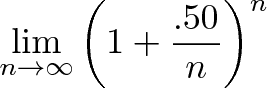
Hrm. What can we do here? Well, imagine we break it down into 50 chunks of 1% growth:

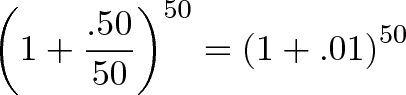
Sure, it’s not infinity, but it’s pretty granular. Now imagine we broke down our “regular” rate of 100% into chunks of 1% growth as well:

Ah, something is emerging here. In our regular case, we have 100 cumulative changes of 1% each. In the 50% scenario, we have 50 cumulative changes of 1% each.
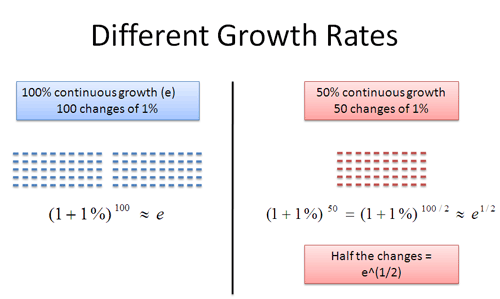
What is the difference between the two numbers? Well, it’s just half the number of changes:

This is pretty interesting. 50 / 100 = .5, which is the exponent we raise e to. This works in general: if we had a 300% growth rate, we could break it into 300 chunks of 1% growth. This would be triple the normal amount for a net rate of e^3.
Even though growth can look like addition (+1%), we need to remember that it’s really a multiplication (x 1.01). This is why we use exponents (repeated multiplication) and square roots (e^1/2 means “half” the number of changes, i.e. half the number of multiplications).
Although we picked 1%, we could have chosen any small unit of growth (.1%, .0001%, or even an infinitely small amount!). The key is that for any rate we pick, it’s just a new exponent on e:

What about different times?
Suppose we have 300% growth for 2 years. We’d multiply one year’s growth (e^3) by itself two times:

And in general:

Because of the magic of exponents, we can avoid having two powers and just multiply rate and time together in a single exponent.
The big secret: e merges rate and time.
This is wild! e^x can mean two things:
- x is the number of times we multiply a growth rate: 100% growth for 3 years is e^3
- x is the growth rate itself: 300% growth for one year is e^3.
Won’t this overlap confuse things? Will our formulas break and the world come to an end?
It all works out. When we write:

the variable x is a combination of rate and time.

Let me explain. In essence, 10 periods of 3% growth has the same growth impact as 1 period of 30% growth, when compounded:
- 10 periods of 3% growth = 30 1% changes, happening over 10 years
- 1 period of 30% growth = 30 1% changes, happening over 1 year
The same number of changes happen in each case. Sure, the 30% yearly growth happens faster — but only for 1 year! The total change is the same!
After all is said and done, there were 30 periods of 1% growth, giving e^.30 = 1.35 in the end. One method just takes longer than the other. Clearly having 30% growth for 10 years is better than 3% growth for 10 years, but that wasn’t the question, now was it?
So, our general formula becomes:

If we have a return of r for t time periods, our net compound growth is e^rt. This even works for negative and fractional returns, by the way.
Example Time!
Examples make everything more fun. A quick note: We’re so used to formulas like 2^x and regular, compound interest that it’s easy to get confused (myself included). Read more about simple, compound and continuous growth.
These examples focus on smooth, continuous growth, not the “jumpy” growth that happens at yearly intervals. There are ways to convert between them, but we’ll save that for another article.
Example 1: Growing crystals
Suppose I have 300kg of magic crystals. They’re magic because they grow throughout the day: I watch a single crystal, and in the course of 24 hours it creates its own weight in crystals. (Those baby crystals start growing immediately as well, but I can’t track that). How much will I have after 10 days?
Well, since the crystals start growing immediately, we want continuous growth. Our rate is 100% every 24 hours, so after 10 days we get: 300 * e^(1 * 10) = 6.6 million kg of our magic gem.
Example 2: Maximum interest rates
Suppose I have $120 in a count with 5% interest. My bank is generous and gives me the maximum possible compounding. How much will I have after 10 years?
Our rate is 5%, and we’re lucky enough to compound continuously. After 10 years, we get $120 * e^(.05 * 10) = $197.85. Of course, most banks aren’t nice enough to give you the best possible rate. The difference between your actual return and the continuous one is how much they don’t like you.
Example 3: Radioactive decay
I have 10kg of a radioactive material, which appears to continuously decay at a rate of 100% per year. How much will I have after 3 years?
Zip? Zero? Nothing? Think again.
Decaying continuously at 100% per year is the trajectory we start off with. Yes, we do begin with 10kg and expect to “lost it all” by the end of the year, since we’re decaying at 10 kg/year.
We go a few months and get to 5kg. Half a year left? Nope! Now we’re losing at a rate of 5kg/year, so we have another full year from this moment!
We wait a few more months, and get to 2kg. And of course, now we’re decaying at a rate of 2kg/year, so we have a full year (from this moment). We get 1 kg, have a full year, get to .5 kg, have a full year — see the pattern?
As time goes on, we lose material, but our rate of decay slows down. This constantly changing growth is the essence of continuous growth & decay.
After 3 years, we’ll have 10 * e^(-1 * 3) = .498 kg. We use a negative exponent for decay — we want a fraction (1/ert) vs a growth multiplier (e(rt)). [Decay is commonly given in terms of “half life”, or non-continuous growth. We’ll talk about converting these rates in a future article.]
More Examples
If you want fancier examples, try the Black-Scholes option formula (notice e used for exponential decay in value) or radioactive decay. The goal is to see e^rt in a formula and understand why it’s there: it’s modeling a type of growth or decay.
And now you know why it’s “e”, and not pi or some other number: e raised to “r*t” gives you the growth impact of rate r and time t.
There’s More To Learn!
My goal was to:
- Explain why e is important: It’s a fundamental constant, like pi, that shows up in growth rates.
- Give an intuitive explanation: e lets you see the impact of any growth rate. Every new “piece” (Mr. Green, Mr. Red, etc.) helps add to the total growth.
- Show how it’s used: e^x lets you predict the impact of any growth rate and time period.
- Get you hungry for more: In the upcoming articles, I’ll dive into other properties of e.
This article is just the start — cramming everything into a single page would tire you and me both. Dust yourself off, take a break and learn about e’s evil twin, the natural logarithm.
168 Comments »
Trackbacks & Pingbacks
-
Pingback by Demystifying the Natural Logarithm (ln) | BetterExplained — May 20, 2007 @ 9:27 pm
-
Pingback by What do you want Better Explained? | BetterExplained — October 8, 2007 @ 10:02 am
-
Pingback by How to Develop a Mindset for Math | BetterExplained — November 27, 2007 @ 3:24 am
-
Pingback by A Visual, Intuitive Guide to Imaginary Numbers | BetterExplained — December 21, 2007 @ 1:18 am
-
Pingback by Mindset :: How to Develop a Mindset for Math :: February :: 2008 — February 5, 2008 @ 3:16 am
-
Pingback by Phil Dawes’ Stuff » Blog Archive » Imaginary numbers: ‘Better Explained’ does it again — February 21, 2008 @ 3:09 am
-
Pingback by Huntersdad.com » e Explained — February 21, 2008 @ 3:00 pm
-
Pingback by How To Analyze Data Using the Average | BetterExplained — March 14, 2008 @ 3:59 pm
-
Pingback by A Gentle Introduction To Learning Calculus | BetterExplained — May 2, 2008 @ 11:20 am
Comments
RSS feed for comments on this post. TrackBack URI
Leave a comment
Have a question? Know an explanation that caused your own a-ha moment? Write about it here.


RSS
Nice graphics!
Anonymous — May 1, 2007 @ 3:19 pm
Thanks. I made them in PowerPoint 2007, which makes graphics pretty easy. You can see the powerpoint file here:
http://betterexplained.com/examples/graphics/Exponential-growth.pptx
Kalid — May 1, 2007 @ 3:46 pm
Fantastic Kalid! I consider myself a pretty bright guy and work with numbers every day but e has always been an opaque subject to me. Ever since high school it’s been hanging out with its friend the logarithm with nothing to do but mock me! I think this article is going to help me think about e in new ways and I may even put it to use. I’m really glad I found your site!
Bob — May 2, 2007 @ 7:26 am
Great Bob, I’m glad you liked it! Yeah, e and its pesky friends like natural logarithms were a thorn in my side for a while. It really bugs me when I use a concept without *really* knowing what it meant.
E got all this attention and I wanted to dig in and see what all the fuss was about
I’ll be writing more on this topic as there are some really interesting ways of looking at “this constant, approximately equal to 2.71828…”
Kalid — May 2, 2007 @ 12:29 pm
nice article, it’s so rare to find actual explanations when it comes to mathematical ideas, I was very happy to have found this one.
Jayson Waddell — May 5, 2007 @ 10:47 pm
Thanks Jayson, the lack of intuitive explanations motivated me to start this site. I’m glad you are finding it useful
Kalid — May 6, 2007 @ 11:55 am
I have a question.
you wrote that x=rate*time and that e^x=growth. using this information is it possible to find the smallest amount of time allowed, the gap between one time to the next. Does this give us the ability to give a value for that infinitesimally small value between each moment in time. Just a random ponderance. Nice guides specially enjoyed the vector calculus series. I was getting worried that i would have to take math as a second language. The words they use in calc. books are too big for me.
Stephen — May 6, 2007 @ 11:45 pm
Hi Stephen, great question!
Yes, if you take the unit of time smaller and smaller, you will get the instantaneous rate of growth at a point. And the surprising thing is that this is e^x!
I want to write more about the calculus of it, but basically, when you have a certain amount of “stuff” (say, 10 units) then you are *growing* at 10 units per unit of time as well. Of course, once you grow just a little bit you have a new amount of “stuff” (10.1 units) and now you are growing at 10.1 per unit time.
It’s a bit mind-boggling, but it’s the way e works — the current instantaneous rate of growth is equal to the current amount. I’ll be writing more on this as I get a good, intuitive understanding of it
Kalid — May 7, 2007 @ 2:55 am
Holy cow….somehow despite four semesters of calculus I forgot or failed to grasp that with any calculator I can do compound interest calculations as easily as circle areas. I’ve been dependent on financial calculators for twenty years. Now I’m going to read all your math-related posts. Keep writing!
joe — May 7, 2007 @ 6:14 am
That’s awesome Joe! I know what you mean, I had forgotten about being able to do compound interest as well — it’s funny how rarely we revisit old topics we’ve learned. E had always bothered me.
I hope you enjoy the other posts, I’ll keep cranking them out
Kalid — May 8, 2007 @ 1:19 am
Thanks for the wonderful explanation. However, at places, confusion seems to arise due to wrong use of terminology. e.g. instead of ‘e is the fundamental rate of change shared by all continually growing processes.’ it should be ‘e is the fundamental net growth in all continually growing processes (in a unit time that would account for 100% simple growth)’, if I have understood correctly. Elsewhere, you do say growth=e^rt, where r is the rate of growth. So e is the total growth & not rate of growth.
Dr Jani — May 31, 2007 @ 2:48 am
Hi Dr. Jani, that’s a great point — the current description of e is confusing. As you say, e^1 = e = the amount of continuous growth after 1 unit of time (assuming growing at a rate of 100% simple growth per unit time).
e^rt lets you compute the net growth for any rate and time. I’ll update the article to make this more clear, I appreciate the feedback!
Kalid — May 31, 2007 @ 7:08 pm
Wow thank you so much for explaining e. The wikipedia article completely confused me about it
David — June 19, 2007 @ 10:08 pm
Thanks David. Yeah, it really bugs me when math topics are explained in a complicated way, I’m glad you liked it.
Kalid — June 19, 2007 @ 10:46 pm
Kalid - thank you (and your contributors for their comments) for this site. I hope that your blog will be even more popular than Wiki and be the “goto” place for teachers and their students!
Sophie — June 22, 2007 @ 8:58 pm
Thanks for the encouragement Sophie, you must have read my mind! I’m hoping this blog evolves into a place to think about new topics in a fresh, intuitive way, and share those “a-ha” moments from everyone.
Wikipedia is a good reference, but encyclopedias tend to focus on facts vs. understanding. There’s a place for both
Kalid — June 23, 2007 @ 12:05 am
This is a great discussion. You should do the fundamental theorem of calculus, also.
Jobie — June 26, 2007 @ 11:01 am
Thanks Jobie, appreciate the comment. Yep, the Fundamental Theorem of Calculus is definitely on my list of upcoming topics
Kalid — June 29, 2007 @ 8:39 am
This was really cool - thanks for taking the time to writ it up. I realy have a grasp of e now!
Dan H — June 30, 2007 @ 1:06 pm
Awesome Dan, I’m happy it helped!
Kalid — July 2, 2007 @ 1:54 pm
Very nice explanation. Even though I have a BS in Engineering, I still didn’t really know what e was. You brought back some memories and helped reinforce the ol’ e.
Your intuitive explanation reminded me of this article on impedance: http://sci-toys.com/attention/2006/04/impedance-matching.html
BTW, what is your profession and education?
Thanks!
Jut — July 14, 2007 @ 6:51 pm
Hi Jut, I’m glad you liked it. I find there’s many subjects we just plow through without really understanding — that feeling has always bothered me
.
I’ve got a BS in Computer Science and do programming/web development now, but enjoy a wide variety of subjects (there’s more in the about section).
Kalid — July 15, 2007 @ 2:23 am
I think I get this whole expotental thing a little more. Thanks! In class, they kind of throw this thing at you.
Alice — July 18, 2007 @ 2:56 pm
Thanks Alice, that’s great! Yeah, things become much easier when you have an intuitive understanding, I’m happy it was able to help.
Kalid — July 18, 2007 @ 8:04 pm
Thanks man!!!
I have a BE in CSE ,still could not get what ‘e’ is.
passing exams and understanding the concepts is really totally different.Thanks again.
Please keep it up.
Saurabh — July 24, 2007 @ 3:07 am
Hello, what about exponential decay when the rate is negative? With positive rates it is easy to understand but for some reason I can’t see it with negative rates
Jayson Waddell — July 26, 2007 @ 8:34 am
Hi Jayson, negative exponents can be tough. Positive exponents imply “growing” and negative exponents mean “shrinking”.
So, e^3 is “The amount of growth after 3 periods of time (assuming 100% growth rate, compounded).”
What’s e^-3? Well, it’s a growth rate of -100%, but what does that mean?
If you could shrink for 100% for one unit of time, you’d end up with zero. However, e is about continuous growth.
So, as you shrink a little bit, your *rate* of shrinking slows down. Instead of shrinking at 100%, maybe you’re shrinking at 90%.
As you shrink more, your rate may decrease to 80%. Then 70%. Eventually, your rate of shrinking is around 1% and it looks like you aren’t shrinking at all.
Thinking about it more, negative exponents are a bit strange
.
Another way is to consider negative exponents as negative *time*, rather than negative *growth*.
e^3 * e^-3 = 1. So, e^-3 can mean “What value do I start with, and grow for 3 units, to get my current value?”
e^-3 would be a really, really small number if it’s allowed to grow. When we look forward, we see growth. When we look backwards, we see decay.
After all, 100 dollars in 2007 might look like “decay” when you look back at it from 2010 (when you have 1000 dollars). In some cases, an amount really is shrinking as time goes forward (and looking back in time looks like growth).
A bit confusing, but hope this helps.
Kalid — July 27, 2007 @ 1:21 am
Can we look forward for more math explanation. The Articles you write can change the world (majority ) view on mathematics. We need such good teachers in our schools. Thanks
taz — July 29, 2007 @ 4:38 pm
Thanks for the encouragement Taz — I have more posts in the works, but want to get them to high enough quality. I love helping people learn, and if I can help people enjoy “hated” subjects like math all the better
Kalid — August 1, 2007 @ 2:42 am
Awesome explanation
Something I wanted to know for a long time.
Please write more of the same kind of articles !
Nasir — August 7, 2007 @ 6:36 am
Well..! Finding good teachers is like finding a treasure.
I got to your explanation by.. serendipity.
Thank you very much!
Internet allows finding people who “just” do extraordinary pieces of work.
All the best!
Michael — August 7, 2007 @ 12:23 pm
Hi Nasir and Michael, thanks for the kind words! I have more articles in the works, so I hope you enjoy them as well.
I completely agree about the Internet in terms of bringing people together and discovering new things — I’m so happy I was born in this “modern” time period
.
Kalid — August 9, 2007 @ 2:34 am
The best explanation of e and ln and have ever seen, and I have looked before. Absolutely awesome.
Dan — August 22, 2007 @ 12:04 pm
Wow, thanks Dan, happy you liked it. I try to explain things the way I wish I were taught.
Kalid — August 24, 2007 @ 12:00 am
What about -e to the x power? My daughter’s pre-cal teacher gave this as homework and test question to graph. I believe the base should be positive, else you will get a hilly graph. Please explain
sophia — September 8, 2007 @ 5:02 am
Hi Sophia, good question. Did the teacher mean -(e^x) or (-e)^x?
If it’s the first, it looks like the reverse of the e^x and isn’t too hard to graph.
If it’s the second (negative base), things get tricky. For whole numbers like (-e)^1, (-e)^2, (-e)^3 you can plot it out, and it will be hilly, jumping from negative to positive.
The tricky thing comes with intermediate values like (-e)^.5. This means the square root of -e, which is an imaginary number! Any non-integer exponent will have this problem.
So, the only real values you can plot are for the integers 1,2,3,4,5, etc. I’d ask the teacher to double-check for a typo, but otherwise you can only plot it out for the integer values.
Kalid — September 8, 2007 @ 11:17 am
Thanks a bunch Kalid. You confirmed what I thought. I intend to ask the teacher about this again. My objective is for my daughter and the rest of the class to fully understand the concepts as they are introduced.
Thanks so much.
sophia — September 12, 2007 @ 6:15 pm
No problem, glad it was useful for you!
Kalid — September 12, 2007 @ 9:23 pm
Now I have clue on e! Thanks! I want to be an actuary now!
jim — September 25, 2007 @ 6:58 pm
Thanks Jim
Kalid — September 25, 2007 @ 7:29 pm
I just “e”njoyed my a-ha moment!
Charanjeev Singh — September 29, 2007 @ 4:57 pm
Awesome, very nice!
Kalid — September 29, 2007 @ 10:14 pm
WOW! Amazing how i was able to condense 16 years of learning into an hour long window! All those years spent into oblivion when teachers would come to class, scribble something in greek (literally)on the board, while students hoped helplessly that they’d someday understand all this! With your tutorial, the world has hope again! I wish teachers would focus on smaller syllabus, but more pertinent, practial, day-to-day stuff! Thank you! You are my official math messiah!
Icegirl — October 8, 2007 @ 11:14 am
Hi Icegirl, thanks for the wonderful comment! I’m happy the article was able to help — yes, the goal is to focus on practical, “this makes sense” insights.
Kalid — October 8, 2007 @ 3:28 pm
Kalid,
Thanks for the great explanation.
My comment is looking for a comment from you.
A new money system.
Every one gets 100 units a day for a year. At the end of the year there are 36,500 units of currency in circulation for each person. The 100 units have diminished as a proportion of the whole to the point of 1/365. On the first day of the second year the daily allotment is increased by 1/365. This keeps the proportion of the daily allotment constant at 1/365. Over year this approximates e, and if the growth is continuous, it is e. I call the type of money salmoney, and this particular version excalibrator.
I guess what I’m looking for is does this resonate with you as an apt or accurate use of e. Thanks for your time. My website is jaspersbox.com It is the attempt to create a new currency with a built in universal dividend.
Thanks for listening.
S. Clark
stephen clark — October 17, 2007 @ 4:14 pm
Hi Steven, thanks for writing, glad you liked the article. I’m not quite sure what you meant by “increasing by 1/365″ — do you want to keep the proportion of money handed out the same? (Even in the first case, giving out 100 per day, the percent changes day after day).
You *can* use e to convert between simple and compound interest — I’m planning on a follow-up article on this topic, which may do a better job of answering your question than I’m doing now
Kalid — October 17, 2007 @ 11:26 pm
This is a great explanation…. It has been twenty years since I have studied this area of mathematics and then I just memorized it and went on about my business. I am now working on a wind turbine design and (to confess) having to look a few things that I have forgotten up. I came upon a speed gradient and surface roughness equation as applied to wind velocity that utilized the natural log of the height / surface roughness length. I did an internet search on the concept of the natural log to brush up on it and found this little jewel. This is one of the best explanations I’ve yet to come across.
todd — October 18, 2007 @ 7:44 pm
Hi Todd, thanks for the wonderful comment! I’m really glad it was useful to you, and hope you figured out that turbine design
Kalid — October 19, 2007 @ 1:30 am
Hi Kalid, thanks a lot for the intuitive explanation. I’ve wondered a lot about “e”. I linked to this article from my lj above.
Keep your good work going!
Deepak — October 19, 2007 @ 10:17 pm
Hi Deepak, thanks for the comment — glad you liked it!
Kalid — October 20, 2007 @ 2:02 am
Fantastic website. I love the explanation. Well definitely be back to read up some more.
Shaw — October 22, 2007 @ 12:19 pm
Thanks Shaw, glad you like it!
Kalid — October 22, 2007 @ 8:13 pm
Nice job, Kalid. Now I’m going to try to explain it to my wife using your approach.
barry — October 24, 2007 @ 1:29 pm
Thanks Barry, hope she enjoys it
Kalid — October 24, 2007 @ 5:10 pm
Hi Kalid, I have a question here. You have given an example to us as follows:
“I have $120 in an account bearing 5% interest. I keep it for 10 years. Assuming compound growth, I’d have 120 * e^(.05 * 10) = 197.85 after the 10 years.”
If I calculate it in the compound interest formula, the results are different:
$120 * (1 + 0.05)^10 = $195
Could you explain why? Thanks
Denis — November 1, 2007 @ 1:25 pm
Hi Denis, great question — clarifying the meaning between simple and continuous growth rates is something I’d like to write about more.
At a high level, “simple” interest is the *final* amount of growth, i.e. what you get at the end of the year. So 5% simple interest for 10 years would be (1.05)^10, as you wrote.
Continuous interest is the *current* rate of growth, i.e. how fast are we growing at this instant. In that case, you use e^(.05 * 10) to find the impact of 5% current growth for 10 time periods.
The reason continuous growth is more is because the “interest you earn, earns interest”. That is, after 1/2 a year you have earned 2.5%. After another half year, that 2.5% interest has earned 2.5% on itself. You can cut the time slice smaller and smaller (like we did for 1/3 of a year above) and see how small chunks of interest can earn more. With simple interest, you just say “I’ll give you 5% at the end of the year… and no compounding before then. If you’re lucky, I’ll spread out these payments each month.” Most banks list *simple interest* as their annual percentage rate, as it’s sometimes easier to think about.
However, continuous growth is more common in science and the real world (radioactive decay), as most things have a current growth rate. We don’t figure out the final amount and work backwards, as banks may. I’d like to write more about this, thanks for bringing it up.
Kalid — November 2, 2007 @ 10:23 pm
Thank Kalid. So I guess it is more appropriate to use e for scientific calculation but not bank transaction calculation as bank’s compound growth rate is usually annual but not continuous.
Denis — November 4, 2007 @ 7:11 pm
Hi Denis, that’s right — banks usually express their interest rates in terms of simple interest over the year.
Kalid — November 4, 2007 @ 8:51 pm
It seems trite to say, after so many comments of the same; however, I have to echo: this is explanation was fantastic!!! When I read about mathematic principles that are so clearly laid out, it reminds me of how much math is such a direct in-road to philosophy. Thanks for helping reveal the mystery. I’m looking forward to you writing more of the same. Very best regards, Mark
Mark — November 11, 2007 @ 9:19 pm
Hi Mark, thanks for the wonderful comment! It’s great to hear that explanations are working, it helps me tailor upcoming articles to do more of the same.
Yes, I think any math principle can be explained simply — it’s us humans who tend to complicate things
. The irony is that it takes a lot of thinking and effort to reveal the “mystery” which is simple after all. I’ll do my best to keep cranking out articles, thanks for dropping by.
Kalid — November 12, 2007 @ 12:34 pm
I have one for you, How can you explain Euler’s formula re^j(theta) in a understandable way.
Read r multiplied by e to the power of imaginary unit j x angle theta
Anonymous — November 18, 2007 @ 6:31 pm
Euler’s formula is on the list — but first I need to do an explanations of complex numbers, possibly sine and cosine as well
Kalid — November 19, 2007 @ 8:57 am
Very nice explanation indeed!
Garry — November 21, 2007 @ 7:38 pm
Thanks Garry!
Kalid — November 21, 2007 @ 8:39 pm
Hi Kalid,
As others have already said, that’s a really nice explanation of the constant e.
I think you can explain Euler’s identity eiπ + 1 = 0 using not much more machinery than you’ve developed for the real-valued case. In fact, knowing the limit as n tends to infinity of (1 + x/n)n is ex is almost enough.
First, interpret the (1 + ix/n) term geometrically as a complex number with real part 1 and imaginary part x/n. For large n this is a number very close to 1 but rotated slightly towards towards the positive imaginary axis. The angle of that rotation will be approximately x/n.
Multiplying two complex numbers results in a new number with the sum of their angles and product of their moduli. So taking the nth power of (1 + ix/n) will result in a new complex number with angle approximately x for large n since the nth power is just n rotations by x/n.
Substituting x = π (a rotation of π radians) gets you to -1 and so the identity holds.
I realise that this is not really a proof, more a sketch really. Also, it takes advantage of a lot of facts about the polar representation of complex numbers which in turn depend on e. That said, in terms of giving me an intuition for Euler’s identity this is the most satisfying explanation I’ve heard so far.
Mark — November 21, 2007 @ 9:39 pm
Hmmm… it seems the `sup` HTML tags didn’t work in that last comment of mine. Also, “π” (pi) looks a lot like “n” (en) which is unfortunate.
So my second paragraph should read (in LaTeX) “… Euler’s identity $e^{i\pi} + 1 = 0 …” and “… of $(1 + x/n)^n$ is $e^x$ …”.
Hope that’s not too confusing.
Mark — November 21, 2007 @ 9:43 pm
Hi Mark, thanks for the wonderful comment! I really, really like that insight, I’ll have to use it when explaining Euler’s formula.
I’d first like to tackle complex numbers to give people (including myself) an intuition for it. Also, I’d like to cover the series expansion of e^x as well [1 + x + x^2/2 + …]. One of the great things about e is that it turns a “mind-bending” operation like imaginary exponent into a “understandable” operation like a series of multiplications/rotations.
Again, thanks for stopping by, that comment helped me a lot.
Kalid — November 21, 2007 @ 9:54 pm
Very nice article. Explains the mystery of e
Siva Chandran P — November 21, 2007 @ 11:01 pm
Thanks Siva
.
Kalid — November 22, 2007 @ 12:05 am
This is really beautiful. Congrats on an elegant explanation. There’s an alternative formula for e that might tickle you: e = lim as `[delta x] -> 0 of (1 + [delta x])^(1/[delta x])
The simplest explanation I ever heard for the importance of exponential grwoth in phenomena like population growth is that with an exponetial function, the growth rate is proportional to the size. I.e., the bigger the population, the faster the growth. It works in reverse, viz., radioactive decay: the less radioisotpe remains, the slower the decay.
mclaren — November 22, 2007 @ 12:21 am
awesome i never thought of e as a base like that. When you compared it to the radius of a unit circle it just clicked. No one ever (or has yet to) said that to me in calc or any other of the engineering courses i’ve taken.
Anonymous — November 22, 2007 @ 8:42 am
You didn’t understand what makes e so important.
It’s because it’s the ‘unity’ of diferentiation/integration
d(e^x)/dx = e^x
Anonymous — November 22, 2007 @ 9:02 am
Any positive number different than 1 could be the e as you have been using in this article…
Anonymous — November 22, 2007 @ 9:04 am
@mclaren: Thanks, that’s another way to think about it
[It’s the same limit but restated]. Yes, the application of “growing as much as you currently have” is part of what makes e great.
@Anon1: Thanks, I’m glad to see it helped! Everyone has a different “a ha!” moment.
@Anon2: Being reversible is one great property of e^x and will be covered eventually, but I find it isn’t what helps people “get it” intuitively. A lot of the time you see e in formulas related to growth rates (heat transfer, radioactive decay), and you want to know why it’s there.
Kalid — November 22, 2007 @ 9:13 am
@Anon3: e is the unique number you get when you compound 100% (unit growth) continuously for a unit time period. Yes, any number can be the base of an exponent, but only 2.71828 (e) emerges from the unit rate and time period.
Kalid — November 22, 2007 @ 9:15 am
Hi Kalid,
I can follow your explanation of e but I can’t relate (1.33)^3 = e^x = 2.37037. If I take the natural log of 2.37037 it equals 0.863046. In other words for this particular case how do I determine what rate*time is?
Thanks, Richard
Richard — November 22, 2007 @ 11:24 am
i feel smarter
william — November 22, 2007 @ 6:17 pm
@Richard: That’s a great question — I think I need to clarify simple vs. compound interest in an upcoming article.
(1.33)^3 means “3 periods of 33% simple interest”. In this case, it happens to equal 2.37.
ln(2.37) = 0.86 = rate * time, which can be interpreted as:
One period (time = 1) of 86% continuous growth (rate = .86) would be 2.37 total.
.86 periods (time = .86) of 100% growth (rate = 1.0) would be 2.37 total.
Regular exponents (1.33^3) measure simple interest. e^x measures compound interest. Natural log helps convert between the two.
Kalid — November 23, 2007 @ 11:34 pm
Your site is wonderful.
And this entry is fantabulous.
Asad — November 24, 2007 @ 7:08 pm
Hi Asad, thanks for the support!
Kalid — November 24, 2007 @ 10:43 pm
Hello,
I found this posting recently and would like to express my admirations.
I also have a question: how could add an unexpected conditions influencing on the growth?
Let me use your Bacteria sample: During their growth, at different time, some of them dies because are too old, other - because of illness, still others - because have been killed somehow…
So the numbers are 1 -> 2 -> 4 -> 3 -> 9 -> 8 -> 7…
how could implement this (let’s name it “unknown factor”) to the growth?
x = e^(r*t)
Thank you
Ivo — November 26, 2007 @ 5:54 am
Hi Ivo, great question. I’m not an expert on this but one way to do it is to subtract a negative term that represents the unknown factor.
For example, you could try
growth = (2 - sin(x)) * e^x
and as sin(x) varies between 1 and -1, your growth will dip up and down (it will generally trend upward).
A sigmoid curve is another way to represent “exponential growth that levels off” as populations compete for resources:
http://en.wikipedia.org/wiki/Logistic_function
Hope this helps.
Kalid — November 26, 2007 @ 11:52 am
That was awesome. Good job!
Anonymous — November 27, 2007 @ 7:11 am
I wish I had read this when I was in class eleven.
wow — November 27, 2007 @ 9:21 am
Thanks, glad you liked it! Yeah, I wish I could go back in time and tutor myself, but the closest I can do is write it for other people to read
Kalid — November 27, 2007 @ 11:22 am
Fantastic article! Thanks for the great overview in layman’s terms.
Adam — November 27, 2007 @ 12:40 pm
Thanks Adam! I find that people who feel a need to explain things in “mathematician’s terms” don’t really understand the topic at a deep level — it’s a good litmus test
Kalid — November 27, 2007 @ 1:47 pm
A fine explanation of a complicated subject — well done!
You might want to revisit your examples, though. The first and third make use of rates which most people already think of in “compound interest” terms, rather than needed to introduce e by moving from simple interest to compound interest. If I’m told that bacteria increase by 100% in 24 hours, then after 24 hours I expect to have twice as many. Similarly, if I’m told that a radioactive sample has a half-life of three months, I expect to have 50% remaining after three months, 25% after six months, and so on.
Jon — November 28, 2007 @ 1:16 pm
Excellent work, and you’re damn right about Wikipedia maths.
A comment on exponential rates of decay:
Why is it we can write decay rates as e^(-RT)? Just to expand your own observations, suppose we put some small deposit X in the bank, which grows exponentially over some time T at some rate R to the sum of Xe^RT. Now suppose we fritter all our gains away at some exponential rate r so that after that same period T we’re back to our original deposit of X.
If both processes work ‘exponentially’, then just as we could multiply X by e^RT to find the value of the larger sum Xe^RT, multiplying this large sum by some other value e^rT will bring us back to our original deposit of X.
So X.e^RT.e^rT = X, which gives
e^rT = 1/e^RT, which is written
e^(-RT), and which also gives us
r = -R
D.jef
D.jef — November 29, 2007 @ 8:04 am
I have to agree. The best explanation this far!
John Smith — November 29, 2007 @ 11:07 am
@Jon: Thanks, glad you liked the article. Yes, you have a great point — the terminology is a bit confusing, I’m planning on going back to rephrase. The problem is we often don’t speak about continuous growth, so interest is assumed to be simple. I’m planning on writing more about this to clarify.
@D.jef: Thanks for the details! Yes, another way to think about negative rates is time going in “reverse” (aka you look backwards and you’re shrinking) or the “reverse” rate (shrinking instead of growing).
@John Smith: Thanks!
Kalid — November 29, 2007 @ 6:12 pm
please, e not E
Anonymous — November 30, 2007 @ 6:20 am
Fantastic article. Great explanation of e. I use e all of the time in my work, and have never really understood it at the intuitive level. This article makes it very clear. Nice work.
Robert R — November 30, 2007 @ 10:02 pm
@Anon: I like e, but sometimes lowercase can look strange in a title.
@Robert: Thanks! I’m really happy the intuitive meaning shined through. I used e throughout physics in college without a good grasp of what it meant, and why it was “really” there (and not some other exponent).
Kalid — November 30, 2007 @ 11:29 pm
It was really a great amazing tutorial! Simple and Efficient! I recommended to many of my colleagues too.
Thank you,
Sarnath, from India — December 5, 2007 @ 4:34 am
Thanks Sarnath, glad you found it useful
Kalid — December 8, 2007 @ 10:12 am
Thanks for the article. I’m teaching Algebra II for the first time and your article will help me give a clear explanation about e and natural logs.
Connie — December 9, 2007 @ 9:19 pm
You’re welcome Connie, I hope your students find it helpful!
Kalid — December 10, 2007 @ 7:00 am
Hey, this is a pretty sweet site. All I ever wanted to know about e! Plz send emails. Btw, I had to read this for a math class. It was worth it. Ok bye.
Matthew B. — December 14, 2007 @ 10:29 am
Nice article. Can you explain how this view of “e” relates to other conceptions of “e” mathematically (perhaps in a second article)? For example, see http://en.wikipedia.org/wiki/E_(mathematical_constant) Alternative characterizations. It would be nice to intuitively understand how these different ways of representing “e” are really part of the same mathematical concept. Thanks!
Ken — December 14, 2007 @ 2:58 pm
Hi Ken, great suggestion. Yes, I was planning on doing a follow-up to show how the alternate characterizations of e can actually mean the same thing
.
I like the interest definition to start (since it’s the most “tangible”) but the infinite series expansion (1 + x + x^2/2 + x^3/3!…) has an intuitive explanation as well. I’ll definitely do a follow-up on this.
Kalid — December 14, 2007 @ 3:09 pm
hi kalid,
what a great attempt.I am glad there is some one out there in the world to make mathematics interesting.I was so happy to read your article after having loads of frustration tryin to understand e and natural log.why dont you write a comprehensive mathematics course.I am sure the professors will learn from you!!!!!!!!!!!!!!!
sudarshan — December 25, 2007 @ 12:40 pm
thank you very much
marcus — December 27, 2007 @ 3:26 am
Really really informative and good use use of graphics
Bagish — January 2, 2008 @ 10:49 pm
@Sudarshan: Thanks for the kind words! Yes, I think math (or any subject) can be interesting if presented in the right light. I’d love to create a math course — right now, I’m taking it one article at a time
.
@Marcus: You’re more than welcome.
@Bagish: Appreciate the comment — I find diagrams really help when approaching complicated topics.
Kalid — January 2, 2008 @ 10:51 pm
cheers, nice one
really nice one. I’m an engineering masters student, yet e keeps eluding me
tchuk — January 4, 2008 @ 11:04 am
Thanks, glad you found it useful. Yes, it’s funny how often we use an idea without understanding it deep down. It took me a long time to “get” e also.
Kalid — January 4, 2008 @ 2:44 pm
I never understood the significance of e.But I am glad that I understood a very important part of maths atleast today
sujatha — January 7, 2008 @ 3:34 am
Thanks Sujatha, glad it worked for you.
Kalid — January 7, 2008 @ 9:17 am
Kalid, Thank you so much for this great explanation! I have been searching for an explanation like this for a long time, as I never fully understood the concept of e, but now I understand it much better.
I do have one point of confusion, so I hope you don’t mind me asking: I understand why why y=e^x describes Compound Interest, because the growth is continuous. However, as you stated above, bacteria cannot function until they are fully born (not while they are still growing out of their mother cell), so that growth is not really continuous (new bacteria born every 24 hrs in your example above). So wouldn’t a better equation for bacteria growth be y=2^x (where x = 1 period or 24 hours), rather than y=e^x (continuous growth), even though in my college biology class we learned that the equation was y=e^x?
Thank you!
Louis — January 9, 2008 @ 8:56 am
Hi Louis, thanks for the comment! You bring up a great point, I should have made the bacteria example more clear. I’m planning on doing a follow-up article on simple vs compound vs continuous interest, as it’s a point I’ve even confused myself about
.
When studying a single cell, the equation 2^x probably fits best, as the cell can’t do anything until it has split.
When studying bacteria cultures (millions of cells), the individual cells aren’t likely on the same phase. At any moment, some are 1/4 done, some are just getting started, some are 99% done, etc. So if you start at noon, there’s some growth at 1pm, even though a given bacteria takes 24 hours to mature. This is one reason e^x makes sense for bacteria — the growth appears continuous on a macro scale.
The other reason e^x makes sense is that it can model *any* growth rate (even 2^x) by using e^(ln(2) * x). In this case, ln(2) becomes a “scaling factor” that transforms e^x into the rate you need. I’ll be doing a follow up on this as well.
Hope this helps — I need to change the last bacteria example because it’s confusing, given what I said above. By the way, this is what I love about blogs — getting immediate feedback on what’s working, and what isn’t
.
Thanks again for the comment.
Kalid — January 9, 2008 @ 10:50 am
Thanks for writing this page. It really helped me a lot. I’ve been looking everywhere for a concrete definition of e and I’ve finally found it here. I now understand why it is natural despite the fact that it has always sounds random!
Nicola — January 16, 2008 @ 3:39 am
Thanks Nicola, glad you found it useful!
Kalid — January 16, 2008 @ 7:54 am
Thanks for that, I am finishing a PhD and e appears often in the equations i use, it is nice to know why it is there rather than just accept it. Brill explination
Spodbod — January 16, 2008 @ 12:50 pm
Awesome, glad it helped. It’s amazing how many ideas there are out there that we only realize the meaning of much later.
Kalid — January 16, 2008 @ 7:15 pm
That’s a great explanation but not sure if using the money example is a good thing because in real life, it doesn’t work like that, it happens in discrete steps, like monthly, it’s still compound but not continuous(with steps tending to infinite).
Thomaz — January 16, 2008 @ 8:09 pm
Great article, I really enjoyed the explanations!
I am having a head scratcher moment though .. it’s been a long time since high school, but with the given equation FV=PV*e^(r*t), how would one solve for r, knowing the other variables?
Bill — January 18, 2008 @ 4:43 am
@Thomaz: Thanks for the comment. I agree, I may have to change the money example since it is most commonly *not* compounded continuously — mostly monthly or daily, as you say. e was discovered by the theoretical maximum return of infinitely compounding interest, so money does have its role (even if banks aren’t so generous as to give you that maximum rate).
@Bill: Thanks, glad you liked it! Great question — to solve for r, you need to “cancel” e by using the natural log. So you’d do:
FV/PV = e^(r*t)
and take the natural log of both sides:
ln(FV/PV) = ln( e^(r*t) )
and since ln and e “cancel”, you get
ln(FV/PV) = r * t
You can then divide by r or t to find one or the other variable.
Kalid — January 20, 2008 @ 9:09 pm
I absolutely love your intuitive approach. I’m studying physics right now and this is soooo much more understandable and fundamental then “e (or ln) cuts the y-axis (or x) at 45 degrees”. Thanks e^(a million)!
Brendan — January 28, 2008 @ 1:10 pm
Thanks Brendan! Yes, many people are taught e by examining its properties, like having a slope of 1 at x=0.
But that’s like saying a circle is the set of all points x^2 + y^2 = r^2. It’s an interesting property, but doesn’t help a beginner! Just say a circle is “round” (so you can visualize it) and then start diving into the details. Glad you liked it.
Kalid — January 28, 2008 @ 1:15 pm
I know people who know about this feels this simple, but i highly appreciate for the way the author has given explanation.
even for the first time people shoould understand without any further micro doubt also
Harisha — January 30, 2008 @ 8:09 am
Thanks Harisha — yes, there’s many things we think we “know” but don’t actually understand until we take a deeper look. Glad you liked it.
Kalid — January 30, 2008 @ 7:52 pm
Louis (#110) and your answer #111 pose a similar concern I have with your radioactive example. You stated that 20 lb would be 2.706 lb after a 3 half-life period(12month/4month). The conventional answer to this is 2.5 lb (20lb*1/2*1/2*1/2). I have never seen this approached any other way for this decay. (After 3 half-life time 1/8 remains is all books on decay I have seen) Are we again getting confused between simple, compound and continuous. Seems similar to the scaling issue in your answer and it should be written as 20lb * e^(ln(2) * x). Where x = -3.
jbaty — February 2, 2008 @ 1:08 pm
Hi jbaty, that’s a great question. I need to revise the example to be more clear, since 50% after 3 months was not meant to be the half life, but the “decay constant”. Looking back, I should have used different numbers.
From what I understand, there are a few ways to describe decay (http://en.wikipedia.org/wiki/Exponential_decay):
Use “decay constant”: This is the continuous decay rate used in e^rt.
Half life: The time it takes to lose 50% of your value. This is used with a “compound interest” formula (2^(x*t)), rather than a continuous one.
As you mention,
half life = ln(2)/decay constant
So we can use either
2^-(half life * time) = e^-(ln(2) * decay constant * time)
The negative signs since we really want the inverse. I’ll try to clarify these examples.
Kalid — February 2, 2008 @ 8:01 pm
Kalid,
Thanks for the article. I definatley have a better grasp on e. I do have one question. Coming from engineering, I am having trouble understanding more of the mathematics of e. Why is it that the derivative or integral of e^x is itself, e^x?
Thanks
Scott — February 2, 2008 @ 9:24 pm
Hi Scott, glad you liked the article. Great question — I’m planning on doing a follow-up on the calculus of e.
There are several explanations for e’s derivative, but one approach I like is this: e represents growth of 100% per time period (we found it by continuously compounding 100% growth).
That is, if you have 1 unit of “stuff”, you are growing at 100% per time period, or 1 per time period. If you have 2 units of “stuff”, then you are growing at 2 units per time period. If you have 17.8 units of stuff, you are growing at 17.8 units per time period.
If you are at some number e^x (if x = 3, then you are at 20.08), you are growing at 20.08 per time period. That is, your current amount if e^x (20.08) and your current rate of change is 20.08.
e is that special number where your rate of change exactly equals your current value. For some numbers, like 2^x, your rate of change is less than your current value. For other numbers, like 3^x, your rate of change is greater than your current value. But e is “just right”. [Sometimes people define “e” to be the number e^x where dy/dx = 1 at (0,1). I don’t like this definition because it misses the intuition about growth].
Hope this helps — I’ll be getting into this more.
Kalid — February 3, 2008 @ 12:24 am
Thanks Kalid. You explained in one post what many a math teachers failed me in all their years.
Needless to say, Keep up the great work.
djamwal — February 11, 2008 @ 1:07 am
I made a bigger post, but it seems I’ve lost it…
Anyway, great explanation, but I can’t understand how can you work with both simple and compound interest, at the same time.
I mean, first you divide the yearly interest rate as if it were simple (let’s say, 100% a year became 50% every 6 months). Then you compounded these 2 periods of 6 months (and 50% for .5 year became 1.5^2-1=1.25=125%).
However, I don’t get it how can you use both. I mean:
A)Had you used simple interest all the way:
1 year interest rate: 100%
.5 year interest rate: 100%/2=50%
going back:
1 year interest rate: 50%*2=100%
B)Had you used compound interest:
1 year interest rate: 100%
.5 year interest rate: (1+100%)^(1/2)-1 = 2^(1/2)-1 =~ 1.414-1 = 41.4%
Going back:
1 year interest rate: (1+41.4%)^2-1=100%
gbuch — February 11, 2008 @ 6:35 pm
@djamwal: Many thanks, glad the explanation was useful for you.
@gbuch: Great question — take a look at http://betterexplained.com/articles/a-visual-guide-to-simple-compound-and-continuous-interest-rates/ for more details.
Basically, continuous growth happens when you compound simple interest. It’s important to realize what type of growth a “rate” like 100% refers to — whether it’s simple (base price) or includes compounding effects (price after tax & shipping, if you get me).
Kalid — February 11, 2008 @ 11:15 pm
thanks so much! all this time, i thought e was just a number and i’d been completely missing the point!
Anonymous — February 13, 2008 @ 6:32 am
Awesome, glad it become more clear for you!
Kalid — February 13, 2008 @ 4:02 pm
u rok
pooman — February 14, 2008 @ 1:06 am
Still, when we say that Uranium 232 has a half live of ~70 years, it means that it loses 50% of it’s weight in 70 years, or (1+.5)^(1/2)-2 = 22% of it’s weight in 35 years.
If it had lost 25% in 35 years, then it wouldn’t have a half-life of 70 years.
gbuch — February 14, 2008 @ 4:53 pm
@pooman: Thanks.
@gbuch: I know what you mean — the terms get mixed up enough since it’s more common for us to think about “final values” (50% less) than the instantaneous rate of decrease. e is 100% instantaneous growth, which turns into 271.8% growth when all is said and done. If something actually grew continuously at 100%, we’d call it 271.8%. Similarly, if something has 50% less after 1 year, we say it decays at “50% per year” though in reality its daily decay is not (50%/365).
But it’s a great point, I think I need to write a follow up on this
.
Kalid — February 14, 2008 @ 7:44 pm
Thanks for demystifying it. For years, I wondered where it came from
Mayilvaganan — February 23, 2008 @ 8:36 am
Found it very informative! Cool explation!
Chidu — March 3, 2008 @ 6:45 am
@Mayilvaganan & Chidu: Glad you liked it!
Kalid — March 3, 2008 @ 11:16 am
What is the value of e^(tau)(pi)?
thanks
Anonymous — March 10, 2008 @ 1:16 pm
Hi there, not sure I understand the question. If you have a value for tau, you can just plug it in to the equation.
Kalid — March 10, 2008 @ 10:21 pm
This seems to breakdown for very large values of n(1,000,000,000,000,000), well short of the limit at infinity. Can you explain what this means, in layman’s terms? I mean, it’s obviously a limitation, but how to interpret/explain it?
Thanks!
zaphod — March 27, 2008 @ 8:03 am
Hi Zaphod, thanks for the comment but I’m not quite sure I understand the question. As n gets large (millions, billions, trillions) the value
(1 + 1/n)^n
gets closer to the real value of “e” (which is an infinite, non-repeating decimal). It’s a bit like getting closer and closer approximations to pi: you can start with a square, then a hexagon, then an octogon and keep adding sides to approach the shape of a circle. As n gets larger, it approaches the shape of continuous growth.
Hope this helps!
Kalid — March 27, 2008 @ 10:29 am
wow!
you are a rare person.good teacher.the best thing i like about your articles is that they are so simply written,and still (rather so) they bring out exactly why the concepts you explain came to be. Nice work.
you have got one more fan.
tejesh — April 5, 2008 @ 2:09 pm
Thanks Tejesh! Yes, I find complex language can get in the way of conveying an idea, so I’m glad you’re enjoying the simpler style. Appreciate the note.
Kalid — April 5, 2008 @ 4:36 pm
your site is great! keep the good work up, perhaps someday we will buy schoolbooks from you
xatrrz — April 14, 2008 @ 5:37 am
Glad you enjoyed it! One day I’d love to turn this all into a book
.
Kalid — April 14, 2008 @ 1:29 pm
Nice article, although I agree with comment 128 (and others) that mixing simple and compound interest without explicitly mentioning the (fundamental) distinction is a tad confusing. It is precisely this confusion which always causes my students to mess up: they often think 20% interest in 10 years means 2% interest per year.
Another very natural way to get to the number ‘e’ is this (someone might find it enlightening). Suppose you’re in a car on a long straight road and there are distance-markers alongside the road, e.g. every km (or mile, if you prefer
. Now you start driving at marker “1 km” and make sure your speedometer says you’re driving 1 km/h (yes, that’s slow
. Very gradually you increase your speed, such that once you reach the “2 km” marker (after less than an hour) your speed is 2 km/h.
You continue speeding up this way, always making sure your speed is equal to the distance-marker. It does take some time to reach marker “200″, but once you’re there you’re driving 200 km/h and reach the 400 km marker within the next hour (driving 400 km/h by then).
If you now plot the graph of time vs distance, you’ve plotted the function distance=e^time. I’ve found that for my students this is one of the most intuitive / accessible introductions to the “meaning” of the number ‘e’.
Hendrik Jan — April 17, 2008 @ 3:36 am
Hi Hendrik, thanks for the comment! Yes, I agree the distinction between simple and compound interest can be confusing. I’m still thinking about the best way to make that distinction, I can see how it’s strange that we take 100% and split it into 50%, then do multiplication (1.5)^2 vs 50% * 2. I’ll be thinking more about how to introduce this simply.
I like that “driving” explanation of e as well, it helps intuitively introduce some of its interesting properties for calculus
.
Kalid — April 17, 2008 @ 11:21 am
Kalid,
Just read my comment from a long time ago. Your response was fine, it was my explanation that was lacking.
This is the scenario. Imagine that the monetary authority decides to double the amount of money in circulation to the benefit of the general public at large. But instead of doing it all at once they do it one day at a time. Instead of creating an amount of money equal to the sum of all existing money, 1/365 is created and distributed. On day two, money has increased by 1/365, so the amount of money created will increase by 1/365 as well. A full year of this will yield the algorythm (1 + 1/365)^365 = e
You have a great site.
Check out my book “Mathematical Measures, Mathematical Pleasures, Mathematical Treasures” on Lulu.com. It is available for free download or purchase of a hard copy. I do not deal with e, but I do deal with pi and phi, in what I think are unique ways. Thanks for your site.
stephen clark — April 17, 2008 @ 10:10 pm
Re:147. Maybe an approach like the following: Your bank agrees to give you 100% interest per year. You’re free however to distribute those 100% over a period of one year whichever way you want. So you could have them pay you 100% at the end of the year. Or they could give you 50% after half a year and another 50% after the second half. In that case your total interest would obviously be more than 100%: 1.5 x 1.5 = 2.25 so you would have gotten 125% interest in total.
Since you’re clever, you realise that getting 25% every 3 months would yield even more money: 1.25^4 = approx 2.44, giving 144% interest. You now start wondering if there’s a maximum to the amount of money you would be able to collect by dividing the year in every smaller and smaller fragments. Maybe you could amass an enormous amount of money in just one year! [etc.]
Just an idea…
BTW, I do like the base-idea — phrasing the classical limit in terms of interest. I’ll remember that the next time this limit comes up in the classes I teach.
Hendrik Jan — April 20, 2008 @ 10:12 am
I don’t get it! I am trying to figure out the growth in Tokyo-Yokohama over a 10 year period. THe average annuyal growth rate was .86%. In 1991, the population was 27.245 million. What was the population in 2001? I am trying to use the formula f(x) = ab^10. So, in my mind, 27.245 million * .86 ^ 10, but the answer does not make sense. It should be more not less than the original amount. Help!
Cassie — April 23, 2008 @ 8:03 pm
Hi Cassie, great question. It’s important to remember that you need to use 1 + rate, not rate by itself. That is, if you double every year (100% growth) you’d multiply by 2 (1 + 100%).
In this case, your growth is .86% so you multiply by (1 + .86%) = 1.0086. So the formula would be
f(x) = original * (1 + rate)^10
= 27.245 million * (1.0086)^10
The reason is that ‘growth’ implies more than the original. So when we have 50% growth, we mean we have 50% more than the orignal (1), or 1 + .50% = 1.50 after the growing is done.
Kalid — April 24, 2008 @ 11:29 am
Hi kalid, I’m from Perú. I never understood ‘e’, I just use it. I love math when I understand the logic and the reality behind the concept, when you really know what something means, you get the feeling that math isn’t as abstract as you thought. Thanks!
Rodrigo — April 25, 2008 @ 4:32 pm
Hi Rodrigo, thanks for the comment! You captured the feeling exactly, I love getting that gut feel and understanding for a topic, vs. just knowing the formula. I’m happy it was useful for you!
Kalid — April 25, 2008 @ 6:52 pm
You should write a book on math topics dude!
Falco — April 30, 2008 @ 3:03 pm
Thanks Falco — I’d love to turn this into an ebook (or regular book) one day
.
Kalid — April 30, 2008 @ 3:58 pm
Nice article Kalid. I will be going through your other stuff too now. I wonder if it makes sense for you to explain the fourier transform also in a intuitive way like this if possible; I can always wish can’t I
.
Viru — May 2, 2008 @ 11:05 pm
Chiming in with my compliments. I understand you. That is, I understand the concepts you aim to explain. Nicely done, keep it up!
Benjamin
Benjamin — May 4, 2008 @ 3:07 pm
Thank you Benjamin! Glad it worked for you.
Kalid — May 4, 2008 @ 8:46 pm
@Viru: Thanks! Yes, I think the Fourier Transform would be a great topic as well, it’s on the list
.
Kalid — May 4, 2008 @ 9:55 pm