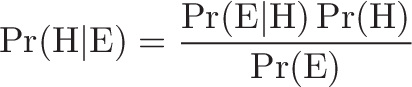
Bayes’ theorem was the subject of a detailed article. The essay is good, but over 15,000 words long — here’s the condensed version for Bayesian newcomers like myself:
- Tests are not the event. We have a cancer test, separate from the event of actually having cancer. We have a test for spam, separate from the event of actually having a spam message.
- Tests are flawed. Tests detect things that don’t exist (false positive), and miss things that do exist (false negative).
- Tests give us test probabilities, not the real probabilities. People often consider the test results directly, without considering the errors in the tests.
- False positives skew results. Suppose you are searching for something really rare (1 in a million). Even with a good test, it’s likely that a positive result is really a false positive on somebody in the 999,999.
- People prefer natural numbers. Saying “100 in 10,000″ rather than “1%” helps people work through the numbers with fewer errors, especially with multiple percentages (“Of those 100, 80 will test positive” rather than “80% of the 1% will test positive”).
- Even science is a test. At a philosophical level, scientific experiments can be considered “potentially flawed tests” and need to be treated accordingly. There is a test for a chemical, or a phenomenon, and there is the event of the phenomenon itself. Our tests and measuring equipment have some inherent rate of error.
Bayes’ theorem gives you the actual probability of an event given the measured test probabilities. For example, you can:
- Correct for measurement errors. If you know the real probabilities and the chance of a false positive and false negative, you can correct for measurement errors.
- Relate the actual probability to the measured test probability. Bayes’ theorem lets you relate Pr(A|X), the chance that an event A happened given the indicator X, and Pr(X|A), the chance the indicator X happened given that event A occurred. Given mammogram test results and known error rates, you can predict the actual chance of having cancer.
Anatomy of a Test
The article describes a cancer testing scenario:
- 1% of women have breast cancer (and therefore 99% do not).
- 80% of mammograms detect breast cancer when it is there (and therefore 20% miss it).
- 9.6% of mammograms detect breast cancer when it’s not there (and therefore 90.4% correctly return a negative result).
Put in a table, the probabilities look like this:

How do we read it?
- 1% of people have cancer
- If you already have cancer, you are in the first column. There’s an 80% chance you will test positive. There’s a 20% chance you will test negative.
- If you don’t have cancer, you are in the second column. There’s a 9.6% chance you will test positive, and a 90.4% chance you will test negative.
How Accurate Is The Test?
Now suppose you get a positive test result. What are the chances you have cancer? 80%? 99%? 1%?
Here’s how I think about it:
- Ok, we got a positive result. It means we’re somewhere in the top row of our table. Let’s not assume anything — it could be a true positive or a false positive.
- The chances of a true positive = chance you have cancer * chance test caught it = 1% * 80% = .008
- The chances of a false positive = chance you don’t have cancer * chance test caught it anyway = 99% * 9.6% = 0.09504
The table looks like this:

And what was the question again? Oh yes: what’s the chance we really have cancer if we get a positive result. The chance of an event is the number of ways it could happen given all possible outcomes:

Probability = desired event / all possibilities
The chance of getting a real, positive result is .008. The chance of getting any type of positive result is the chance of a true positive plus the chance of a false positive (.008 + 0.09504 = .10304).
So, our chance of cancer is .008/.10304 = 0.0776, or about 7.8%.
Interesting — a positive mammogram only means you have a 7.8% chance of cancer, rather than 80% (the supposed accuracy of the test). It might seem strange at first but it makes sense: the test gives a false positive 10% of the time, so there will be a ton of false positives in any given population. There will be so many false positives, in fact, that most of the positive test results will be wrong.
If you take 100 people, only 1 person will have cancer. Another 10 will not have cancer but will get a false positive result. Getting a positive result means you only have a roughly 1/11 chance of being the person who really has cancer (7.8% to be exact).
Bayes’ Theorem
We can turn the process above into an equation, which is Bayes’ Theorem. It lets you take the test results and correct for the “skew” introduced by false positives. You get the real chance of having the event. Here’s the equation:
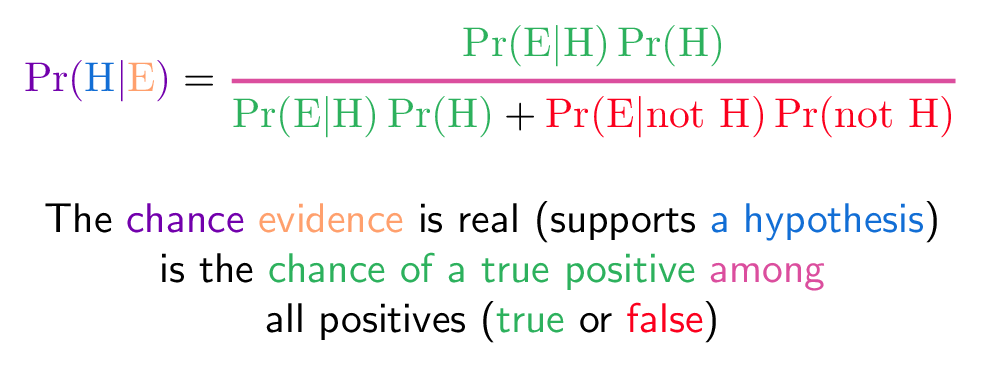
And here’s the decoder key to read it:
- Pr(A|X) = Chance of having cancer (A) given a positive test (X). This is what we want to know: How likely is it to have cancer with a positive result? In our case it was 7.8%.
- Pr(X|A) = Chance of a positive test (X) given that you had cancer (A). This is the chance of a true positive, 80% in our case.
- Pr(A) = Chance of having cancer (1%).
- Pr(~A) = Chance of not having cancer (99%).
- Pr(X|~A) = Chance of a positive test (X) given that you didn’t have cancer (~A). This is a false positive, 9.6% in our case.
Try it with any number:
It all comes down to the chance of a true positive result divided by the chance of any positive result. We can simplify the equation to:

Pr(X) is a normalizing constant and helps scale our equation. Without it, we might think that a positive test result gives us an 80% chance of having cancer.
Pr(X) tells us the chance of getting any positive result, whether it’s a real positive in the cancer population (1%) or a false positive in the non-cancer population (99%). It’s a bit like a weighted average, and helps us compare against the overall chance of a positive result.
In our case, Pr(X) gets really large because of the potential for false positives. Thank you, normalizing constant, for setting us straight! This is the part many of us may neglect, which makes the result of 7.8% counter-intuitive.
Intuitive Understanding: Shine The Light
The article mentions an intuitive understanding about shining a light through your real population and getting a test population. The analogy makes sense, but it takes a few thousand words to get there
.
Consider a real population. You do some tests which “shines light” through that real population and creates some test results. If the light is completely accurate, the test probabilities and real probabilities match up. Everyone who tests positive is actually “positive”. Everyone who tests negative is actually “negative”.
But this is the real world. Tests go wrong. Sometimes the people who have cancer don’t show up in the tests, and the other way around.
Bayes’ Theorem lets us look at the skewed test results and correct for errors, recreating the original population and finding the real chance of a true positive result.
Bayesian Spam Filtering
One clever application of Bayes’ Theorem is in spam filtering. We have
- Event A: The message is spam.
- Test X: The message contains certain words (X)
Plugged into a more readable formula (from Wikipedia):

Bayesian filtering allows us to predict the chance a message is really spam given the “test results” (the presence of certain words). Clearly, words like “viagra” have a higher chance of appearing in spam messages than in normal ones.
Spam filtering based on a blacklist is flawed — it’s too restrictive and false positives are too great. But Bayesian filtering gives us a middle ground — we use probabilities. As we analyze the words in a message, we can compute the chance it is spam (rather than making a yes/no decision). If a message has a 99.9% chance of being spam, it probably is. As the filter gets trained with more and more messages, it updates the probabilities that certain words lead to spam messages. Advanced Bayesian filters can examine multiple words in a row, as another data point.
Further Reading
There’s a lot being said about Bayes:
Have fun!
72 thoughts on “An Intuitive (and Short) Explanation of Bayes' Theorem”
you have a typo, in …
9.6% of mammograms miss breast cancer when it is there (and therefore 90.4% say it is there when it isn’t).
… you meant to say somthing like :
9.6% of mammograms incorrectly indicate breast cancer when it isn’t there, and the other 90.4% correctly say it is not there when, well, it is not there.
Thanks Gavrilo — I just fixed it.
Hey, here’s an interesting bayes problem i came across first in a book (The curious incident of the dog in the night time).
Suppose you are in a game show. You are given the choice of three doors – one of which conceals a valuable prize and the
others conceal a goat.
After you make a choice, the host opens one of the other doors (–one without a prize).
He then gives you the option of staying with the initial choice of door or switching to the other door. The door finally chosen is then opened.
Should you switch, not switch, or does it make no difference what the contestant does?
_____________________________________________
ANSWER
by Bayes theorum you can see that if you switch u’d have a 2:1 advantage.
Hi Amal, thanks for dropping by. Yes, I like that question too, it was presented to us as “The Monty Hall” problem when studying computer science.
It’s pretty amazing how counter-intuitive the results can be — switching your choice after you’ve picked “shouldn’t” change your chances, right? I plan on writing about this paradox, too
Oddly useful! I’ve been reading Bayes explanations for a while, and this one really hit home for me for some reason.
One thing that you might consider adding (something I’ve never seen) is a pie-chart visualization of what’s going on. Basically, you have a pie of 100% of people. 1% of that pie has cancer, so that’s a tiny slice. The test will produce a positive for 80% of that 1% slice + 9.6% of the remaining 99% slice– you can imagine that as a little blue translucent piece of appropriate size that covers most of the 1% slice and a chunk of the 99% slice. From that mental image, it’s obvious what’s going on– there’s a lot more blue on the 99% than on the 1%. Might be too complicated, but hey.
Anyways, thanks.
Hey Ed, thanks for the comment. I agree — some type of chart may make the relationship that much clearer. Appreciate the suggestion, I’ll put one together.
Bayes theorem can also be thought of as
True Positives
——————————–
True Positivees + False Positives
So a large number of false positives reduces the accuracy of the test because the denominator increases.
Thanks Lee! That’s a great way to put it.
About Monty Hall- the Bayes application to this seems very forced. The Monty Hall problem is a simple probability problem, or it can be viewed as a partitioning problem. See:
http://randy.strausses.net/tech/montyhall.htm
Using Bayes for this makes it needlessly complex, not “betterExplained”.
Similarly, the article above is needlessly complex- nuke the first equation and leave the simpler one. You just pulled it out of thin air anyway- it doesn’t help anyone.
The usual diagram, given in HS stats classes, is a rectangle, with A, ~A on the top, B, ~B on the side. Say A is .9 and B is .2. The area of the small quadrant (.02), is the probability of A and B both happening. This area can be also viewed as P(A|B)*P(B) or P(B|A)*P(A). You have to explain why, but it’s pretty evident from the diagram. Then just equate these two and divide by P(B) and you have the simpler equation.
Hi Randy, Bayes may be overkill for the Monty Hall problem, but it’s interesting to see that it can apply there as well.
Yes, the diagram you mention may be a helpful addition to the discussion above, appreciate the feedback.
Just wanna say thank you for writing this. I know about the original article and I tried reading it but somewhere along the way I got lost and couldn’t follow it.
Hi numerodix, you’re welcome — I found the original article interesting but a bit long as well, so I decided to summarize it here.
Hello, I just came upon this site and I’m finding it beautiful. I think I spotted an error in this article, though.
When you say:
“”Of those 100, 80 will test positive” rather than “80% of the 1% will test positive”).”,
you probably wanted to say: “rather than ’80% of the 100% will test positive’”.
Hi Matteo, thanks for the comment. The statement actually refers to the original 1%, so it’s giving a way of giving compound percentages (80% of 1% vs. 80 out of 10,000).
wow thank you so much for this, you really did a good job explaining it, i have my AP statistics exam today at noon so this might save me
Randy, back on Nov 7 2007, suggested using overlapping rectangles – Venn diagrams – to help clarify the Rev. Bayes. In their book “Chances Are…” (Viking Penguin, 2006), Kaplan & Kaplan did so on pp. 184 ff. Indeed it does help.
you. are. the. best.
oh my god this is the dogs bollocks for my molecular phylogenetics revision!
@Anonymous: Thanks!
@John: Appreciate the reference. Another explanation with a venn diagram: http://blog.oscarbonilla.com/2009/05/visualizing-bayes-theorem/
@Anonymous: Thank you!
@Patty: Glad it helps
This is one of the best explanations I’ve found. Perhaps we can see if I really understand it by trying a real world problem I’m wrestling with.
Here’s the data:
– The odds of a chest pain (CP) being caused by a heart attack is 40%.
– The odds of a CP being caused by other factors (anxiety, depression, etc.) is 60%.
– The odds of a heart attack occurring to a female above age 50 is 80%.
– The odds of a heart attack occurring to a female under age 50 is 20%.
I am presented with a 24 year old female who says she is having chest pain. What is the probability that her chest pain is caused by a heart attack? Is it 0.4 x 0.2 = 0.08?
Also, 78% of patients having heart attacks present with diaphoresis (sweating), so 22% of patients having heart attacks don’t sweat. This female is not sweating, so are the odds of her having a heart attack 0.22 x 0.08 = 0.0176?
Thank you!
Thanks for writing this!! Even my stats prof was making this too difficult for everyone, but you have simplified it for me. I now have an understanding of the Bayes formula (enough to write my midterm this morning
).
thanks! finally got the concept behind bayes rule
@Ayush: Glad it helped!
Could you work out an example of an email with *two* words, say ‘Viagra’ and ‘hello’?
I didnt get that, bayes theorem is still a tilted pot for me, but thanks for helping!
what would happen if we have to consider other prior probability..lets say, the doctor looked at the symptoms of the patient and guessed that he has 60 percent chance of having cancer. Doctor sends him for the test and test showed positive result. How would we incorporate that 60 percent odd of having cancer based on the patient’s symptoms to the Bayesian equation.
hi
thank you for this article. The first time I came across Bayes Theorem in a business statistics book it was not so clear at all. No it makes more sense for me and its pretty clear..
@France: You’re welcome, glad it helped. I understand it better now too, but there’s still more to go before it’s completely intuitive for me
. I’d like to do a follow-up to this focusing on using the probabilities it predicts.
On the cancer example, it’s interesting to see that a negative test is really significant. That is, if the test says you don’t have cancer, then probability of not having cancer is 99.78% ! So, the value of mammogram is that the healthcare $ can be employed in further investigating the positive (+ and -) cases only.
Thank you for taking the time to write this – it has really helped me get my head around the concept!
@Dan Weisberg: 14% of chest pains in women under 50 are therefore caused by heart attacks. Its (0.2*0.4)/((0.2*04)+(0.8*0.6)) = 0.14
@Dan Weisberg: for some odd reason, my posts seem to disappear and reappear… anywho, the other part to your question (as earlier posted) is 4.5% irrespective of when you choose to include the diaphoresis variable.
wow, thank you so much for this, made the concept so much clearer to me
@Bips: Glad it helped!
This post is filled with jargon, and I’m surprised people can tolerate it.
Nicely explained; this really helped me study for my stat final. Thanks!
Thanks so much for this simple breakdown!
@Concerned: You should have seen the original
.
@Pooja, @Alec: Thanks!
“A Bayesian is someone who, vaguely expecting a horse, and glimpsing the tail of a donkey, concludes he has probably seen a mule.” – John Hussman
Not really helpful, but rather funny.
Extremely helpful article. The lecture by the stats prof was utterly bewildering….. thanks!
@MH: Awesome, glad it helped.
Your explanation using the cancer example was superb.
@Joseph: Thanks!
Do you know of “The theory that would not die,” Sharon Bertsch McGrayne’s history of the Bayes controversy? It is history at its best including breaking the Enigma Code during the Second World War, plus lots of other applications. The book was published by Yale University Press in 2011.
Woman’s percent chance of having cancer if tested negative for breast cancer.
P(False Neg)/(P(False Neg) + P(Accurate Negative)) => .01(.2)/(.01(.2) + .99(.904)) =.0022 = .22%
How’s my math?
Very Helpful! I appreciate the intuitive explaination. Thank You!
Your analysis of the Monty Hall problem *assumes* that the host’s intentions and attitudes are irrelevant to his *choice* of whether to reveal the secret of one non-winning selection. If the host wishes you to win, he will only open a door when you chose the wrong one first, but if he wishes you to lose, then he will open a door only when you have chosen the right one first. Thus unless you know that his wishes don’t matter then Bayes’ Theorem will not help. If you were to know his wishes do matter, then your rational choice depends solely on your estimate of whether he wishes you to win (switch) or lose (don’t switch).
@Richard: It might need to be clarified, but the rules are the host will always reveal a goat in one of the two doors you didn’t pick. Even if you’ve already picked the car, he will still reveal a goat.
Thanks for writing that! Really cleared it up…I have also since read the explanation with a small binomial tree, which was pretty helpful, but this really hit home. Thanks for the clear explanation!
@Geoff: Glad it helped! I’m planning on doing a follow-up to Bayes since it’s used so much in spam filtering and other machine learning.
bayes theorem is incredible
Hello Kalid, I am glad I found this helpful site and also your older one at princeton.edu. About your explanation of Bayes’ theorem, however, I have two minor caveats.
You wrote: “Interesting — a positive mammogram only means you have a 7.8% chance of cancer, rather than 80% (the supposed accuracy of the test).”
Shouldn’t we better take 90.4% as the supposed accuracy of the test? The sensitivity of the test is 80%; it tells us that 20% of the negative results are false; but if we’ve got a positive mammogram, that information about negative results doesn’t interest us in the first place. Much more interesting is the specificity of the test: it’s 90,4% and therefore tells us that 9,6% of the positive results will be false. If our test result is positive, we would wish the specificity of the test were still much lower, because then we could have a much better founded hope of being healthy despite the positive result.
You wrote: “It all comes down to the chance of a true positive result divided by the chance of any positive result. […] Pr(X) is a normalizing constant and helps scale our equation. Without it, we might think that a positive test result gives us an 80% chance of having cancer. Pr(X) tells us the chance of getting any positive result, whether it’s a real positive in the cancer population (1%) or a false positive in the non-cancer population (99%). It’s a bit like a weighted average, and helps us compare against the overall chance of a positive result. In our case, Pr(X) gets really large because of the potential for false positives. Thank you, normalizing constant, for setting us straight!“
Instead of 80% I would again prefer to read 90,4% here. But even after this modification I doubt whether your explanation of the “normalizing” could be called sufficient, because in my interpretation it’s not only our using Pr(X) as denominator that helps us “scaling the equation”. We’ve got a positive test result, and that’s why we are inquiring after Pr(A|X). As soon as we take Pr(X) into consideration, we must not compare it with the specificity of the test nor with the unqualified (i.e., unconditional) sensitivity; rather, we have to compare it with the conditional probability of the following case: that someone has breast cancer (1%) and that the test detects it (80%). So not only the denominator Pr(X), but also the factor Pr(A) in the numerator (i.e., the a priori probability of having breast cancer) is a “normalizing” element, isn’t it?
Here are two contradictory statements in your article regarding False positives. I quote:
Pr(X|~A) = Chance of a positive test (X) given that you didn’t have cancer (~A). This is a false positive, 9.6% in our case.
The chances of a false positive = chance you don’t have cancer * chance test caught it anyway = 99% * 9.6% = 0.09504
These two interpretations of false positives are often mixed in various texts.
One is Pr(X|~A) and the other is Pr(X∩~A)
Hello guys;
could you help me to solve this problem as soon as possible?
Transplant operations for hearts have the risk that the body may reject
the organ. A new test has been developed to detect early warning signs
that the body may be rejecting the heart. However, the test is not
perfect. When the test is conducted on someone whose heart will be
rejected, approximately two out of ten tests will be negative (the test is
wrong). When the test is conducted on a person whose heart will not
be rejected, 10% will show a positive test result (another incorrect
result). Doctors know that in about 50% of heart transplants the body
tries to reject the organ.
*Suppose the test was performed on my mother and the test is positive
(indicating early warning signs of rejection). What is the probability that the
body is attempting to reject the heart?
*Suppose the test was performed on my mother and the test is negative
(indicating no signs of rejection). What is the probability that the body is
attempting to reject the heart?